The 3 Raw Materials Powering a Multi-Trillion Dollar EV Revolution: What Every Investor Needs to Know
What’s up, fellow investors?
I’ve been in this game for a while, and if there’s one thing I’ve learned, it’s that the real gold rush isn’t always where everyone is looking.
We all see the shiny electric vehicles zooming down the street, right?
Tesla, Rivian, Ford, GM—the list goes on.
The stock charts for these carmakers are on everyone’s screen, and the hype is palpable.
But what if I told you the real treasure is buried deeper, right at the heart of what makes these EVs move?
I’m talking about the batteries, my friends.
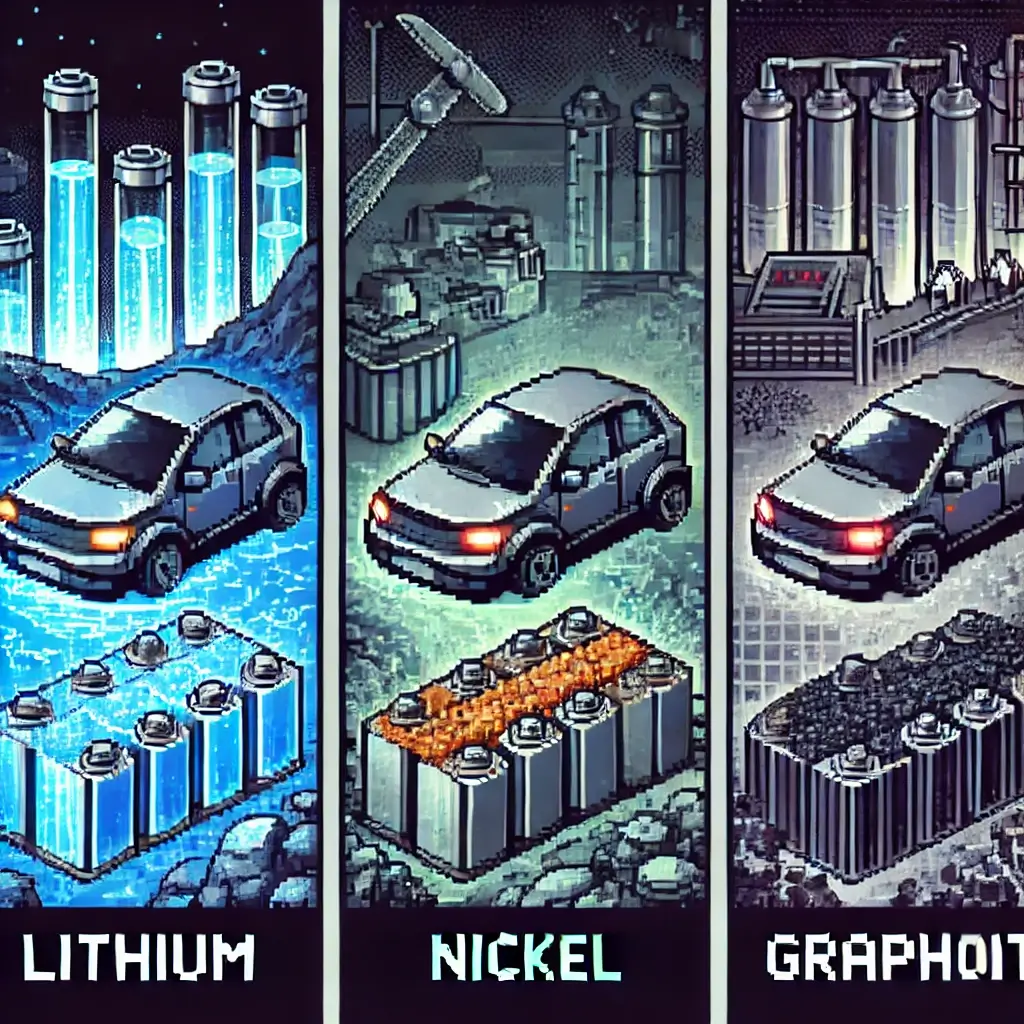
And more specifically, the raw materials that make those batteries tick: **lithium, nickel, and graphite**.
Think of it this way: everyone is buying shovels to dig for gold, but you’re the one selling the shovels.
The demand for these materials is skyrocketing, and it’s not just a trend—it’s a fundamental shift in our global economy.
The global EV battery market is projected to reach an insane **$300 billion by 2030**, and that’s a conservative estimate.
You want to get in on that action?
Then you need to understand the building blocks.
Let’s dig in.
Seriously, grab a coffee.
This is the kind of insight that can change your portfolio for good.
And trust me, you don’t want to miss this. —
Table of Contents
—
Why EVs Are the Tip of the Iceberg: The Unstoppable Demand for Raw Materials
Okay, so let’s get a few things straight.
The EV revolution isn’t just about cars.
It’s a massive, multi-faceted ecosystem that includes everything from grid storage for renewable energy to consumer electronics like laptops and phones.
The common thread?
Lithium-ion batteries.
This isn’t a speculative play on a new gadget.
This is about the fundamental infrastructure of the future.
Governments are pushing for electric vehicles with aggressive targets and incentives.
Automakers are spending billions to retool their factories.
And global titans like Panasonic and LG are in a furious race to build mega-factories, all of which require a steady, massive stream of raw materials.
The demand is so powerful that it’s outstripping the current supply chain.
That’s where the investment opportunity comes in.
The miners, the refiners, the processors—these are the companies that will be cashing in as the world transitions from fossil fuels to clean energy.
It’s a classic supply-and-demand story, but on a scale we haven’t seen in decades.
Remember the old saying: “In a gold rush, sell picks and shovels.”
Well, lithium, nickel, and graphite are the new picks and shovels.
And believe me, the miners are working around the clock. —
Lithium: The Kingpin of the Battery Revolution
Let’s start with the one everyone’s heard of: **lithium**.
It’s the heart of the modern battery.
It’s a lightweight, highly reactive metal that’s essential for energy storage.
Without it, the battery as we know it simply doesn’t exist.
The market for **lithium** is a roller coaster, and you have to have a stomach for it.
We’ve seen prices surge to astronomical highs, then correct sharply, and now they’re finding a new equilibrium.
This volatility can scare off some investors, but it’s where the smart money makes its move.
When you hear about lithium, you’re usually hearing about it being mined from either hard rock deposits (like in Australia) or from brine pools (like in the “Lithium Triangle” of Chile, Argentina, and Bolivia).
The extraction process is different for each, and it has a direct impact on the cost and environmental footprint.
Hard rock mining is faster but more expensive; brine extraction is slower but cheaper.
This is the kind of nitty-gritty detail you need to know when you’re picking stocks.
It’s not just about who has the most lithium, but who can get it out of the ground most efficiently and sustainably.
I once talked to a mining engineer who compared it to a complex chess game.
Each move—from exploration to refinement—has to be calculated and precise.
There are a few big players in the lithium space, companies like Albemarle, SQM, and Ganfeng Lithium, which are often called the “Big 3.”
But there are also smaller, up-and-coming players, junior miners who are working on new projects that could become the next big thing.
That’s where the real potential for a home run lies, but it also comes with higher risk.
It’s a bit like betting on a startup—some will fail, but a few will become giants.
I’ve seen it happen.
The key is to do your homework and look for companies with solid management, good financials, and a clear path to production.
Lithium: The Cornerstones of an EV Battery
Supply and Demand
Global demand for lithium is projected to grow by over 500% by 2030, driven by the EV market and stationary energy storage. This creates a supply gap that is attracting massive investment.
Primary Uses
Lithium-ion batteries are used in Electric Vehicles, grid-scale energy storage, and consumer electronics like phones and laptops.
Key Players
Major producers include companies in Australia (hard-rock mining) and the Lithium Triangle (brine extraction) in South America.
Investment Angle
Look for companies with proven reserves, a clear production timeline, and strong partnerships with battery manufacturers.
—
Nickel: The Power Player in Battery Performance
Next up, we have **nickel**.
While lithium gets all the headlines, nickel is the muscle behind a high-performance EV battery.
A higher concentration of nickel in the cathode allows for a greater energy density, which translates to a longer range for your EV.
That’s a huge deal for consumers, and automakers are racing to produce nickel-rich batteries.
This is where things get interesting.
Not all nickel is created equal.
There are two main types: Class I and Class II.
For EV batteries, you need **high-purity Class I nickel**, specifically in a form called nickel sulfate.
Most of the world’s nickel production goes into making stainless steel, which uses a lower-purity Class II nickel.
This means the supply chain for battery-grade nickel is much tighter and more specialized.
Indonesia is a huge producer of nickel, but they mostly produce the lower-grade stuff.
Companies that can produce battery-grade nickel are in a prime position.
This is a fascinating bottleneck in the supply chain.
Automakers like Tesla and GM are so desperate for this high-purity **nickel** that they are cutting direct deals with mining companies to secure their supply.
This tells you everything you need to know about the value of this material.
The market for **nickel** has seen its own share of drama.
I remember watching the London Metal Exchange (LME) suspend trading because of a massive short squeeze.
It was a real-world thriller, and it showed just how volatile and unpredictable this market can be.
For an investor, that kind of volatility can be scary, but it also creates opportunities.
It means you need to be patient, do your due diligence, and be ready to jump in when others are panicking.
I’m not a fan of emotional investing, but sometimes, a little controlled aggression can pay off handsomely.
Especially when you know the long-term fundamentals are rock solid. —
Graphite: The Unsung Hero of the Anode
Finally, we come to **graphite**.
If lithium is the superstar and nickel is the power lifter, then **graphite** is the reliable workhorse.
It makes up about 50% of the anode in a lithium-ion battery.
Yes, you read that right—about **50% of the weight of a typical EV battery’s anode is graphite**.
And here’s the kicker: the world relies almost entirely on China for its graphite supply.
This is a huge geopolitical risk, and a massive opportunity for companies outside of China to step up.
Just like with nickel, there are different kinds of **graphite**.
There’s natural graphite, which is mined, and synthetic graphite, which is man-made.
Most batteries use a blend of both, but there’s a growing push for more natural **graphite** because it’s cheaper and more environmentally friendly to produce.
The demand is so high that new mines are being developed in countries like Canada, Australia, and Mozambique.
I’ve seen some of these projects up close, and they’re truly incredible feats of engineering and determination.
These aren’t just holes in the ground; they’re high-tech operations designed to meet a very specific, high-purity standard.
For investors, the **graphite** market offers a unique proposition.
It’s less volatile than lithium and nickel, but the supply chain is incredibly fragile and concentrated.
Any disruption in China can send shockwaves through the entire industry.
That’s why I’m a big believer in looking for companies that are developing alternative sources of supply.
This isn’t just about making money; it’s about investing in a more resilient and secure global supply chain. —
How to Invest in These Materials: Your Game Plan
So, you’re convinced.
You want a piece of this action.
But how do you actually do it?
You’ve got a few options, and I’ll walk you through them like I’m talking to a friend over a beer.
First, there are the **individual stocks**.
This is for the hands-on investor who likes to do their research.
You can buy shares in mining companies that specialize in **lithium**, **nickel**, or **graphite**.
This gives you direct exposure, but it also comes with company-specific risk.
One bad quarter, a permitting issue, or a geopolitical hiccup can send the stock tumbling.
On the flip side, if you pick a winner, the returns can be explosive.
Second, you can go with an **ETF (Exchange Traded Fund)**.
This is a great option for those who want exposure to the sector without picking individual stocks.
An ETF holds a basket of companies related to battery technology and **raw materials**.
This diversifies your risk and gives you a broader play on the entire industry.
It’s a more conservative approach, and it’s what I recommend for most people starting out.
Third, there are the **futures markets**.
This is for the seasoned pro and is not for the faint of heart.
Trading futures is a high-risk, high-reward game that involves a lot of leverage.
You can make a ton of money, but you can also lose your shirt faster than you can say “electric car.”
I’ve seen it happen.
Unless you’re a professional trader, I would stay away from this and stick to stocks or ETFs.
No matter which path you choose, remember this: the key is to look for companies with strong management, solid financials, and a clear path to production.
It’s not just about a resource in the ground; it’s about a well-run business that can get that resource to market.
I’ve seen too many investors get burned by companies with big promises but no results.
Don’t be one of them. —
Navigating the Risks: The Wild West of Commodity Investing
Alright, let’s get real for a minute.
This isn’t a get-rich-quick scheme.
Like any investment, there are risks, and with commodities, they can be particularly sharp.
The first big one is **price volatility**.
The prices of **lithium**, **nickel**, and **graphite** can swing wildly based on supply, demand, and global economic sentiment.
You have to be prepared for the ups and downs.
The second is **geopolitical risk**.
A lot of these materials are mined in politically unstable regions.
A change in government policy, a trade war, or a new tax can completely change the game overnight.
Remember the dominance of China in the **graphite** market?
That’s a risk that’s on everyone’s mind right now.
Third, you have to consider **technological disruption**.
What if a new battery technology comes along that uses less of these materials, or uses a completely different set of elements?
It’s a valid concern, and it’s why I always say you need to be diversified.
Don’t put all your eggs in one basket.
You need a well-rounded portfolio that includes not just **raw materials** but also other players in the EV ecosystem, like battery manufacturers and charging infrastructure companies.
It’s a bit like building a house.
You don’t just buy lumber; you buy nails, insulation, and everything else you need to build a solid structure.
A diverse portfolio is your foundation.
Look, investing in these materials is exciting, but it’s not a fairy tale.
You have to be smart, you have to be patient, and you have to be willing to do the hard work.
There are plenty of resources out there to help you.
I always recommend checking out reliable sources for market data and analysis.
Here are a few that I’ve found helpful over the years:
Fastmarkets – Battery Raw Materials Argus Media – Battery Materials Wood Mackenzie – EV & Battery Supply Chain
These sites can give you a lot of the data and insights you’ll need to make informed decisions. —
Wrapping It Up: My Final Thoughts on This Golden Opportunity
If you’ve made it this far, you’re serious.
And that’s awesome.
The global shift to electric vehicles is one of the biggest investment themes of our lifetime.
And while the car companies get all the glory, the real, foundational wealth is being built in the dirt, in the mines, and in the supply chains that power this revolution.
Investing in **lithium**, **nickel**, and **graphite** isn’t just about chasing a hot trend.
It’s about making a calculated bet on the future of energy and transportation.
It’s a marathon, not a sprint.
The market will have its ups and downs, but the long-term trajectory is undeniable.
So, do your homework, think like a prospector, and remember to diversify.
Because when the EV boom is in full swing, you want to be the one who was smart enough to invest in the picks and shovels.
Trust me on this one.
Good luck out there, and happy investing!
Raw Materials, EV Batteries, Lithium, Nickel, Graphite
🔗 Tesla Showdown: Lease vs Buy Posted 2025-08-15 06:28 UTC 🔗 Tesla Service Center Visit Posted 2025-08-14 07:23 UTC 🔗 Tesla Smart Home Integration Posted 2025-08-13 08:47 UTC 🔗 Public EV Charging Etiquette Posted 2025-08-12 06:57 UTC 🔗 Tesla’s 5,000 Patents Posted (no date) 🔗 Tesla Lease vs Buy in 2025: Shocking Insights Posted 2025-08-15