Don’t Be a Villain: 7 Unforgivable Sins of Public EV Charging Etiquette
Welcome, fellow traveler on the electric highway!
You did it.
You’ve joined the electric vehicle revolution, trading in gas station smells for the quiet hum of a battery topping up.
It’s a beautiful thing, isn’t it?
But with great power (literally) comes great responsibility.
The world of public EV charging can sometimes feel like the Wild West.
There are unwritten rules, unspoken glares, and a whole lot of confusion for newcomers.
I’ve seen it all: the good, the bad, and the downright ugly.
I’m talking about the kind of behavior that makes you want to write a strongly worded note and leave it under someone’s wiper.
But we’re better than that, right?
This guide is your key to becoming a public charging pro, a respected member of the EV community, and most importantly, not “that person” at the charging station.
Let’s dive into the seven unforgivable sins you must avoid.
Table of Contents
Sin #1: The Charger Hog – Treating a Public Charger Like Your Personal Garage
Okay, let’s start with the most egregious offense, the one that causes the most frustration and dirty looks.
We’ve all seen it.
You pull up to a charging station, battery percentage nervously low, and see a car just sitting there, fully charged.
The charging light is a happy green, indicating the battery has been full for who-knows-how-long.
The owner is nowhere in sight.
This, my friends, is the work of a Charger Hog.
Think of a public charger like a table at a busy restaurant on a Saturday night.
You wouldn’t finish your meal, pay the bill, and then sit there for two hours playing on your phone while a line of hungry patrons stares you down, would you?
Of course not!
It’s rude, inconsiderate, and it clogs up the whole system.
A public EV charger is a shared, limited resource.
When your car is done charging, you are occupying a space that someone else desperately needs.
Many charging networks, like Electrify America, have started implementing idle fees for this very reason.
Once your charging session is complete, they give you a grace period (usually about 10 minutes) to move your car.
After that, they start charging you by the minute.
It’s a financial penalty designed to stop this exact behavior.
But we shouldn’t need a financial threat to be decent human beings.
The golden rule is simple: Once your car has enough charge to get to your next destination, or once it’s finished its charging session, move it.
Don’t go see a three-hour movie and leave your car plugged in.
Don’t plug in overnight at a hotel’s only fast charger.
Set a timer on your phone.
Use the charging network’s app to monitor your session.
Do whatever it takes, but don’t be a Charger Hog.
Remember that someone else might be running on fumes (or, well, electrons) and that charger you’re blocking might be their only hope.
It’s about community and sharing the infrastructure so we can all make this EV transition work smoothly.
Sin #2: The 100% Gremlin – Ignoring the Sacred 80% Rule
This one is a bit more nuanced, and it separates the rookies from the seasoned EV pros.
It’s the temptation to charge your battery all the way to 100% at a public DC fast charger.
It feels satisfying, right?
Seeing that full bar, knowing you have maximum range.
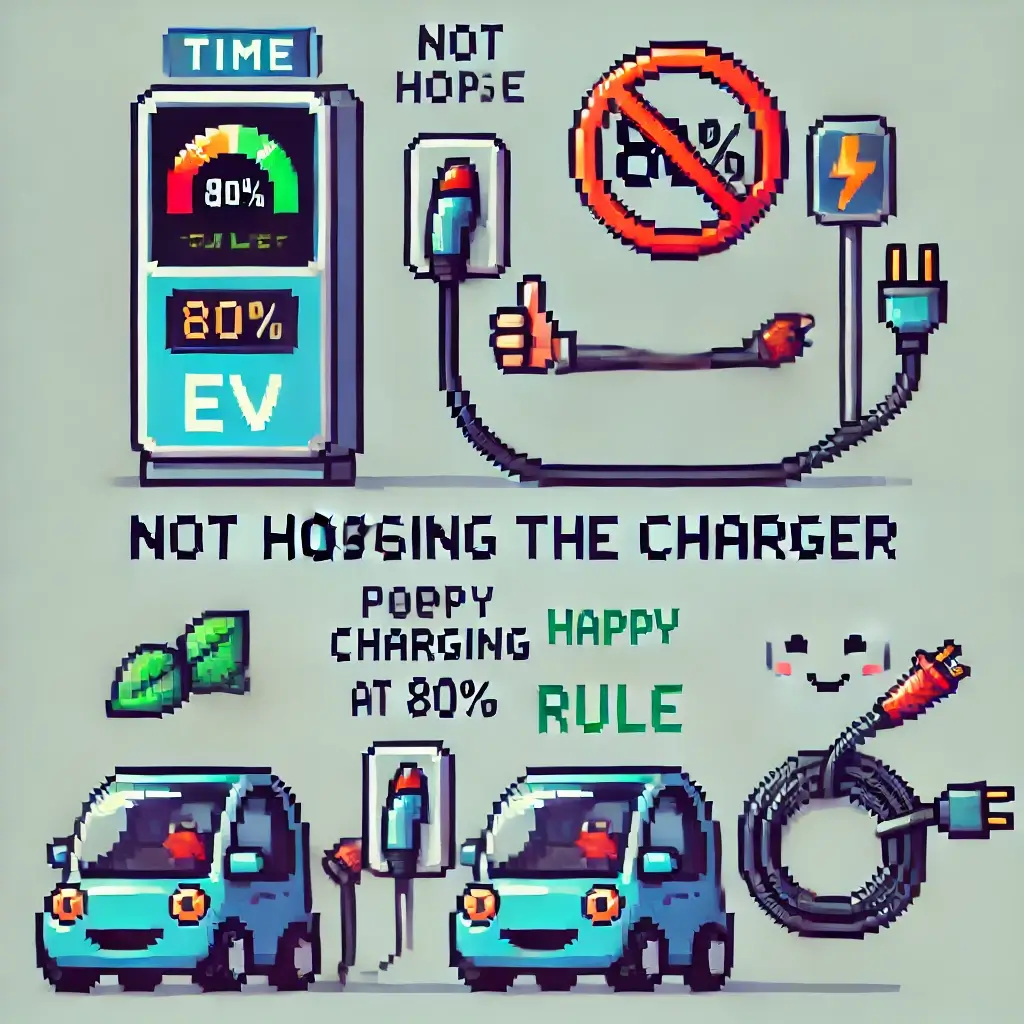
But here’s the secret: charging that last 10-20% at a fast charger is inefficient, bad for your battery’s long-term health, and a major time-waster for everyone.
Let me explain why using an analogy.
Imagine you’re packing a suitcase.
At first, you can just throw clothes in, and it fills up really fast.
That’s your battery charging from 10% to 80%.
The electrons are just flying in there, finding plenty of empty space.
This is the “bulk phase” of charging, and it’s super quick.
Now, imagine the suitcase is about 80% full.
You can’t just toss things in anymore.
You have to start carefully folding, rolling, and tucking socks into corners to use every last inch of space.
It becomes a slow, painstaking process.
That’s what happens to your EV’s battery after about 80%.
This is called the “absorption phase.”
The car’s Battery Management System (BMS) dramatically slows down the charging speed to protect the battery cells from damage as they get full.
So, while it might take you 25-30 minutes to get from 20% to 80% on a fast charger, it could take another 30 minutes or more just to get from 80% to 100%.
You’re occupying that high-demand fast charger for an extra half-hour just for a tiny sliver of range that you probably don’t even need unless you’re about to cross the desert.
In the time it takes you to squeeze in that last 20%, another driver could have charged from 10% to 60% and been on their way.
The public etiquette is to charge to 80% and then leave.
This keeps the queue moving and respects everyone’s time.
Save the slow, 100% top-ups for your charger at home overnight, where time isn’t a factor.
Consistently fast-charging to 100% can also degrade your battery faster over time.
Think of it like always sprinting a marathon; you’ll finish, but you’ll wear yourself out much faster than if you paced yourself.
So, do yourself and everyone else a favor: unplug at 80% and hit the road.
Sin #3: The Cable Sprawler – Creating a Tripping Hazard of Epic Proportions
This seems like a small thing, but it speaks volumes about a driver’s awareness and consideration for others.
Charging cables are thick, heavy, and often dirty.
When you’re done charging, the absolute worst thing you can do is just unplug it from your car and drop it on the ground.
I once saw a cable left sprawled across a parking spot in the rain, lying in a puddle.
Not only is this disrespectful to the next person who has to pick up a grimy, wet cable, but it’s also dangerous.
These cables can be a major tripping hazard, especially for people with mobility issues or parents with young children running around.
Furthermore, leaving the connector end on the ground exposes it to dirt, water, and being run over by other cars.
A damaged connector can lead to charging failures or, in a worst-case scenario, become a safety issue.
These charging stations are expensive pieces of equipment; let’s treat them with some respect.
The proper etiquette is simple and takes about 15 seconds:
1. Unplug the cable from your vehicle.
2. Neatly re-wrap the cable around the holder on the charging station.
3. Securely place the connector back into its dock or holster.
Think of it like returning your shopping cart to the corral instead of leaving it in the middle of a parking space.
It’s a small act of civic duty that keeps the space neat, safe, and functional for everyone.
If you arrive at a station and the previous user was a Cable Sprawler, take a deep breath and be the better person.
Hang it up properly before you plug in.
It’s about maintaining a standard of care for our shared infrastructure.
A clean, organized charging station is a happy charging station.
Sin #4: The Ghost – Disappearing Without a Trace (or a Note)
Communication is the bedrock of any healthy community, and the EV world is no exception.
The “Ghost” is a driver who plugs in their car and then vanishes into thin air, leaving no way for other drivers to contact them.
This becomes a huge problem when you’re a Charger Hog (Sin #1) and someone is waiting for you.
Let’s paint a picture.
You’re on a road trip, you have 5% battery left, and you pull into the only DC fast charger for 50 miles.
There’s a car there, fully charged, and the owner is gone.
What do you do?
You wait.
And wait.
And wait, your anxiety growing with every passing minute.
If only the owner had left a note!
Many EV drivers have adopted the wonderful practice of leaving a small card or note on their dashboard.
It can be as simple as, “Hi! If I’m done charging and you need the spot, please feel free to text or call me at [Your Number]. I’m nearby!”
You can buy pre-made placards for this on Etsy or just use a sticky note.
This small gesture is a game-changer.
It turns a moment of frustration into a simple, polite interaction.
The waiting driver doesn’t have to guess or get angry; they have a way to solve the problem.
You, as the charging driver, get peace of mind knowing you won’t inconvenience someone too badly if you lose track of time.
Many modern charging apps, like PlugShare, have a “check-in” feature that allows you to see who is using a charger and sometimes even send them a message through the app.
If you’re going to be leaving your car, checking in on PlugShare is a great digital alternative to a physical note.
Don’t be a ghost.
Be a considerate, communicative member of the tribe.
Leave a note, check in on an app, and be reachable.
It transforms the charging experience from an anonymous, potentially hostile environment into a friendly, cooperative one.
Sin #5: The Unprepared Newbie – Arriving Clueless and Holding Up the Line
We were all new once.
No one expects you to be an expert on your first day.
However, there’s a difference between being new and being unprepared.
The Unprepared Newbie pulls up to a busy charging station, gets out of their car, and then begins the 15-minute fumble.
They don’t know how to open their charge port.
They don’t have the right app downloaded.
They don’t have an account set up.
They can’t figure out how to initiate the session.
Meanwhile, a line of other EVs is forming behind them, drivers sighing with impatience.
It’s like getting to the front of the grocery line and then starting to look for your wallet and coupons for the first time.
Again, it’s okay to be new, but you can do your homework!
Before you ever need to use a public charger, do a dry run.
Sit in your driveway and practice opening your charge port.
Figure out if your car has a manual release.
Download the major charging network apps on your phone *before* you leave the house (Electrify America, EVgo, ChargePoint, Blink, etc.).
Go ahead and create accounts and add your payment information.
Watch a few YouTube videos on how to use a DC fast charger.
It might sound silly, but a little bit of prep work can save you—and everyone else—a lot of time and stress.
When you do get to the station, if you’re still having trouble, don’t just stand there blocking the way.
If there’s another identical charger open, consider moving to that one to let someone else charge while you figure it out.
And don’t be afraid to ask for help!
Most EV drivers are enthusiasts and are more than happy to help a newcomer get started.
A little humility and a “Hey, sorry, this is my first time, could you give me a hand?” goes a long way.
Just don’t make a busy charging station your personal classroom during rush hour.
Do your homework, be prepared, and you’ll slide in and out like a pro in no time.
Sin #6: The Silent Sufferer – Not Reporting a Broken Charger
This is a sin of omission, not commission, but it’s a critical one.
You pull up to a charger, you try to initiate a session, and… nothing.
It’s broken.
The screen is blank, it’s throwing an error code, or it just won’t connect to your car.
Frustrated, you move on to the next one, or you give up and leave.
But you don’t tell anyone.
You’re a Silent Sufferer.
An hour later, I pull up in my car, low on charge, counting on that station.
I go through the same frustrating process you did, only to discover it’s broken.
If only you had reported it!
Charging networks can’t fix what they don’t know is broken.
They rely on users to be their eyes and ears on the ground.
If you encounter a faulty or non-functional charger, take two minutes to report it.
There is almost always a toll-free number printed right on the side of the charging station.
Give them a call.
Tell them the station ID (also printed on the machine) and the problem you’re having.
Even better, use an app like PlugShare to report the station’s status.
You can mark a station as “out of order” and leave a comment for other drivers.
This is incredibly valuable information.
It can save someone from driving miles out of their way to a charger that doesn’t work.
It alerts the network that maintenance is needed.
By reporting a broken charger, you are doing a service to the entire EV community.
It’s like telling the store manager that a freezer door is broken or a restroom needs attention.
It’s part of the shared responsibility of using public amenities.
Don’t just suffer in silence and pass the problem on to the next person.
Be a hero.
Make the call, report it in the app, and help get that station back online for everyone.
Sin #7: The ICEhole – The Ultimate Transgression
This one isn’t committed by EV drivers, but we are often the victims, and it’s important to know about.
“ICEing” (from Internal Combustion Engine) is when a gasoline-powered car intentionally parks in a designated EV charging spot, blocking it.
Sometimes it’s out of ignorance, but often it’s a deliberate, passive-aggressive act.
The driver might think, “It’s just a parking spot,” not understanding that for an EV driver, it’s the equivalent of a gas car parking directly in front of the only gas pump.
It renders the “fueling” infrastructure completely useless.
So, what do you do when you’ve been ICEd?
First, take a breath.
Getting angry and confrontational rarely helps and can escalate the situation.
Don’t key the car or leave an aggressive note.
That just makes our whole community look bad.
Look for signage.
Many jurisdictions now have laws that make it illegal to park in an EV spot without charging, and there may be a number to call for parking enforcement.
If it’s in a private lot (like a grocery store or mall), you can politely inform the store manager.
They can often have the vehicle owner paged.
Some people have had success with polite, educational notes.
There are printable cards online that say something like, “Hi there! This spot is reserved for charging electric vehicles. When you park here, we’re unable to ‘refuel’. Thanks for your consideration next time!”
It’s a gentle way to inform someone who may genuinely not understand the issue.
The problem of ICEing is a growing pain of the EV transition, and the long-term solution is better enforcement and public education.
As EV drivers, our role is to handle these situations with grace and advocate for clearer signage and rules, not to get into parking lot brawls.
Expert Resources & Further Reading
Don’t just take my word for it!
The experts at major charging networks and government agencies have fantastic resources.
Check out these links to become an even more informed EV driver.
Conclusion: Be the Change You Want to See at the Charger
Living the EV life is a blast, but it requires a slight shift in mindset.
We’re no longer in the apathetic world of gas stations, where you pull up, pump, and leave without a thought.
We are a community sharing a new and growing infrastructure.
Every time you pull up to a public charger, you have a choice.
You can be a source of frustration, or you can be a considerate pro who makes the system work better for everyone.
It all boils down to one simple idea: empathy.
Think about the driver who will come after you.
Think about the person on a long trip with a low battery.
Think about the new driver who is nervous and unsure.
If we can all just be a little more mindful, patient, and communicative, the public charging experience will be a dream.
So let’s make a pact.
Let’s hang up the cables, move our cars when they’re done, charge to 80%, leave a note, and help out the newbies.
Let’s be the kind of EV drivers we’d want to meet.
Happy (and courteous) charging!
Keywords: EV charging etiquette, public EV stations, charger hog, 80% rule, electric vehicle
🔗 Tesla’s 5,000 Patents Posted 2025-08-11 08:23 UTC 🔗 Tesla Resale Value Posted 2025-08-10 06:40 UTC 🔗 Tesla Apps Posted 2025-08-09 04:12 UTC 🔗 EV Truck Showdown: Cybertruck Posted 2025-08-08 06:50 UTC 🔗 Tesla’s Epic Energy Gamble Posted (No date provided) 🔗 Tesla’s 20,000 Patents: Shocking Truth Posted 2025-08 (Exact time not provided)