Tesla’s Epic Energy Gamble: 3 Products, a $10 Billion Market, and One Wild Ride!
Hey there, friends!
Let’s talk about something that gets my gears turning: Tesla.
When you hear that name, your mind probably jumps to sleek electric cars, right?
The Model 3, the Cybertruck—all that futuristic goodness.
But what if I told you that the real magic, the part that could change the world in a more fundamental way than any car, is happening with their energy division?
Seriously, it’s not just about what they’re building; it’s about the massive, mind-blowing impact it’s having on how we power our lives.
I’ve been following this space for years, and let me tell you, the journey from a car company to a full-blown energy titan is one for the history books.
It’s like they looked at the world, saw a problem (our outdated, dirty, and inefficient power grids), and just said, “You know what? We can fix that.”
And they are.
This isn’t just a side project; it’s a full-on, multi-billion-dollar assault on the status quo.
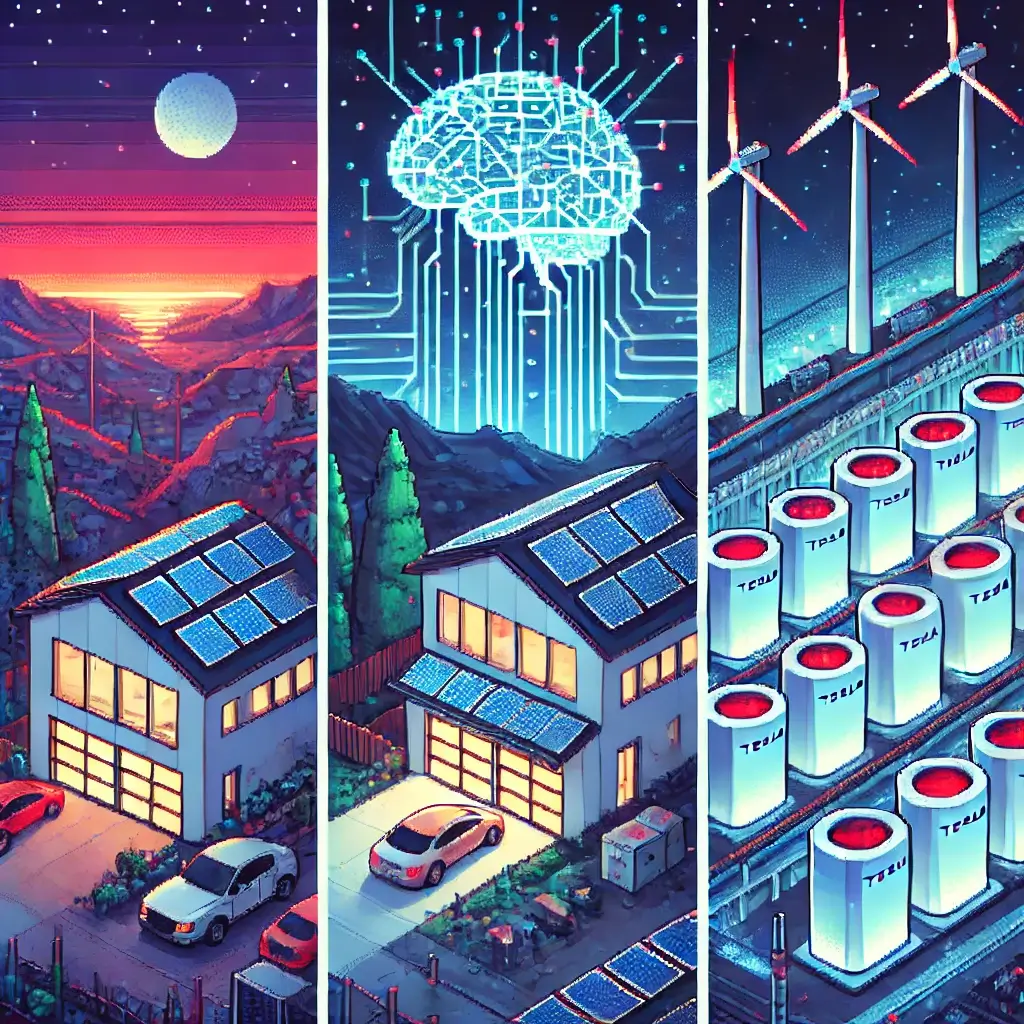
So, buckle up, because we’re going to dive deep into the three pillars of Tesla’s energy empire: the Powerwall, the Megapack, and the brain behind it all, Autobidder.
It’s a story of innovation, massive scale, and a whole lot of ambition.
And trust me, it’s a story you’ll want to hear.
—
Table of Contents
—
Tesla’s Big Picture: Why Energy Storage is the Real Game-Changer
Before we get into the nitty-gritty of the products, let’s take a step back.
Why is energy storage such a big deal?
Think of our current power grid like a massive, creaky old machine.
It was built for a different time—a time when we had big, centralized power plants burning fossil fuels to generate electricity.
They’d just crank it up when demand was high and slow it down when it wasn’t.
It worked, but it was inefficient, dirty, and super fragile.
Now, we’re moving towards a world powered by renewables like solar and wind.
And while that’s fantastic, it creates a new problem: the sun doesn’t always shine, and the wind doesn’t always blow.
This is where energy storage, and specifically **Tesla’s energy storage**, comes in.
Batteries are the missing link.
They allow us to capture all that clean energy when it’s abundant and save it for later when we need it most.
This isn’t just about keeping the lights on during a storm; it’s about fundamentally changing the entire grid.
It’s like upgrading a dial-up modem to a fiber-optic connection.
Tesla saw this coming a mile away.
They didn’t just create a car; they created an entire ecosystem built on the same core technology: batteries.
Their goal, as Elon has said time and time again, is to accelerate the world’s transition to sustainable energy.
And you can’t do that with just cars.
You need to tackle the problem from the other side—the power generation and storage side.
They’re not just building products; they’re building the future of our power infrastructure.
That, my friends, is why this is such a huge deal.
—
The Tesla Powerwall: The Ultimate Home Upgrade
Let’s start with the one you’ve probably heard of: the **Tesla Powerwall**.
It’s a sleek, unassuming box that hangs on the wall of your garage or outside your home.
But don’t let its minimalist design fool you; this thing is a powerhouse.
Literally.
Imagine a power outage.
The lights flicker, the fridge goes quiet, and you’re suddenly plunged into darkness.
It’s a huge inconvenience, right?
With a Powerwall, that’s a problem of the past.
It kicks in instantly, providing backup power for your entire home.
It’s so seamless you might not even realize the grid went down.
But the Powerwall isn’t just for emergencies.
Its true genius lies in its ability to manage your home’s energy usage.
If you have solar panels on your roof, the Powerwall stores all that excess energy you generate during the day.
Then, when the sun goes down and electricity prices go up (a phenomenon known as “time-of-use” rates), your home switches to the battery.
You’re literally running your house on sunshine you captured hours earlier.
It’s like having your own personal, silent power plant.
This isn’t just about saving money, although it does that in a big way.
It’s about energy independence.
It’s about having control over your power, and it’s a crucial step towards a more resilient and decentralized grid.
I’ve talked to people who have installed these, and the change in their mindset is incredible.
They’re no longer just consumers of energy; they’re part of the solution.
They can see their energy flowing in and out, and they feel a real sense of empowerment.
It’s a beautiful thing.
—
Beyond the Home: The Gigantic Tesla Megapack
Now, if the Powerwall is the hero of the home, the **Tesla Megapack** is the superhero of the grid.
Think of it like the Powerwall’s older, much bigger, and incredibly muscular sibling.
These things are massive, container-sized battery systems designed for utility-scale projects.
We’re not talking about powering a house here; we’re talking about powering entire cities or stabilizing the grid for a whole region.
I saw a picture of a Megapack installation once, and it looked like a sci-fi movie set.
Just rows and rows of these giant white boxes, all humming away, doing the work of a small power plant.
It’s awe-inspiring.
So, what do these behemoths do?
Just like the Powerwall, they store energy.
But on an industrial scale.
They can be paired with massive solar farms or wind turbines to capture that energy and then release it back into the grid when it’s needed.
For example, during a heatwave, when everyone is blasting their AC, the grid can get stressed.
A Megapack can instantly inject a huge amount of stored energy into the system, preventing blackouts and keeping things running smoothly.
This is what’s known as a “peaker plant”—a power plant that only fires up during peak demand.
The old peaker plants used to be dirty, expensive fossil fuel plants.
The new peaker plants are Megapacks—clean, silent, and incredibly fast.
This is where Tesla is making a real difference in the world.
They’re not just building a product; they’re helping utilities around the globe replace dirty fossil fuels with clean, reliable battery storage.
And the numbers are staggering.
A single Megapack can store enough energy to power thousands of homes for hours.
And they’re deploying them by the dozens.
This isn’t just a good idea; it’s a necessary one.
It’s the key to making a renewable-powered grid a reality.
—
The Secret Sauce: How Autobidder Makes It All Work
Okay, so we have the hardware: the Powerwall for homes, the Megapack for utilities.
But what’s the brain behind the operation?
This is where **Autobidder** comes in, and it’s perhaps the most fascinating part of this whole story.
Autobidder isn’t a battery; it’s a software platform.
Think of it as an AI-powered energy trader.
It’s the secret sauce that makes Tesla’s battery storage systems so incredibly valuable.
The energy market is a complex beast.
The price of electricity fluctuates constantly, sometimes minute by minute.
There are all kinds of variables: the time of day, the weather, major events—you name it.
Trying to manage a large-scale battery system in this environment is like playing a game of 4D chess.
And this is where Autobidder shines.
It’s a real-time trading and control platform that uses machine learning to predict energy prices and demand.
It can automatically and autonomously charge or discharge the batteries to maximize their value.
For a utility with a Megapack, this means Autobidder can look at the market, see that electricity prices are about to spike, and instantly sell the stored energy back to the grid for a profit.
Or, it can see that a solar farm is producing more energy than the grid can handle, and it will start charging the batteries to store the excess.
It’s a constant, intelligent balancing act that optimizes the entire system.
And for Powerwall owners, it can do a similar thing.
Tesla has been exploring virtual power plants (VPPs) where thousands of Powerwalls can act as one giant battery.
Autobidder can then use this collective power to provide grid services, earning money for the homeowners in the process.
It’s a brilliant, elegant solution that ties the whole ecosystem together.
It makes the hardware even more valuable and turns every battery, no matter the size, into a smart, revenue-generating asset.
—
The Future is Now: What Tesla’s Energy Expansion Means for Everyone
So, what’s the big takeaway from all this?
Tesla isn’t just a car company; they’re a full-stack energy company.
They’re building the cars, the batteries, the software to manage them, and even the solar panels to charge them.
It’s a comprehensive, end-to-end solution for a world that desperately needs a new way to power itself.
And the scale is what blows my mind.
They’ve gone from a niche carmaker to a global powerhouse in both transportation and energy.
They’re not just selling products; they’re driving a transition.
The Powerwall is making homes more resilient and independent.
The Megapack is stabilizing grids and making a transition to renewables possible on a massive scale.
And Autobidder is making it all smart, efficient, and profitable.
This is more than just technology; it’s a vision for the future.
A future where our power isn’t dependent on fossil fuels and a fragile grid.
A future where energy is clean, decentralized, and accessible.
It’s a future that, thanks to companies like Tesla, is getting a little bit closer every single day.
And I, for one, am incredibly excited to see what they do next.
Tesla, Powerwall, Megapack, Autobidder, Grid Services