The V2G Revolution: How 1 Car Could Power 2 Homes!
Have you ever looked at your electric car and thought, “That’s just a giant battery on wheels”? Well, you’re not wrong, but what if I told you that very same battery could save us from a blackout? We’re on the cusp of an energy revolution, and the key player isn’t some massive new power plant—it’s your humble EV. We’re talking about Vehicle-to-Grid, or V2G, and it’s far more than just a buzzword. It’s the secret weapon we need to finally make our renewable energy dreams a reality. Imagine a world where every electric car is a mini power plant, a dynamic part of a massive, interconnected network. Sounds like science fiction, right? It’s not. It’s happening right now, and it’s going to change everything you thought you knew about electricity and transportation.
I know what you’re thinking. “How is my little car going to power a whole house, let alone a whole grid?” It’s a fair question, and the answer is pure genius. Think of it this way: your car spends over 95% of its life parked. That’s a lot of idle time for a very powerful battery. V2G technology takes that potential energy and puts it to work. It’s about leveraging the incredible, untapped power of all those batteries to support our grid when it needs it most. This isn’t just about saving money on your electricity bill; it’s about building a stable, resilient, and sustainable energy system for everyone. So, buckle up—we’re about to dive deep into the electrifying world of V2G and see how our cars are about to become the superheroes of the energy grid.
Table of Contents
V2G: What in the World is It?
Let’s get the big question out of the way. What exactly is V2G? The acronym stands for **Vehicle-to-Grid**. At its core, it’s a technology that allows electric vehicles (EVs) to not only draw power from the grid to charge their batteries but also to send power back to the grid. Yes, you read that right. Your car can become a power source. Think of it like this: your EV battery is a giant, mobile power bank. When electricity is cheap and plentiful—say, in the middle of a sunny day when solar panels are producing a ton of energy—your car can charge up. When the grid is stressed and electricity is expensive—like during a hot summer evening when everyone is blasting their AC—your car can send some of that stored energy back to the grid.
This isn’t a simple one-way street anymore. It’s a two-way superhighway of energy flow, and it’s a total game-changer. Historically, our relationship with electricity has been passive and unidirectional. We get power from the utility company, we use it, and that’s the end of the story. V2G flips that script. It makes your car an active, dynamic participant in the energy ecosystem. This is a crucial distinction. It’s not just about charging your car; it’s about using your car to help manage the entire grid. This shift from a passive consumer to an active “prosumer” is the very foundation of a smarter, more resilient energy future.
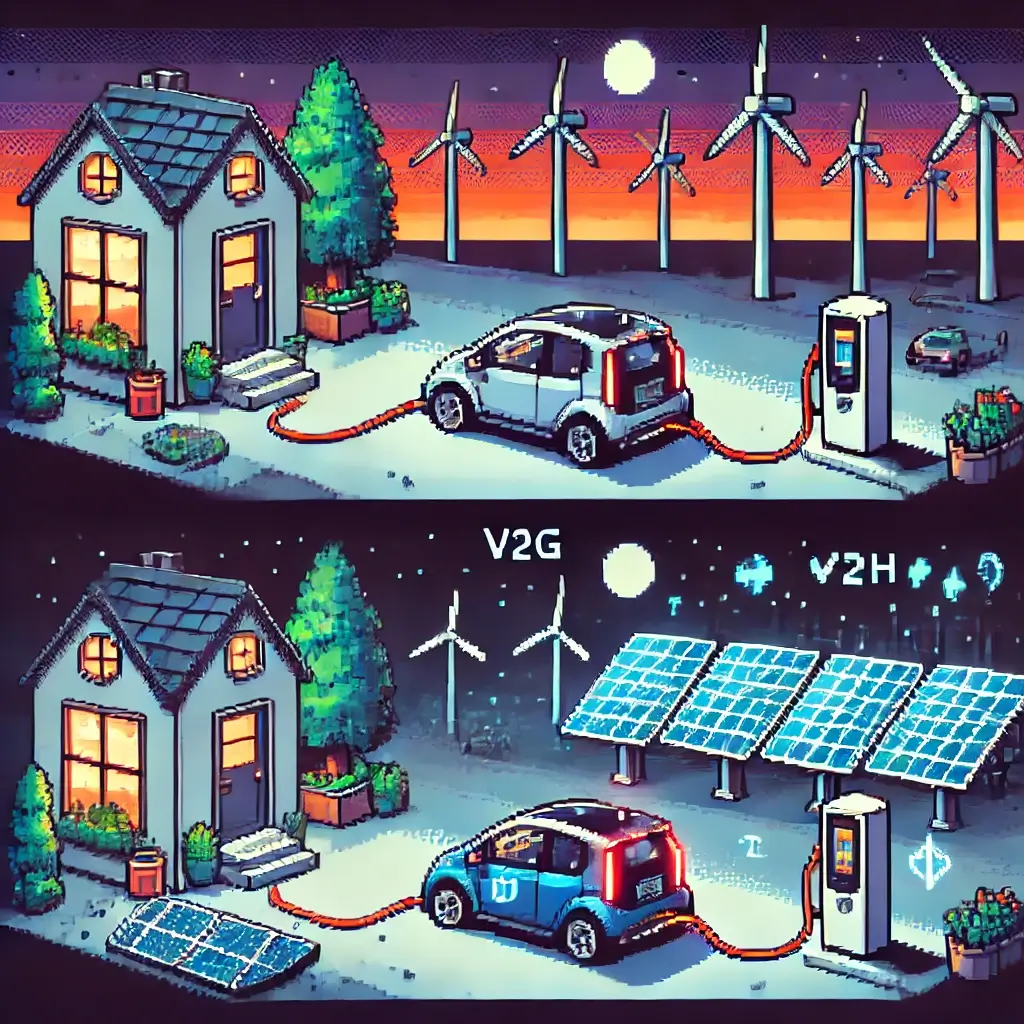
And it’s not just “V2G.” This is part of a bigger family of technologies under the umbrella of **bidirectional charging**. You might also hear terms like V2H (Vehicle-to-Home), where your car powers your house, or V2B (Vehicle-to-Building), where it powers an office. V2G is the one that directly interacts with the larger utility grid, but they all share the same core principle: your EV’s battery is an asset, not just a fuel tank.
The Intermittent Renewables Nightmare: Why We Need V2G’s Superpower
Now, let’s talk about the problem V2G is designed to solve. We all love the idea of green energy, right? Solar panels on every roof, wind turbines spinning on every hill. It’s a beautiful, clean vision. But there’s a massive, inconvenient truth at the heart of it all: **renewables are intermittent**. The sun doesn’t always shine, and the wind doesn’t always blow. This “intermittency” is the single biggest challenge facing our modern electric grid. We have an abundance of solar power in the afternoon, but then as soon as the sun goes down, that supply vanishes. Demand, however, stays high. This creates what’s often called the “**duck curve**” in energy graphs—a huge dip in the middle of the day and a sharp spike in the evening.
This is where our old, fossil fuel-based system comes in. To handle those evening spikes, utilities have to fire up “peaker plants,” which are typically inefficient, expensive, and dirty power plants that burn natural gas or coal. They are a necessary evil to keep the lights on, but they completely undermine our efforts to go green. This is the nightmare scenario that keeps grid operators up at night: a grid with too much supply at one moment and not enough the next.
Here’s where V2G swoops in to save the day. Instead of turning on those dirty peaker plants, we can tap into the massive, distributed energy storage we have parked in our driveways. Your car, charged with clean solar power from earlier in the day, becomes a clean, on-demand power source. The collective power of millions of EVs could smooth out the duck curve, filling in the gaps and making our renewable energy sources truly reliable. This isn’t just about an incremental improvement; it’s a fundamental shift that enables us to fully embrace a 100% renewable energy future without compromising on stability.
How the V2G Technology Actually Works Its Magic
Okay, so how does this actually work? It’s a bit more complex than just plugging in a cable. The magic happens through a few key components and a smart communication system. The first and most crucial part is a **bidirectional charger**. A standard EV charger is a one-way street: power goes from the grid to the car. A bidirectional charger, on the other hand, is a two-way street. It can convert the alternating current (AC) from the grid into direct current (DC) to charge the battery, and then, when needed, it can convert the DC from the battery back into AC to send it to the grid. It’s like a super-smart traffic cop for electricity.
Next, we have the communication protocols. The car, the charger, and the grid operator need to be able to talk to each other. This is where standards like **ISO 15118** and **OCPP (Open Charge Point Protocol)** come into play. These protocols allow the system to determine when to charge, when to discharge, and how much energy to move. This isn’t about some human flipping a switch; it’s a sophisticated, automated system that’s constantly monitoring grid conditions, electricity prices, and your charging preferences to make the most efficient decisions. For example, the system will know you need your car fully charged by 8 a.m. for your commute, so it will only discharge what’s safe and will ensure the battery is topped up on time.
The final piece of the puzzle is the **Energy Management System (EMS)**. This is the brain of the operation. It aggregates data from millions of vehicles, analyzes the real-time needs of the grid, and sends the right signals to each charger. This is where the true power of V2G lies—in the collective. A single car’s battery might be a drop in the ocean, but the combined power of thousands or even millions of EVs becomes a force of nature, a giant, distributed virtual power plant that can respond to grid needs in seconds. This is the “smart” in “smart grid,” and it’s what makes V2G so incredibly valuable.
The Game-Changing Benefits of V2G for the Grid and Us
Alright, so we’ve established that V2G is cool. But let’s get into the nitty-gritty of why it’s a total game-changer, not just for the grid, but for you and me. First and foremost, V2G helps with **grid stability**. As we said, renewables are fickle. When a cloud passes over a massive solar farm, or the wind suddenly dies down, it creates a dip in power supply. V2G can immediately inject power back into the grid to compensate for these fluctuations, acting as a buffer that prevents brownouts or blackouts. It’s like having a giant, distributed shock absorber for our energy system.
Then there’s the **economic benefit**. This is a big one. By selling power back to the grid during peak hours—when electricity is most expensive—you, the EV owner, can earn money. You can charge your car at night when rates are low, and then sell a small amount of that energy back in the afternoon, essentially turning your car into a profit center. This not only helps you, but it also helps lower overall energy costs for everyone by reducing the need for those expensive peaker plants. It’s a win-win-win scenario.
The environmental benefits are just as huge. By stabilizing the grid and making renewables more reliable, V2G accelerates our transition away from fossil fuels. It allows us to integrate more solar and wind power than we ever could before. This means cleaner air, less pollution, and a healthier planet. And let’s not forget the added bonus of **resilience**. In the event of a power outage—a natural disaster, a grid failure—your V2G-enabled car can act as a backup power source for your home. Imagine being the only house on the street with your lights on and your fridge running, all thanks to your EV. That’s not a hypothetical; it’s a reality being tested in places like Japan, where V2G has been used to provide emergency power after earthquakes.
I’ve talked to people who are testing these systems, and their excitement is contagious. One user I spoke with said, “It’s like my car has a superpower. I don’t just drive it; I use it to power my life, to make money, and to do my part for the planet. It’s a completely different relationship with my vehicle.” This isn’t just technology; it’s a new mindset.
V2G in Action: From Munich to Your Garage
This isn’t just a theoretical concept. V2G is already being deployed in real-world scenarios around the globe. Countries and companies are pouring resources into making this a reality. For instance, in Munich, Germany, a case study projected that by 2030, the collective V2G power of private and commercial vehicles could reach around **200 MW**, a substantial portion of the city’s peak load. This is a clear demonstration of the massive potential that V2G holds for large, urban centers. It’s not just about a few cars; it’s about a city-wide, integrated system.
In the UK, projects like the one with OVO Energy and Indra have been testing domestic V2G systems with Nissan LEAF owners. The goal was to see if V2G could be monetized for both the homeowner and the energy company. The results were incredibly promising, with participants expressing much less concern about the technology after experiencing it firsthand. It proved that V2G could not only work but could be a valuable and trusted part of a person’s energy life. These real-world trials are crucial for ironing out the kinks and building consumer confidence.
And the automakers are taking notice. Companies like Ford with their F-150 Lightning and Nissan with their LEAF have been at the forefront of this movement. The F-150 Lightning, with its massive battery, can already power an average American home for up to three days. This isn’t just V2G; it’s V2H in action, a tangible example of how EVs are becoming more than just transportation. They’re becoming mobile power hubs. The industry is rapidly moving toward a future where bidirectional charging is a standard feature, not a niche capability.
The Roadblocks on Our V2G Journey (and How We’re Crushing Them)
Now, let’s be real. It’s not all sunshine and rainbows. There are some challenges that need to be addressed before V2G becomes a mainstream reality. The biggest concern I hear from people is about **battery degradation**. Will constantly charging and discharging the battery wear it out faster? It’s a legitimate question. Battery technology has come a long way, and modern batteries are incredibly robust.
However, V2G systems are designed with this in mind. They use smart algorithms that control the charging and discharging to stay within optimal battery health parameters, often using only a small portion of the battery’s capacity and avoiding extreme states of charge. Think of it like taking a few sips of water from a full glass, not draining the whole thing. The financial compensation from V2G also needs to be enough to offset any potential long-term battery wear, making it an easy choice for consumers.
Another major hurdle is **standardization and policy**. We need clear, consistent standards for how EVs and chargers talk to the grid, and we need regulatory frameworks that make it easy for people to participate. The good news is that organizations like the **Interstate Renewable Energy Council (IREC)** and national energy agencies are working hard to create these standards. We need policies that encourage utilities to embrace V2G and that compensate consumers fairly. This is an area where progress is being made, but it’s a marathon, not a sprint.
Finally, there’s the cost of the hardware itself. Bidirectional chargers are currently more expensive than their one-way counterparts. As V2G becomes more common and economies of scale kick in, we can expect these costs to drop significantly. The industry is rapidly innovating, and with the incredible projected growth of the V2G market—some forecasts put it at a staggering **$46 billion by 2032**—we’re going to see costs fall and adoption soar.
The Explosive Future of V2G: A $46 Billion Market by 2032!
If you’re still not convinced that V2G is the future, let me hit you with some numbers. The global V2G market is projected to grow from a value of **$8.2 billion in 2025** to a remarkable **$46.9 billion by 2032**, reflecting a robust compound annual growth rate (CAGR) of over 28%. That’s not just growth; that’s an explosion. This isn’t some niche market; this is a foundational pillar of our future energy system. The world is finally waking up to the incredible potential of having millions of distributed energy storage units on wheels.
What’s driving this explosive growth? A few key factors. First, the rapid adoption of electric vehicles is creating a massive pool of potential V2G assets. As more EVs hit the road, the potential for V2G grows exponentially. Second, the increasing share of intermittent renewable energy sources on our grids is creating an urgent need for solutions like V2G. Grid operators can’t afford to ignore this problem anymore. And third, governments and corporations are actively investing in smart grid infrastructure and V2G pilot projects, recognizing the immense value this technology brings.
This is a journey that is just beginning, but it’s one with a clear destination: a world where our energy is clean, reliable, and decentralized. A world where our cars don’t just get us from A to B, but also play a critical role in powering our communities and our planet. The future is not just electric—it’s bidirectional. And it’s a future that is, without a doubt, going to be absolutely electrifying.