Tesla Showdown: Lease vs. Buy? Your 2025 Financial Game Plan!
Hey there, fellow future-car-owner! So, you’ve been dreaming of that sleek, silent, mind-bendingly fast Tesla.
The autopilot, the over-the-air updates, the fact that you’re part of the electric revolution—it all sounds amazing, right?
But then the little voice in your head, the one that handles your budget, pipes up with the age-old question: **”Should I lease or should I buy?”**
This isn’t just about personal preference; it’s a high-stakes financial decision that could save you thousands—or cost you a lot more than you bargained for.
And let’s be real, a Tesla isn’t just a car; it’s a statement, an investment in technology, and for many, a major chunk of their financial life.
Forget what you heard in the past. The rules of the game have changed, and if you’re looking at a Tesla in 2025, you need the most up-to-date, no-nonsense breakdown.
I’ve been in your shoes. I’ve crunched the numbers, talked to the experts, and yes, even driven a few.
And I’m here to tell you, the answer isn’t as simple as “leasing is for those who want low payments” or “buying is for those who want to own.”
It’s far more nuanced than that.
Ready to get into the nitty-gritty? Let’s dive deep into the economics of leasing vs. buying a Tesla and figure out which path leads you to financial freedom—and which one might just leave you spinning your wheels.
Think of me as your financial co-pilot on this journey. Buckle up!
Table of Contents
1. The Great Debate: Leasing vs. Buying a Tesla
2. The Allure of Leasing: The Pros
3. The Hard Truths of Leasing: The Cons
4. The Long-Term Power of Buying: The Pros
5. The Hidden Costs of Ownership: The Cons
6. A Hard Look at the Numbers: A 2025 Financial Breakdown
7. Visualizing the Difference: An Infographic
8. Navigating the Tax Credits and Incentives Maze
9. The Resale Value Riddle: Will My Tesla Hold Its Worth?
10. So, Who Should Lease a Tesla?
11. So, Who Should Buy a Tesla?
12. The Final Verdict: My Personal Take
1. The Great Debate: Leasing vs. Buying a Tesla
Think of buying a car like buying a house.
You get a mortgage, you build equity over time, and eventually, you own the asset outright.
It’s a long-term commitment, but the payoff is yours to enjoy.
Leasing, on the other hand, is like renting an apartment.
You get to live there, enjoy the amenities, but you don’t own the place.
You make monthly payments for a set period, and then you hand the keys back at the end of the term.
With a Tesla, this analogy gets a little more complex.
Why?
Because we’re not just talking about a vehicle; we’re talking about a piece of technology that updates and changes almost as fast as your smartphone.
The value proposition is constantly shifting.
A Tesla Model 3 from 2022 is a very different machine from a 2025 Model 3, thanks to software upgrades and minor hardware tweaks.
This constant evolution is a key factor in the lease vs. buy decision.
Do you want to own a static asset, or do you want to perpetually ride the wave of the latest and greatest?
That’s the core question we’ll be answering.
And trust me, there’s no one-size-fits-all answer.
It all depends on your lifestyle, your financial goals, and your personality.
Let’s get into the specifics.
2. The Allure of Leasing: The Pros
Let’s start with the seductive side of leasing.
It’s all about access, not ownership.
You get to enjoy the new car smell, the cutting-edge tech, and the smooth, silent ride without the long-term commitment.
The most obvious benefit?
Lower monthly payments.
Because you’re only paying for the depreciation of the vehicle over the lease term (usually 2-4 years), your monthly bill is significantly smaller than a car loan payment for the same vehicle.
This frees up cash flow, which you can use for other investments, savings, or, let’s be honest, that weekend trip you’ve been putting off.
And for a company like Tesla, where the tech is evolving at light speed, this is a massive advantage.
You get to constantly have a new vehicle with the latest features, the newest battery tech, and maybe even a few Easter eggs you haven’t discovered yet.
Think about it: every two or three years, you can trade up from a Model 3 to a Model Y, or from a Standard Range to a Long Range.
You never have to worry about your car feeling “old.”
Plus, maintenance is usually a non-issue.
Most leases include a warranty that covers the entire term, so if anything goes wrong, you just take it to the service center and it’s fixed, no questions asked.
No surprise repair bills.
No worrying about battery degradation beyond the warranty period.
It’s a worry-free driving experience, and for many people, that peace of mind is worth its weight in gold.
You get the thrill of the new, the predictability of a fixed monthly payment, and the freedom to move on when the lease is up.
3. The Hard Truths of Leasing: The Cons
Now, for the other side of the coin.
Leasing is not all sunshine and rainbows.
There are some serious drawbacks you need to consider before signing on the dotted line.
First and foremost, you don’t own the car.
Ever.
All those monthly payments you’re making?
They’re essentially rent.
You’re building zero equity.
At the end of the lease, you have to hand the car back, and all that money is gone, like a phantom limb you once had.
This can be a tough pill to swallow for anyone who values ownership and the idea of a tangible asset.
Then there are the restrictions.
Leases come with strict mileage limits, usually around 10,000 to 15,000 miles per year.
If you’re a road tripper or have a long commute, this could be a dealbreaker.
Going over the limit can result in hefty per-mile fees that can add up faster than you can say “range anxiety.”
And what about wear and tear?
Lease agreements have very specific definitions of what constitutes “normal wear and tear.”
That small scratch on the door from a rogue shopping cart?
That tiny dent from a pebble on the highway?
Those can all result in additional fees at the end of your term.
It’s like the landlord inspecting your apartment with a fine-tooth comb before you move out.
Finally, there’s a big one that’s specific to Tesla leases.
As of 2025, you cannot purchase your Tesla at the end of the lease term.
This is a huge change from traditional car leases and a critical factor in your decision.
So, if you fall in love with your car and want to keep it, you’re out of luck.
You have to hand it back and start the process all over again.
4. The Long-Term Power of Buying: The Pros
Now, let’s talk about the buying side.
This is the traditional, American-dream approach to car ownership.
You buy it, you own it, it’s yours.
The most significant benefit is the one we just talked about: you build equity.
Every payment you make, you’re putting a dent in the principal, and a portion of that car is becoming yours.
Once the loan is paid off, the car is a tangible asset in your possession.
No more car payments.
That’s a fantastic feeling.
And you get the freedom that comes with ownership.
No mileage limits.
Want to drive across the country and back? Go for it!
Want to take that scenic route that adds an extra 50 miles? No problem!
You can customize your car to your heart’s content.
Want to add a custom wrap? Go for it.
New wheels? Sure thing.
And if you get into a fender bender, it’s just a repair, not a potential end-of-lease penalty.
But here’s a big one that’s unique to electric vehicles in 2025: the federal tax credit.
When you buy a new Tesla, you may be eligible for a federal tax credit of up to $7,500.
This is a massive incentive that can significantly lower the effective purchase price of the vehicle.
You don’t get this benefit when you lease.
That credit goes to the leasing company, not you.
So, if you’re a buyer, you get to claim this sweet deal for yourself.
5. The Hidden Costs of Ownership: The Cons
Of course, buying isn’t a perfect solution either.
The most significant downside is the higher monthly payment.
A car loan payment will almost always be higher than a lease payment for the same car because you are paying off the full value of the vehicle plus interest, not just the depreciation.
This can put a strain on your monthly budget.
And what about depreciation itself?
That’s a fancy word for “the car losing value over time,” and it’s a brutal reality of car ownership.
For a traditional car, this is bad enough, but for a Tesla, with its rapid technological advancements, depreciation can be a wild card.
The new Model 3 “Highland” update, for example, made the previous generation of the Model 3 less valuable overnight.
You’re holding an asset whose value is constantly in flux due to factors outside your control.
And let’s not forget about maintenance and repairs.
While Teslas are known for being relatively low-maintenance, they’re not indestructible.
Once your warranty runs out, any repairs are on you.
And with a highly specialized vehicle like a Tesla, a simple repair can be incredibly expensive.
Need a new battery pack down the line?
That could be a five-figure bill.
And what if you decide you want to sell it in a few years?
The resale process can be a headache, from finding a buyer to negotiating the price.
With a lease, you just hand back the keys and walk away.
6. A Hard Look at the Numbers: A 2025 Financial Breakdown
Okay, enough with the abstract pros and cons.
Let’s get down to the brass tacks and look at some cold, hard numbers for a hypothetical Tesla Model Y.
This is where the real decision is made.
Let’s assume a brand-new 2025 Tesla Model Y Long Range with an MSRP of $50,000.
We’ll assume a 60-month loan for buying and a 36-month lease.
This is a simplified example, but it will give you a clear picture of the financial commitment.
**Buying Scenario:**
* **MSRP:** $50,000
* **Down Payment:** $5,000
* **Loan Amount:** $45,000
* **Interest Rate:** Let’s assume a healthy 7% APR in 2025.
* **60-Month Monthly Payment:** Around $891
* **Total Paid (over 5 years):** $53,460 (plus interest of around $8,460)
* **Potential Federal Tax Credit:** Up to $7,500
* **Total Out-of-Pocket over 3 years (the duration of the lease):** $32,076 ($891 x 36 months) + $5,000 down = $37,076
**Leasing Scenario:**
* **Vehicle Price (MSRP):** $50,000
* **Residual Value (what the car is worth at the end of the lease):** Let’s assume 55% of the MSRP, so $27,500.
* **Depreciation:** $50,000 – $27,500 = $22,500
* **Down Payment:** $2,000
* **36-Month Monthly Payment:** Around $550 (This is a simplified calculation and doesn’t include the money factor, taxes, or fees, but it’s a realistic ballpark).
* **Total Paid (over 3 years):** $2,000 (down) + ($550 x 36) = $21,800
**The “Aha!” Moment:**
Look at those numbers.
Over three years, the total cost for leasing is **$21,800**, while the total cost for buying is **$37,076**.
That’s a difference of over $15,000 in your pocket!
This is the core reason people lease.
The lower monthly payment and the lower total cost over the short term are undeniable.
But remember, at the end of the three years, the person who bought the car has an asset worth a significant amount of money (let’s say it’s worth $27,500, the residual value), while the leaser has… nothing.
They have to start over.
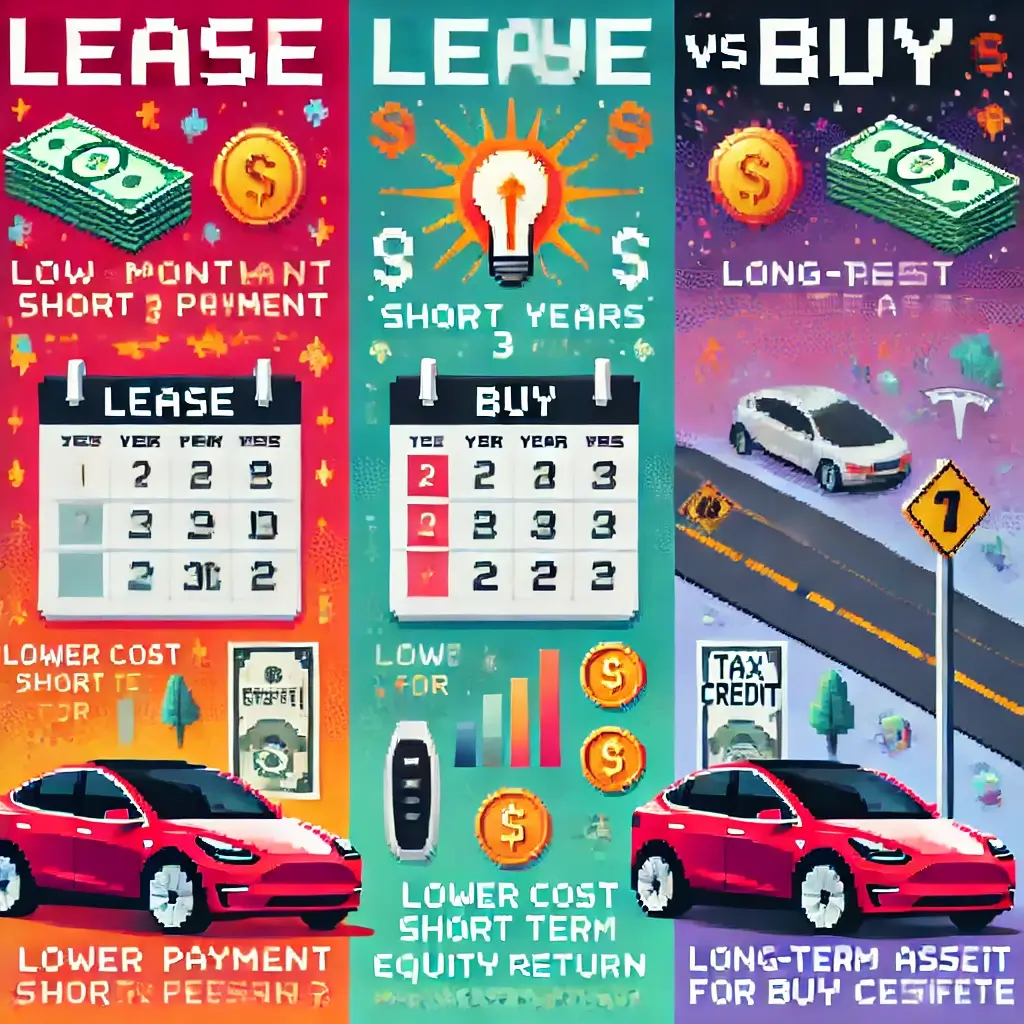
7. Visualizing the Difference: An Infographic
Sometimes, a picture is worth a thousand words.
To make this even clearer, I’ve put together a simple visual breakdown.
This isn’t just a fancy chart; it’s a tool to help you see where your money is going and what you’re getting in return.
Leasing vs. Buying a Tesla: A Visual Breakdown
(Hypothetical 2025 Model Y)
Leasing
Monthly Payment: ~ $550
Total Cost (3 Years): ~ $21,800
End of Term: Return car, zero equity
Benefits: Low payments, new car every few years, maintenance-free
Drawbacks: Mileage limits, no ownership, no tax credit
Buying
Monthly Payment: ~ $891
Total Cost (3 Years): ~ $37,076
End of Term: Own the car, build equity
Benefits: Ownership, no mileage limits, tax credit, long-term value
Drawbacks: Higher payments, depreciation risk, repair costs
The bottom line: Leasing costs less upfront but provides no ownership. Buying costs more but results in a long-term asset.
8. Navigating the Tax Credits and Incentives Maze
This is one of the most critical parts of the equation in 2025, and it’s where a lot of people get confused.
The U.S. government offers a federal tax credit for eligible electric vehicles, and for Tesla, this can be a game-changer.
As of right now, certain Tesla models still qualify for a portion of the credit, depending on battery component and critical mineral sourcing.
For a car that costs tens of thousands of dollars, a **$7,500 tax credit** is a huge deal.
Think of it as a massive discount.
But here’s the catch: the credit is for the *purchaser* of the vehicle.
When you lease a car, the leasing company is technically the owner, and they get to claim that tax credit.
Now, some leasing companies pass a portion of that savings on to you in the form of a lower monthly payment, but it’s rarely the full amount.
It’s a black box, and you’re at their mercy.
When you buy, you can claim the full credit (assuming you meet the income requirements and the vehicle qualifies) and use it to offset your tax bill for the year.
It’s a direct financial benefit that makes buying far more attractive from a pure numbers standpoint.
And don’t forget about state and local incentives!
Many states offer their own rebates, tax credits, or even free charging passes for EV owners.
Do your homework on your specific location to see if you can stack these benefits.
It could make the difference between a good deal and a great one.
9. The Resale Value Riddle: Will My Tesla Hold Its Worth?
This is the million-dollar question for anyone considering buying a Tesla.
Will it hold its value?
The answer is… complicated.
On one hand, Teslas have historically held their value better than most other luxury cars.
The demand is high, and the cars are seen as a desirable commodity.
But on the other hand, a lot of things can change in the next few years.
The market is becoming saturated with new electric vehicles from competitors like Ford, GM, Hyundai, and more.
The competition is heating up, and that could affect Tesla’s resale value.
And then there’s the big one: technological obsolescence.
Tesla is constantly innovating.
What if they release a new battery with a much longer range?
What if a major software update renders an older model less efficient or desirable?
The value of your car could plummet overnight.
This is the risk you take when you buy, and it’s a risk that a leaser avoids.
They just hand the car back and let the leasing company deal with the depreciation.
If you’re buying, you have to be comfortable with the fact that your asset’s value is not guaranteed.
It could be a great investment, or it could be a money pit.
It all depends on how the market evolves.
10. So, Who Should Lease a Tesla?
Based on everything we’ve discussed, here’s a quick breakdown of the type of person for whom leasing is the perfect fit.
**1. The Tech Enthusiast:** If you’re someone who always needs the latest and greatest gadget, a lease is perfect.
You’ll get to upgrade to a new model every few years, with the latest software, hardware, and battery tech.
You’ll never feel like you’re driving an old car.
**2. The Budget-Conscious Driver:** If you want a Tesla but your monthly budget is tight, a lease can make it happen.
The lower monthly payments give you access to a premium vehicle without breaking the bank.
**3. The Low-Mileage Commuter:** If you work from home, have a short commute, and don’t do a lot of long road trips, the mileage limits of a lease won’t be an issue.
You can enjoy the car without worrying about going over your limit.
**4. The Risk-Averse Driver:** If you’re worried about the long-term resale value of a Tesla, or the potential for expensive out-of-warranty repairs, a lease is a great way to avoid that risk.
You just hand the car back and let the leasing company worry about it.
**5. The Entrepreneur:** For some business owners, a lease can offer tax advantages by allowing them to deduct the full monthly payment as a business expense.
Check with your accountant to see if this applies to you.
11. So, Who Should Buy a Tesla?
And here’s the other side of the coin: who is buying for?
**1. The Long-Term Planner:** If you plan on keeping your car for more than five years, buying is almost always the better financial decision.
Once the loan is paid off, your car payments are gone, and you’re just paying for insurance and upkeep.
**2. The High-Mileage Driver:** If you have a long commute, love road trips, or just drive a lot, buying is the only way to go.
There are no mileage limits, so you can drive to your heart’s content without worrying about extra fees.
**3. The Customizer:** If you want to put your personal stamp on your car with custom wraps, wheels, or other modifications, you need to own it.
You can’t do that with a lease.
**4. The Value Seeker:** If you want to take advantage of the full federal tax credit and build equity in a tangible asset, buying is your best bet.
You get a massive discount and a car that is an asset, not a liability.
**5. The Ownership Lover:** This is a big one.
For some people, the feeling of true ownership is more important than anything else.
They want to have something that is truly theirs, a car they can drive for a decade or more, and then pass on to a family member or sell for a nice chunk of change.
12. The Final Verdict: My Personal Take
Alright, we’ve looked at the numbers, the pros and cons, and the different types of drivers.
So, what’s the final verdict?
If you were to ask me, my personal recommendation for the vast majority of people is to **buy** a Tesla.
Here’s why.
The ability to get the federal tax credit is a massive financial benefit that you can’t ignore.
And while the higher monthly payment might seem daunting, think of it as a forced savings plan.
You’re not just paying for a car; you’re building equity in an asset that will eventually be yours, free and clear.
But the biggest reason is the **freedom of ownership**.
The ability to drive as much as you want, to customize your car, and to not worry about wear and tear penalties is a luxury in itself.
Sure, the resale value is a bit of a gamble, but so is everything in life.
And the truth is, Teslas have historically done very well on the used market.
You’ll have a paid-off car that you can either continue to drive for years, or sell for a substantial amount of money, which you can then use as a down payment on your next vehicle.
Of course, if you’re a tech nerd who absolutely must have the latest model every three years, and you don’t drive much, a lease is a perfectly valid and smart choice.
But for the rest of us, who want to build wealth and have a car we can truly call our own, buying is the clear winner.
13. Additional Resources
If you’re still not sure, or you want to do some more research on your own, here are some great resources to help you out.
Tesla, Leasing, Buying, 2025, Electric Vehicle
🔗 Tesla Service Center Visit Posted 2025-08-14 07:23 UTC 🔗 Tesla Smart Home Integration Posted 2025-08-13 08:47 UTC 🔗 Public EV Charging Etiquette Posted 2025-08-12 06:57 UTC 🔗 Tesla’s 5,000 Patents Posted 2025-08-11 08:23 UTC 🔗 Tesla Resale Value Posted 2025-08-11 UTC 🔗 The 3 Ways Tesla Smart Home Integration Posted 2025-08 UTC