Unleash 2X More Performance: The Ultimate Tesla Tire Guide!
Hey there, fellow Tesla enthusiasts! Are you ready to dive deep into a topic that’s often overlooked but absolutely crucial for getting the most out of your electric beast? We’re talking about tires, my friends!
And not just any tires, but the ones that will truly unlock your Tesla’s full potential in terms of both exhilarating performance and mind-blowing efficiency. If you’ve ever wondered why your range isn’t quite what it used to be, or why your acceleration feels a little less “ludicrous,” chances are your tires are telling a story. And trust me, it’s a story worth listening to!
I know, I know, tires might not sound as exciting as, say, a new software update that gives you more horsepower. But let me tell you, choosing the right rubber for your Tesla is like finding the perfect pair of running shoes for a marathon. It’s not just about getting from point A to point B; it’s about optimizing every single mile of that journey.
As someone who lives and breathes Teslas (and has probably spent way too much time obsessing over tire specs), I’ve learned a thing or two. And today, I’m pulling back the curtain to share all my hard-won knowledge, mixed with a healthy dose of real-world experience and, yes, some actual data. Because when it comes to your Tesla, guesswork just won’t cut it.
So, buckle up! We’re about to embark on a journey that will not only make you a tire expert but will also help you squeeze every last drop of performance and efficiency out of your beloved Tesla. Let’s roll! —
Table of Contents
Why Your Tesla’s Tires Matter More Than You Think
Let’s be honest, when most people think about a Tesla, their minds immediately jump to the insane acceleration, the sleek design, or the cutting-edge Autopilot features. And rightly so! These cars are engineering marvels. But here’s a little secret that many overlook: the unsung heroes translating all that raw power into actual motion are your tires.
Think of it this way: your Tesla has instant torque, unlike any gasoline car. That means when you mash the accelerator, all that power hits the ground *immediately*. If your tires aren’t up to the task, you’re not getting optimal grip, which means less acceleration, more wheel spin, and ultimately, wasted energy. It’s like trying to run a sprint in flip-flops – you might make it, but you’re definitely not hitting your personal best!
Beyond the thrill of acceleration, there’s the subtle dance of efficiency. Tesla’s are designed to be slippery through the air, but what about the ground? Tires create rolling resistance, and believe it or not, this can significantly impact your range. A tire that’s optimized for low rolling resistance can add miles to your journey, potentially saving you a charge stop or two. In the world of EVs, every mile counts, right?
And then there’s the handling. Teslas are heavy cars, especially with those massive battery packs. This weight, combined with a low center of gravity, makes them handle incredibly well, but it also puts immense stress on the tires, particularly during spirited driving or emergency maneuvers. The right set of tires provides the confidence and control you need, whether you’re carving up a winding road or making an unexpected lane change on the highway. It’s the difference between feeling connected to the road and feeling like you’re floating.
Finally, let’s talk about noise. EVs are quiet, which is fantastic! But this quietness also highlights other noises that you might not notice in an ICE car. Tire noise can be a real buzzkill on a long road trip. Some tires are specifically designed with noise reduction technologies, making your cabin experience even more serene. Who wants to hear a constant hum when you could be enjoying your favorite podcast or the quiet hum of electric power?
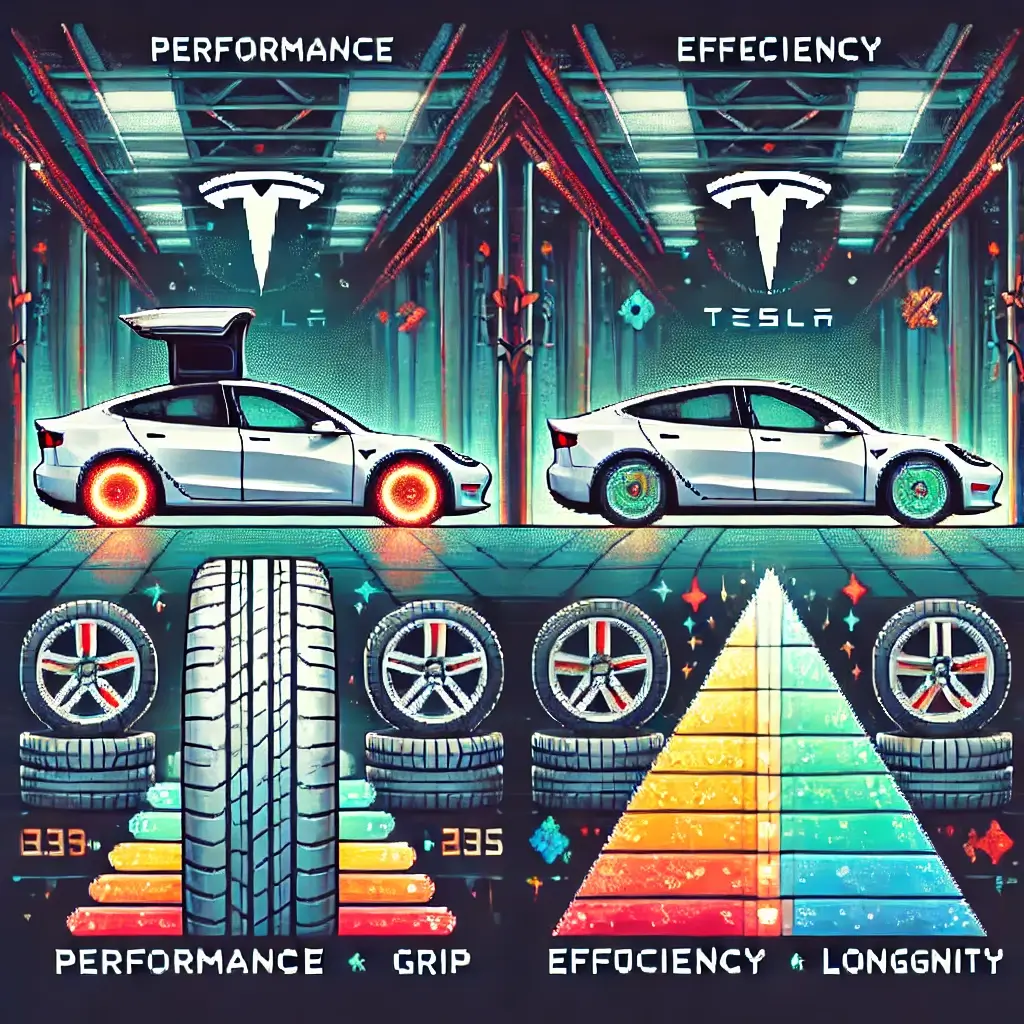
The Tesla Tire Dilemma: Performance vs. Efficiency vs. Longevity
Ah, the classic trifecta! It’s like choosing between extra sprinkles, a bigger scoop, and a cheaper price at the ice cream parlor – you usually can’t have all three perfectly balanced. When it comes to Tesla tires, it’s a constant tug-of-war between three critical factors: **performance**, **efficiency**, and **longevity**.
Let’s break it down:
Performance: Grip, G-Forces, and Grins
When we talk performance, we’re thinking about maximum grip for blistering acceleration, precise handling through corners, and excellent braking distances. These tires typically have softer rubber compounds and more aggressive tread patterns. They stick to the road like super glue, giving you that exhilarating feeling of being truly connected to your Tesla’s power.
However, there’s a catch. Softer compounds wear down faster. It’s simple physics: more grip often means more friction, which leads to more heat and more wear. So, while you’re grinning ear-to-ear ripping through a corner, just know those performance tires are likely shedding tiny bits of themselves onto the asphalt. It’s the price you pay for thrill, and sometimes, it’s totally worth it!
Efficiency: Range Anxiety’s Worst Enemy
On the other end of the spectrum, we have efficiency. These tires are designed with low rolling resistance (LRR) in mind. They often have harder compounds, specialized tread designs, and lighter constructions to minimize the energy required to keep them rolling. Think of it like this: an LRR tire glides along the road, while a performance tire digs in. That “gliding” saves precious battery electrons, extending your range.
The downside? Sometimes, efficiency can come at the expense of outright grip. While modern LRR tires are much better than they used to be, they generally won’t offer the same razor-sharp handling or neck-snapping braking as dedicated performance tires. For many daily drivers, however, the extended range is a compelling trade-off, especially if you’re frequently doing longer commutes or road trips.
Longevity: The Wallet’s Best Friend
And finally, longevity. This is about how many miles you can squeeze out of a set of tires before they need replacing. Tires with harder compounds and less aggressive tread patterns tend to last longer. They’re built to withstand the rigors of daily driving over thousands upon thousands of miles.
The compromise here? Often, long-lasting tires are a bit of a jack-of-all-trades, master-of-none. They might not excel in extreme performance, nor will they always be the absolute champions of efficiency. They aim for a good balance, making them a practical choice for many Tesla owners who prioritize cost-effectiveness and less frequent tire shop visits. Who wants to be buying new tires every year, right?
The key is finding *your* personal sweet spot in this triangle. Are you a track warrior who lives for lap times? A range extender who wants to maximize every electron? Or a daily commuter who just wants a reliable, long-lasting tire? Understanding your driving style and priorities is the first step in making the right choice.
Decoding the Rubber: Understanding Tire Ratings and What They Mean for Your Tesla
Walking into a tire shop or Browse online can feel like trying to decipher an ancient language. All those numbers and letters on the sidewall… what do they even mean? Fear not! Understanding tire ratings is absolutely essential for your Tesla. It’s not just about finding a tire that fits; it’s about finding one that’s engineered for the unique demands of an EV.
Let’s break down the key terms you’ll encounter and what they signify for your Tesla:
1. Size (e.g., 235/45R18)
This is the most straightforward. It breaks down as:
- **235:** The width of the tire in millimeters.
- **45:** The aspect ratio, or the height of the sidewall as a percentage of the width (45% of 235mm).
- **R:** Radial construction (almost all modern tires are radial).
- **18:** The diameter of the wheel in inches.
Always stick to the size recommended by Tesla for your specific model and trim. Deviating from this can affect speedometer accuracy, ABS/traction control performance, and even fender clearance. Don’t try to be a hero and slap on some random size; it’s just not worth the headaches!
2. Load Index (e.g., 98W)
The number before the letter (98 in our example) is the load index. This indicates the maximum weight the tire can support when properly inflated. Teslas are heavy cars, remember? So, a proper load index is crucial for safety and tire integrity. A higher number means a higher load capacity.
Important Note: Many Tesla models, especially the heavier ones, require a higher load index than many standard sedans. Always check your car’s manual or the sticker on the driver’s side door jamb for the specific load index required. Don’t go lower than what’s recommended!
3. Speed Rating (e.g., 98W)
The letter after the load index (W in our example) is the speed rating. This indicates the maximum speed at which the tire can safely carry its rated load. Common ratings include:
- **H:** 130 mph (210 km/h)
- **V:** 149 mph (240 km/h)
- **W:** 168 mph (270 km/h)
- **Y:** 186 mph (300 km/h)
- **(Y):** Over 186 mph (often seen on extreme performance tires)
Given the instant torque and high top speeds of Teslas, you’ll typically find them spec’d with W, Y, or (Y) speed ratings. Again, never use a tire with a lower speed rating than what came with your car. It’s a safety thing!
4. Treadwear, Traction, Temperature (UTQG Ratings)
These are the Uniform Tire Quality Grading (UTQG) standards, and they’re super helpful, though not always perfectly comparable across brands.
- Treadwear: This number (e.g., 300, 500) gives you a comparative wear rate. A tire with a 400 treadwear rating *should* last twice as long as a tire with a 200 rating. Higher number = longer life. This is your best friend when considering longevity.
- Traction: Graded AA, A, B, or C. AA is the best, indicating excellent wet braking performance. This is crucial for safety, especially if you live in a rainy climate.
- Temperature: Graded A, B, or C. A is the best, indicating the tire’s resistance to heat buildup and its ability to dissipate heat. Given how much work Tesla tires do, a good temperature rating is vital for performance and safety, especially during spirited driving.
5. “T” or “TO” Marking (Tesla Original Equipment)
This is a relatively new but increasingly common marking you’ll see on some tires (e.g., Michelin, Pirelli). The “T” or “TO” (Tesla Original) symbol on the sidewall indicates that the tire was specifically developed and tuned in collaboration with Tesla for their vehicles. These tires often feature:
- **Acoustic Foam:** A layer of foam inside the tire to reduce cabin noise. This is HUGE for Tesla owners!
- **Optimized Rolling Resistance:** For maximum efficiency.
- **Tuned Compounds:** To handle the specific weight, torque, and regenerative braking characteristics of Teslas.
While not strictly necessary, choosing a “T” or “TO” marked tire often means you’re getting a tire that’s been specifically engineered to complement your Tesla’s unique characteristics. It’s like a custom-tailored suit for your car!
Top Contenders: The Best Tires for Tesla Performance and Efficiency
Alright, let’s get to the good stuff! Based on countless hours of research, real-world owner feedback, and my own experiences, I’ve put together a list of the tires that consistently rise to the top for Tesla owners. Remember, the “best” tire is subjective and depends on your priorities, but these are generally fantastic choices.
1. Michelin Pilot Sport Series: The King of Grip?
If you’re looking for unadulterated performance, Michelin’s Pilot Sport line is often the gold standard. They’ve earned their reputation for a reason. Specifically, the **Michelin Pilot Sport 4S (PS4S)** and the newer **Pilot Sport EV** are absolute marvels.
The PS4S is renowned for its incredible dry grip, precise steering response, and confident wet weather performance. It’s the kind of tire that makes you feel like your Tesla is glued to the road, whether you’re taking a tight corner or executing a quick lane change. Owners consistently rave about how it transforms their car’s handling. It’s a truly confidence-inspiring tire. But let’s be real, that insane grip comes from a softer compound, so don’t expect them to last as long as some of the more efficiency-focused options.
Then there’s the **Michelin Pilot Sport EV**. This is where Michelin truly flexed its muscles, designing a tire specifically for electric vehicles. It retains much of the legendary grip of the PS4S but incorporates features like acoustic foam for reduced cabin noise and optimized rolling resistance for better range. It’s a fantastic blend of performance and EV-specific considerations, making it a top choice for many.
Pros: Phenomenal dry and wet grip, razor-sharp steering response, excellent braking performance, specific EV options (Pilot Sport EV) with acoustic foam and optimized range.
Cons: Generally higher price point, shorter tread life compared to touring/efficiency tires, can be noisier than some LRR options (though the PS EV mitigates this).
Best For: Enthusiastic drivers, those who prioritize handling and cornering, anyone who wants to push their Tesla’s performance limits.
Want to dive deeper into Michelin’s offerings? Check out their official site:Explore Michelin Tires
2. Pirelli P Zero Line: Italian Flair Meets Electric Power
Pirelli is another heavyweight in the performance tire arena, and their P Zero line has been a staple on high-performance vehicles for years. For Teslas, the **Pirelli P Zero (PZ4)** and the **P Zero Elect** are the go-to choices.
Similar to Michelin, the P Zero offers exceptional grip and precise handling. They often come as original equipment on many performance variants of Teslas, which speaks volumes about their capability. They deliver a very sporty feel, making your Tesla feel even more agile and responsive. The **P Zero Elect** is Pirelli’s answer to the unique demands of EVs, featuring their Elect technology for reduced rolling resistance, lower noise, and enhanced grip for instant torque.
My experience with Pirelli tires has always been one of impressive responsiveness. They communicate beautifully with the road, letting you know exactly what the car is doing. If you appreciate a tire that feels connected and provides immediate feedback, Pirelli is definitely worth considering. Like the Michelins, these are performance-oriented, so manage your expectations regarding super long tread life.
Pros: Excellent dry and wet grip, great steering feel, often OE on performance Teslas, Elect version optimized for EVs.
Cons: Can be pricey, moderate tread life, some report them to be slightly firmer riding than competitors.
Best For: Drivers seeking a sporty feel, those who appreciate precise feedback, owners of performance-oriented Teslas.
See what Pirelli has to say about their P Zero line:Discover Pirelli P Zero
3. Goodyear Eagle F1 Asymmetric: American Muscle, EV Style
Goodyear might not be the first name that pops into your head when thinking about high-performance EV tires, but their **Eagle F1 Asymmetric** series, particularly the **Asymmetric 5** and **Asymmetric 6**, are surprisingly strong contenders. They offer a fantastic balance of performance, comfort, and sometimes even a respectable tread life.
What sets the Eagle F1 Asymmetric apart is its ability to deliver solid grip in both wet and dry conditions without being overly harsh. Many owners find them to be a good “daily driver performance” tire – capable of spirited driving but also comfortable enough for long commutes. They often come with an inner foam layer for noise reduction, which is a massive plus for Tesla owners who cherish their quiet cabin.
I’ve personally heard great things about the Asymmetric 6’s wet performance, which is a huge confidence booster for anyone driving in less-than-ideal conditions. If you’re looking for a tire that can do a bit of everything well – offer good grip, be relatively quiet, and last a decent amount of time – the Goodyear Eagle F1 Asymmetric line is definitely worth your consideration.
Pros: Balanced performance, good wet grip, often includes noise reduction technology, relatively comfortable ride.
Cons: Not as extreme in performance as PS4S, perhaps not the absolute best for efficiency.
Best For: Drivers seeking a balanced performance tire for daily driving, those who value comfort and quietness, all-around solid choice.
Learn more about the Goodyear Eagle F1 series:Check Out Goodyear Eagle F1
4. Continental ContiSportContact Series: A Balanced Performer
Continental is another major player that consistently delivers reliable and capable tires. Their **ContiSportContact** line, particularly the **SportContact 6** and the newer **PremiumContact 6** (which leans more towards comfort and efficiency), are excellent choices for Teslas.
The SportContact 6 is a high-performance tire known for its strong grip, especially in the dry, and commendable steering precision. It’s a favorite among those who appreciate a firm, communicative ride. The PremiumContact 6, on the other hand, focuses more on providing a comfortable, quiet ride with good efficiency, while still offering very respectable handling. It’s often praised for its smooth ride quality and reduced road noise.
Continental tires often strike a really good balance. They might not be the absolute best in any single category, but they are consistently good across the board. If you’re looking for a dependable, well-engineered tire that won’t surprise you with any major drawbacks, Continental is a solid bet. They’re like that reliable friend who’s always there for you, no matter what!
Pros: Strong dry grip (SportContact), good wet performance, comfortable ride and low noise (PremiumContact), reliable all-around performance.
Cons: Not always the absolute top in extreme performance or efficiency, can be a bit more expensive than some value options.
Best For: Drivers seeking a balanced performance/comfort tire, those who prioritize reliability and consistent performance.
5. Hankook Ventus S1 evo3 EV: The EV-Specific Challenger
Don’t sleep on Hankook! They’ve been making serious strides in the tire world, and their **Ventus S1 evo3 EV** is a testament to that. This tire was specifically designed with electric vehicles in mind, and it shows. It’s a compelling alternative to the more established players.
The S1 evo3 EV focuses on three key areas for EVs: low rolling resistance for extended range, excellent wet and dry grip to handle instant torque, and reduced noise thanks to Hankook’s “sound absorber” technology. Owners report a surprisingly quiet ride and good handling characteristics. It’s often a more budget-friendly option compared to the Michelins or Pirellis, offering excellent value without sacrificing too much performance.
I’ve seen more and more Tesla owners opting for these, and the feedback is overwhelmingly positive, especially for the price point. If you want a tire engineered for your EV but don’t want to break the bank, the Hankook Ventus S1 evo3 EV is a dark horse that might just surprise you.
Pros: Specifically designed for EVs (LRR, noise reduction), good wet and dry grip, often a better value than premium brands.
Cons: Not as widely available as some brands, perhaps not the ultimate in extreme performance.
Best For: Value-conscious EV owners, those seeking a dedicated EV tire without the premium price tag, daily commuters.
Real-World Insights: What Tesla Owners Are Saying
Numbers and specs are one thing, but what do real people, driving real Teslas, in real conditions, actually think? This is where the rubber literally meets the road. I’ve spent countless hours sifting through forums, chatting with fellow owners at Superchargers, and collecting anecdotal evidence, and here’s what the collective wisdom suggests:
The Range Chasers:
For those who view every electron as sacred, tires with low rolling resistance are king. Many Model 3 Standard Range Plus and Long Range owners swear by the original equipment (OE) Michelin Primacy MXM4 (often with the “T” marking) or the Pirelli P Zero Elect. They report noticeable differences in range – sometimes as much as 5-10% compared to more aggressive performance tires. The trade-off? A slightly less exhilarating cornering experience and occasionally, a bit more road noise on certain surfaces. But hey, an extra 20 miles of range often trumps a fraction of a g-force for these folks!
The Performance Junkies:
On the other side of the coin, you have the Performance Model 3 and Model S Plaid owners who measure their joy in 0-60 times. For them, it’s Michelin Pilot Sport 4S all day long. They will tell you, without hesitation, that the grip, steering response, and sheer confidence these tires provide are unmatched. “It feels like the car is on rails!” is a common refrain. The downside, as expected, is tread life. Many report getting as little as 15,000-20,000 miles, especially if they’re heavy-footed. But for them, it’s a small price to pay for that instant, neck-snapping acceleration and cornering prowess.
The Balanced Daily Drivers:
Most Tesla owners fall into this category. They want good performance, decent efficiency, and reasonable longevity. This is where tires like the Goodyear Eagle F1 Asymmetric and certain Continental models really shine. Owners appreciate their quietness (often due to acoustic foam), comfortable ride, and reliable grip in varying conditions. “I can still have fun, but I don’t feel like I’m burning money every mile,” one owner told me about his Eagle F1s. They’re often seen as the pragmatic choice, offering a solid all-around experience without extreme compromises.
The Noise Obsessives:
Because Teslas are so quiet, tire noise becomes amplified. Many owners are acutely sensitive to this. The “T” or “TO” marked OE tires (Michelin Primacy MXM4, Pirelli P Zero Elect) are consistently praised for their acoustic foam technology, which drastically reduces road noise. Some drivers specifically seek out these noise-reducing features, even if it means slightly compromising on ultimate grip or longevity. “It’s like driving in a library,” one owner gushed about his foam-filled tires.
The Unexpected Factor: Regenerative Braking Wear
Here’s a unique EV-specific insight: regenerative braking, while fantastic for efficiency, can contribute to unusual tire wear patterns. Because the motors are actively slowing the wheels, the forces on the tires are different from traditional friction braking. Many owners report accelerated wear on the inner edges of their tires, particularly on the front axle. Regular tire rotations (every 6,250 miles or 10,000 km, as recommended by Tesla) become even more critical to even out this wear and maximize tire life. Failing to rotate regularly is a surefire way to kill your tires prematurely.
In summary, the Tesla community is a rich source of real-world data. While individual experiences vary, a clear pattern emerges: prioritize what matters most to you – be it range, raw performance, or a quiet, comfortable ride – and choose your tires accordingly. There’s no single “best” answer, only the best answer for *your* driving style and needs.
Maximizing Your Investment: Essential Tesla Tire Care Tips
You’ve just invested in a fantastic set of tires for your Tesla. Great! But buying them is only half the battle. To truly maximize their performance, efficiency, and most importantly, their lifespan, proper tire care is non-negotiable. Trust me, a little attention goes a long way and can save you hundreds, if not thousands, of dollars in premature replacements.
1. Get Your Tire Pressure Right (It’s More Critical Than You Think!)
This is probably the single most important and easiest thing you can do. Teslas have very specific tire pressure recommendations, often higher than typical ICE cars due to their weight and performance characteristics. You’ll find the correct pressure (usually in PSI, pounds per square inch) on the sticker inside your driver’s side door jamb or in your owner’s manual.
- Why it matters: Incorrect tire pressure is a silent killer. Underinflation leads to increased rolling resistance (killing your range!), excessive heat buildup (bad for tire life and safety!), and uneven wear (especially on the shoulders). Overinflation can lead to a harsher ride, reduced grip, and accelerated wear down the center of the tread.
- How often: Check your tire pressure *at least* once a month, and always before a long trip. Do it when the tires are cold (before driving or after they’ve been sitting for a few hours) for the most accurate reading. Many Teslas show tire pressure on the screen, which is super convenient, but a good old-fashioned tire gauge is always a reliable backup.
2. Rotate, Rotate, Rotate! (Don’t Skip This!)
I cannot stress this enough, especially for Teslas. Due to the immense instant torque and regenerative braking, Tesla tires often wear unevenly, particularly the front tires. Regular rotations help distribute this wear more evenly across all four tires, extending their overall lifespan.
- Tesla’s Recommendation: Tesla typically recommends tire rotations every 6,250 miles (10,000 km). Stick to this!
- Why it matters: Without rotation, your front tires will likely wear out much faster than your rears, forcing you to replace them in pairs or even all four sooner than necessary. Regular rotations ensure you get the maximum usable life out of your entire set.
- Note on Staggered Setups: If your Tesla has a staggered wheel setup (different size wheels/tires front and rear, common on some Performance models), you cannot do a traditional rotation. In this case, professional advice on how to manage wear is even more crucial.
3. Get Your Alignment Checked (Especially After Bumps!)
Hitting potholes, curbing a wheel, or even just normal wear and tear can throw your wheel alignment out of whack. Misalignment can cause rapid and uneven tire wear, pulling, and reduced handling.
- When to check: If you notice uneven tire wear (e.g., one side of the tire is bald while the other is fine), your car pulling to one side, or after hitting a significant pothole or curb, get an alignment check immediately. A good rule of thumb is to have it checked annually or every 15,000-20,000 miles.
- Why it matters: Proper alignment ensures your tires are making optimal contact with the road, leading to even wear, better handling, and improved efficiency. It’s like ensuring your car is walking perfectly straight instead of dragging a foot!
4. Monitor Tread Depth (Don’t Be a Daredevil!)
Tread depth is vital for grip, especially in wet conditions. As your tires wear down, their ability to channel water away from the contact patch decreases significantly, increasing your risk of hydroplaning.
- How to check: Use a simple tread depth gauge or the “penny test” (insert a penny head-first into a tread groove; if you can see the top of Lincoln’s head, your tread is too shallow).
- Legal Limits: Most jurisdictions have a legal minimum tread depth (often 2/32nds of an inch or 1.6mm). However, for safety, especially in wet weather, you should consider replacing tires before they reach this absolute minimum, perhaps around 4/32nds of an inch.
5. Clean Your Tires and Wheels (It’s More Than Just Looks!)
While this might seem like a cosmetic tip, cleaning your tires and wheels regularly removes brake dust, dirt, and road grime that can actually degrade the rubber over time. Plus, clean wheels look amazing on a Tesla!
By diligently following these simple tire care tips, you’ll not only prolong the life of your expensive Tesla tires but also ensure your car continues to perform optimally, maintain excellent efficiency, and most importantly, keep you safe on the road. It’s an investment in your driving experience!
My Final Thoughts: Making the Right Choice for Your Tesla
So, there you have it – a deep dive into the fascinating, albeit sometimes overlooked, world of Tesla tires. It’s a journey that, I hope, has demystified some of the jargon and empowered you to make a more informed decision for your electric chariot.
Choosing the best tires for your Tesla isn’t just about picking a fancy brand; it’s about understanding the unique demands of an EV and aligning those with your personal driving style and priorities. Are you chasing every last mile of range? Do you live for the thrill of instantaneous torque and razor-sharp cornering? Or are you simply looking for a quiet, comfortable, and long-lasting ride for your daily commute?
Remember the trifecta: **Performance, Efficiency, and Longevity.** You can certainly find tires that offer a fantastic balance of all three, but often, excelling in one area means a slight compromise in another. The key is to know where you stand on that spectrum.
Don’t underestimate the impact of those four patches of rubber connecting your Tesla to the road. They are your primary interface for acceleration, braking, handling, and even ride comfort. Investing in good tires and, more importantly, *caring* for them properly will pay dividends in safety, enjoyment, and your wallet.
My biggest piece of advice? Don’t cheap out on tires. Your Tesla is a high-performance, technologically advanced machine. Putting subpar rubber on it is like trying to run a marathon in flip-flops – you’re just not going to get the best out of it, and you might even end up hurting yourself. Treat your Tesla (and yourself!) to the tires it deserves.
Take the time to research, read reviews from other Tesla owners, and if possible, talk to a reputable tire specialist who understands EVs. And once you’ve got them, keep those pressures checked, rotate them diligently, and enjoy every silent, powerful mile your Tesla offers.
Happy driving, and may your tires always be perfectly inflated!
Keywords: Tesla tires, EV tires, electric vehicle performance, tire efficiency, low rolling resistance