Unlock 5 Epic Tesla Adventures: Your EV Camping & Overlanding Guide!
Hey there, fellow adventurers!
Ever dreamed of ditching the bustling city for the silent serenity of nature, all while driving your sleek, eco-friendly Tesla?
Well, buckle up, because EV camping and overlanding isn’t just a dream anymore—it’s a thrilling reality!
Gone are the days when “off-roading” meant guzzling gas and spewing emissions.
Now, your Tesla, with its instant torque, silent operation, and surprisingly spacious interior, is ready to revolutionize your outdoor escapades.
As someone who’s spent countless nights under the stars with my Model Y (and a few adventurous days navigating less-traveled paths), I can tell you firsthand: it’s an absolute game-changer.
Imagine waking up to the sound of birds, not an idling generator, with the sun streaming into your comfortable Tesla “tent.”
Or pulling up to a remote campsite, knowing you’ve left zero trace, just tire marks on the dirt.
This isn’t just about saving on fuel; it’s about a deeper, more harmonious connection with the environment.
But let’s be real, taking your high-tech EV into the wilderness comes with its own set of questions and challenges.
How do you charge it off-grid?
What gear do you *really* need?
And how do you make sure your adventure doesn’t turn into a stranded nightmare?
Don’t worry, I’ve got you covered.
Consider this your ultimate guide to transforming your Tesla into the ultimate overlanding and camping machine.
We’re going to dive deep into equipping your Tesla for adventure, covering everything from essential modifications to smart power management and ingenious packing strategies.
So, whether you’re a seasoned overlander looking to electrify your journeys or a Tesla enthusiast curious about the wild, this guide is for you.
Let’s unlock the incredible potential of your electric vehicle for unparalleled outdoor exploration.
Let the electric adventures begin! —
Table of Contents
—
Why Tesla for Adventure? The Shocking Truth!
Alright, let’s address the elephant in the room – or rather, the silent, sleek electric vehicle in the wilderness.
Why on earth would you choose a Tesla, a car synonymous with urban sophistication and cutting-edge tech, for rough-and-tumble adventures like camping and overlanding?
Many folks, especially those ingrained in the traditional overlanding scene, might scoff, picturing a pristine Model S stuck in mud.
But let me tell you, they’re missing the electrifying point!
Silence is Golden (and Green!)
First off, the silence. Oh, the blissful silence!
Imagine pulling into a secluded campsite in the dead of night, not with the roar of a combustion engine, but with barely a whisper.
No more waking up your fellow campers, no more scaring off wildlife.
It’s just you, the gentle hum of the electric motors (if you even hear them), and the symphony of nature.
This isn’t just a convenience; it’s a fundamental shift in how you experience the outdoors.
Plus, zero tailpipe emissions mean you’re literally leaving no trace in terms of air pollution, which, let’s be honest, feels pretty darn good.
Instant Torque and Unmatched Control
Now, let’s talk performance. Teslas, especially the dual-motor all-wheel-drive (AWD) variants, offer instant torque that traditional gasoline vehicles can only dream of.
This isn’t just for drag races on the highway; it’s incredibly useful for navigating tricky terrain.
Need to climb a steep, rocky incline? The immediate power delivery means no lag, no struggling, just smooth, controlled ascent.
The electronic control over each wheel in AWD models provides superior traction management, often outperforming mechanical systems in slippery conditions.
I’ve personally been amazed at where my Model Y can go, far beyond what most people would expect from a “car” of its type.
It’s like having a finely tuned mountain goat, but with heated seats and a killer sound system.
The Powerhouse On Wheels: Battery as Your Lifeline
Here’s where Teslas truly shine for camping: the massive battery pack isn’t just for propulsion; it’s a colossal power bank!
Forget lugging around noisy, fume-spewing generators.
Your Tesla can power almost anything you need: lights, refrigerators, induction cooktops, laptops, even electric blankets for chilly nights.
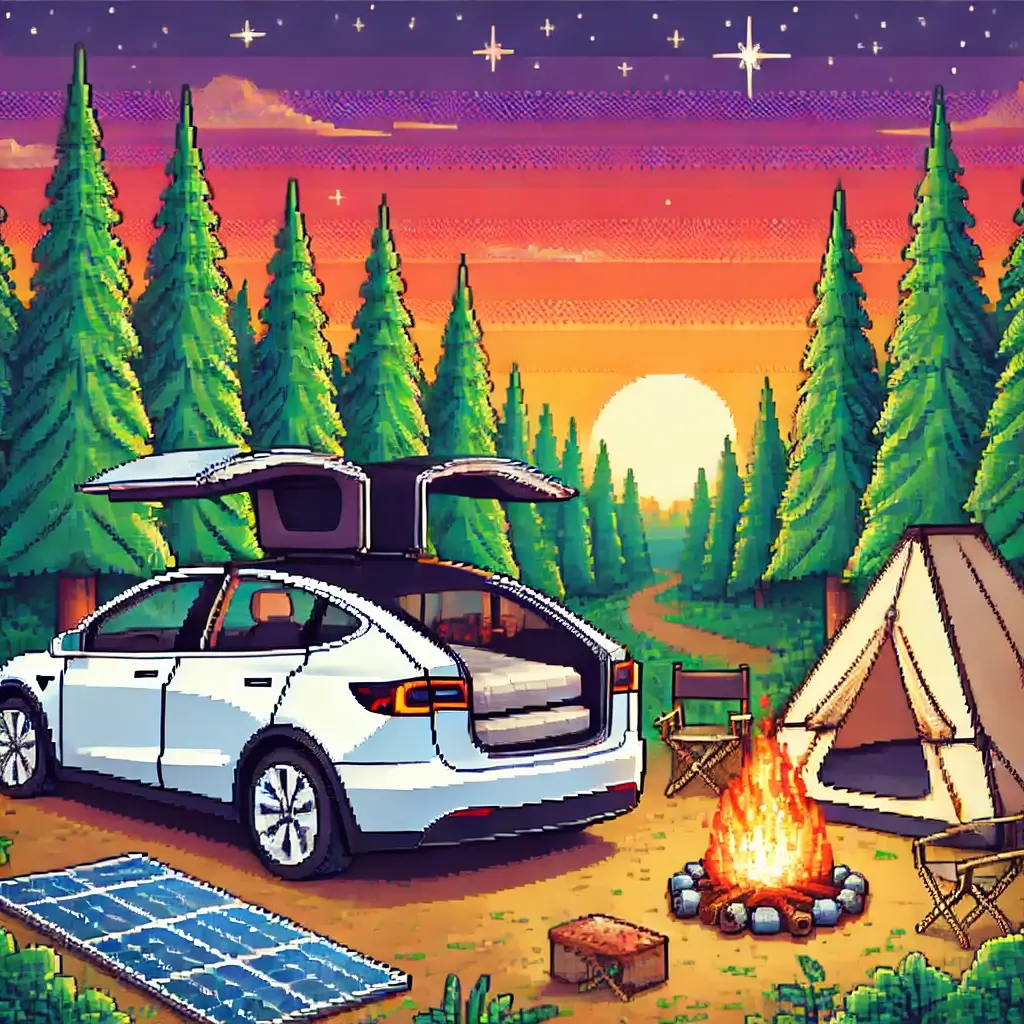
With features like Camp Mode (more on that later), your Tesla becomes a climate-controlled, entertainment-rich mobile base camp.
This inherent ability to provide clean, silent power is, in my opinion, the single biggest advantage of using an EV for extended outdoor stays.
It’s like having a small, portable off-grid cabin tucked neatly into your garage, ready to roll at a moment’s notice.
The Digital Nomad’s Dream Machine
For those who blend work with adventure, or simply can’t live without their creature comforts, a Tesla is a digital nomad’s dream.
The large touchscreen provides entertainment, navigation, and connectivity.
Need to check emails or stream a movie after a long day of hiking?
No problem.
The built-in Wi-Fi connectivity (if you subscribe) and robust infotainment system make downtime enjoyable, even in the middle of nowhere.
Plus, the spacious interior, especially in the Model Y and Model X, allows for comfortable sleeping arrangements, effectively turning your vehicle into a cozy bedroom on wheels.
It’s far more comfortable than roughing it in a traditional tent, especially when the weather decides to be less than cooperative.
Low Maintenance, High Reliability
Compared to a complex internal combustion engine with its hundreds of moving parts, an EV powertrain is remarkably simple.
Fewer moving parts mean less to break down when you’re far from a service center.
No oil changes, no spark plugs, no fuel filters to worry about.
This inherent reliability provides immense peace of mind when venturing into remote areas, where a breakdown could quickly turn into a serious predicament.
Of course, you still need to check your tires and fluids (like washer fluid!), but the core drivetrain is impressively robust.
So, while the image of a rugged 4×4 might still dominate the overlanding psyche, the Tesla is quietly, powerfully, and silently making its case as a superior adventure vehicle for the modern explorer.
It’s not just about getting there; it’s about how you experience the journey, and the destination, with minimal impact and maximum comfort.
Tesla Camping, Tesla Overlanding, EV Adventure, Electric Vehicle Camping, Silent Camping —
Equipping Your Tesla: 10 Must-Have Essentials!
Alright, you’re convinced your Tesla is the ultimate adventure machine. Fantastic!
But before you hit the road with nothing but your phone charger and a bag of chips, let’s talk gear.
Equipping your Tesla for camping and overlanding isn’t just about throwing things in the trunk; it’s about smart choices that enhance comfort, safety, and functionality.
Based on my own trial-and-error (and a few “oops” moments), here are 10 must-have essentials that will transform your EV from a commuter car into a formidable adventure rig.
1. Comfortable Sleeping Setup: Mattress & Blackout Curtains
This is arguably the most crucial item for comfortable Tesla camping.
While the seats fold flat, you’ll want a dedicated mattress designed for your Tesla model (Model Y/3/X/S have slightly different dimensions).
Companies like Dreamcase or Tesloid offer custom-fit mattresses that make sleeping surprisingly comfortable.
Pair this with blackout window covers or curtains. Seriously, you don’t want the morning sun blazing into your eyes at 5 AM, nor do you want curious onlookers peering in.
These create a private, dark sanctuary, perfect for a good night’s sleep after a day of exploration.
2. Portable Power Station (Backup for the Backup!)
While your Tesla battery is a powerhouse, having a dedicated portable power station (like a Jackery or Goal Zero) is an absolute lifesaver.
Why?
It keeps your smaller devices charged (phones, drones, cameras) without constantly dipping into your car’s main battery, preserving range.
It’s also crucial for things like powering an induction cooktop for longer periods, or as a contingency if you run into an unexpected charging issue with your vehicle.
Think of it as your portable, self-contained energy hub.
3. 12V Refrigerator/Cooler
Forget soggy ice and lukewarm drinks.
A 12V compressor refrigerator is a game-changer for food storage.
These units run efficiently off your Tesla’s 12V outlet (or your portable power station) and keep your perishables genuinely cold, like a mini-fridge.
This means fresh food for longer trips and no more frantic searches for ice.
Brands like Dometic or ICECO are popular choices among overlanders.
4. Robust Charging Adapters & Cables
You’ll need more than just your standard mobile connector.
Invest in a J1772 adapter (essential for non-Tesla Level 2 chargers), an NEMA 14-50 adapter for RV parks, and ideally, an extension cable for your mobile connector.
Some even carry a TT-30 adapter for 30A RV outlets.
The more charging options you have, the less stress you’ll experience trying to find a compatible plug in the wild.
5. Off-Road Recovery Gear (If Venturing Off-Pavement)
If your “adventure” involves more than just paved campgrounds, recovery gear is non-negotiable.
Think traction boards (like Maxtrax), a kinetic recovery rope, shackles, and a small shovel.
While Teslas are surprisingly capable, they’re not invincible, and getting stuck in sand or mud can happen quicker than you think.
Better to have it and not need it, than need it and not have it, right?
6. Portable Induction Cooktop (and Cookware)
Remember that massive battery?
Put it to work! An induction cooktop is far safer and cleaner than gas stoves, especially inside or near your vehicle.
They heat up incredibly fast and are highly efficient.
Just make sure your cookware is induction-compatible (magnetic bottom) and consider a small, efficient setup for easy storage.
7. Portable Shower & Water Storage
Staying clean on the road is vital.
A portable shower (solar-heated bag or a 12V pump shower) combined with collapsible water containers (5-10 gallons) will make a huge difference.
Whether it’s for a quick rinse after a dusty hike or washing dishes, accessible water is a luxury you’ll appreciate.
8. Leveling Blocks
Unless you enjoy sleeping on a slope, leveling blocks are a must.
Many campsites, especially dispersed ones, aren’t perfectly flat.
These simple blocks allow you to quickly and easily level your Tesla for a comfortable night’s sleep and proper fridge operation.
9. High-Quality Headlamps & Lanterns
Even with your Tesla’s interior lights, you’ll need hands-free illumination for setting up camp, cooking after dark, or late-night bathroom breaks.
Headlamps are essential, and a good portable lantern (LED, rechargeable) creates a cozy ambiance inside or outside your vehicle.
10. Tool Kit & Tire Repair Kit
Don’t leave home without it!
A basic tool kit (wrenches, screwdrivers, pliers) can solve many minor issues.
More importantly, a comprehensive tire repair kit (tire plugs, air compressor, tire pressure gauge) is critical.
Teslas don’t come with a spare tire, so being able to fix a flat on the go can save your entire trip (and potentially a costly tow).
Equipping your Tesla for adventure is an ongoing process, and you’ll undoubtedly discover your own personal “must-haves” as you gain experience.
But starting with these 10 essentials will set you up for success and ensure your EV camping and overlanding experiences are comfortable, safe, and truly unforgettable.
Tesla Gear, EV Camping Equipment, Overlanding Essentials, Tesla Accessories, Off-Grid Gear —
Power Play: 7 Smart Strategies for Tesla Off-Grid Power!
This is where the magic really happens for Tesla adventurers!
Your Tesla isn’t just a car; it’s a giant battery on wheels, and understanding how to effectively manage that power off-grid is key to a successful trip.
Forget the old days of noisy generators and finicky propane tanks.
With smart planning, your Tesla can be your silent, emission-free power hub.
Here are 7 ingenious strategies to keep your adventure powered up, even when you’re miles from the nearest Supercharger.
1. Master Camp Mode: Your Tesla’s Secret Weapon!
If you have a recent Tesla model, **Camp Mode** (accessible from the climate control screen) is your best friend.
It maintains cabin temperature, keeps interior lights on (dimmable!), powers USB ports, and allows you to stream media, all while minimizing battery drain.
It even disables Sentry Mode (which can be a huge power hog when parked) and ensures the screen stays on, acting as your central command.
This mode is designed specifically for overnight stays and dramatically improves comfort and efficiency compared to just leaving the car on.
It’s like having a climate-controlled, tech-savvy mini-apartment wherever you park.
2. Understand Vampire Drain & Mitigate It
Ah, “vampire drain” – the silent killer of EV range when parked.
Even when off, your Tesla uses a small amount of power for background systems, connectivity, and features like Sentry Mode or Cabin Overheat Protection.
To minimize this when off-grid:
- **Disable Sentry Mode:** This is the biggest culprit. Turn it off unless you absolutely need it (e.g., in a busy, unsecured parking lot).
- **Disable Cabin Overheat Protection:** If temperatures aren’t extreme and you’re not in the car, turn this off.
- **Disable “Always Connected” (if an option):** Some older models had this. Keeping your car awake for instant app access drains power.
- **Minimize App Check-ins:** Constantly checking your car’s status on your phone keeps it awake. Resist the urge!
By being mindful of these background processes, you can significantly extend your parked range.
3. Leverage the 12V Outlet & USB Ports Wisely
Your Tesla has multiple USB ports and a 12V cigarette lighter-style outlet.
These are perfect for charging phones, tablets, and running low-power devices like a 12V fridge or a portable fan.
However, be strategic. While the 12V outlet is great for continuous use (like your fridge), use your external portable power station for high-draw items or charging multiple gadgets simultaneously to save your main car battery for driving.
4. Solar Panels: A Slow but Steady Replenisher
While you can’t typically “solar charge” your Tesla directly (not efficiently enough for the main battery, anyway), portable solar panels are invaluable for topping up your *portable power station*.
Set up a flexible solar panel on your roof, or a foldable one next to your car, connected to your Jackery or Goal Zero.
This creates a self-sustaining loop for your smaller electronics and fridge, leaving your Tesla’s main battery solely for propulsion.
It’s a slower charge, but it’s free, silent, and sustainable!
5. Plan Your Energy Budget (Like a Financial Budget!)
Before you even leave, estimate your power consumption.
How many hours will you run your fridge? How often will you charge your phone? Will you use an induction cooktop?
Knowing your expected usage will help you determine how much battery percentage your “camp mode” activities will consume per day.
This allows you to factor in charging stops more accurately and avoid range anxiety when deep in the wilderness.
Think of your car’s battery as your bank account – spend wisely!
6. Pre-Cool/Heat and Pack Efficiently
Before you arrive at your campsite, pre-cool or pre-heat your Tesla’s cabin while it’s still plugged in or has ample charge.
It takes significantly more energy to change the temperature of a hot or cold cabin than to maintain it.
Similarly, ensure your 12V fridge is pre-chilled at home before loading it with food.
These small acts of efficiency can save valuable battery life when you’re off-grid.
7. Use Climate Control Prudently
In Camp Mode, the climate control is fantastic, but it’s also one of the biggest power consumers.
If temperatures are mild, consider cracking a window (with bug screens!) instead of running the AC or heat constantly.
Dress in layers, use a good sleeping bag for warmth, and blankets for comfort.
Only crank the climate control when absolutely necessary to conserve your precious electrons.
By adopting these smart power management strategies, you’ll not only extend your Tesla’s utility far beyond driving but also gain immense confidence in its ability to support your off-grid adventures.
It’s all about working with your EV’s strengths and making informed decisions.
Tesla Power, Off-Grid Charging, Camp Mode, EV Battery Management, Solar for EV —
Charging Ahead: 5 Genius Ways to Power Up Your Tesla in the Wild!
This is often the number one concern for anyone contemplating EV camping or overlanding: “How do I charge my Tesla when I’m miles away from a Supercharger?”
It’s a valid question, but thankfully, the answer isn’t “you don’t.”
With a bit of foresight and the right adapters, your Tesla can find a power source in surprisingly diverse locations.
Here are 5 genius ways to keep your electric steed energized, even in the heart of the wilderness (or at least, its fringes).
1. RV Parks & Campgrounds: Your Level 2 Oasis!
This is probably the most common and reliable method for Level 2 charging outside of urban areas.
Many RV parks and campgrounds offer 50-amp (NEMA 14-50) or 30-amp (TT-30) outlets.
Your Tesla Mobile Connector, combined with the appropriate adapter (NEMA 14-50 comes with your Tesla; TT-30 usually needs to be purchased separately), can plug directly into these.
A 50-amp outlet can give you a healthy 25-30 miles of range per hour, which is perfect for an overnight charge while you sleep.
Even a 30-amp outlet provides 15-20 miles/hour, perfectly adequate for topping up over several hours.
Always call ahead to confirm availability and ask about their policy on EV charging (some might charge a small fee or have dedicated spots).
It’s a fantastic way to blend traditional camping with modern EV charging.
2. Public J1772 Chargers: The Ubiquitous Option
While Superchargers are great, you’ll often find J1772 Level 2 chargers in more remote towns, at hotels, restaurants, public parks, and even some smaller businesses.
Every Tesla comes with a J1772 adapter, making these accessible.
They typically charge at 20-30 miles per hour, similar to the 50-amp RV hookups.
Apps like PlugShare are your absolute best friend here, as they show you the location, availability, and user reviews of these chargers.
You might be surprised at how many are available if you know where to look!
It’s like a scavenger hunt for electrons, but with a highly rewarding prize.
3. Destination Chargers: Hotels and Resorts
Many hotels, particularly those catering to higher-end clientele or eco-conscious travelers, now offer Tesla Destination Chargers or universal J1772 chargers as an amenity.
If you’re planning a stopover in a town, consider booking a hotel that offers these.
You get a good night’s sleep and wake up to a fully charged Tesla, ready for the next leg of your adventure.
Again, using apps like PlugShare or simply checking the hotel’s amenities list when booking can reveal these hidden gems.
It’s charging disguised as luxury!
4. The “Wall Outlet” Lifeline: Level 1 (120V) Charging
This is your slowest charging option, but it’s the most ubiquitous. Anywhere you can find a standard household wall outlet (NEMA 5-15), you can trickle charge your Tesla.
Using your Mobile Connector with the standard 5-15 adapter, you’ll get a meager 2-4 miles of range per hour.
Sounds slow, right?
It is, but it’s a lifesaver in a pinch.
Overnight, you can add 30-50 miles of range, which might be just enough to get you to a faster charger or to your next destination.
Think visitor centers, small cafes (ask politely!), or even a friend’s house in a rural area.
It’s not ideal for a full charge, but it can be the difference between getting home and getting stranded.
Always carry a robust extension cord designed for outdoor use and heavy loads.
5. Portable EV Chargers: When There’s Nothing Else
For the truly adventurous (and prepared!), portable EV chargers that draw power from industrial outlets can be an option.
These are more specialized and expensive, often requiring specific adapters for various industrial plugs (e.g., NEMA 6-50 for welder outlets, or various 3-phase industrial plugs).
They can offer faster charging than Level 1, sometimes even approaching Level 2 speeds, but finding these specific outlets in the wild is rare and often requires prior arrangement or special access.
This is more for advanced overlanders with specific routes in mind, but it’s an intriguing possibility for ultimate self-sufficiency.
One notable example of such a provider is EVR Products, which specializes in adapters for various industrial plugs.
The key to successful charging in the wild is planning, flexibility, and a healthy dose of creativity.
Don’t just rely on Superchargers; expand your charging horizons, and you’ll find that your Tesla is surprisingly capable of staying energized, no matter where your adventures take you!
Tesla Charging, EV Charging Solutions, Off-Grid Charging, RV Park Charging, Tesla Adapters —
Navigate & Communicate: 3 Lifesaving Tips for Remote Tesla Trips!
You’ve got your Tesla prepped, your gear stowed, and your power strategies ready.
But what about actually finding your way to those remote, breathtaking spots and staying connected (or wisely disconnected) when you’re there?
Navigation and communication are absolutely critical for safe and enjoyable remote Tesla adventures.
Relying solely on your Tesla’s built-in navigation or your phone’s signal when out of cell range is a rookie mistake that can lead to a lot of frustration, or worse, danger.
Here are 3 lifesaving tips to keep you on track and in touch.
1. Don’t Just Rely on Tesla Nav: Offline Maps are Your GPS Godsend!
Your Tesla’s navigation system is fantastic for paved roads and areas with good connectivity.
However, once you venture into true wilderness, cell signal can drop faster than a rock off a cliff.
That means your real-time traffic updates and even basic map data might disappear.
This is where dedicated offline mapping apps become your absolute best friend.
My top recommendations are:
- **Gaia GPS:** This is the gold standard for off-road navigation and overlanding. You can download detailed topographic maps, satellite imagery, and even public land boundaries for specific regions. It’s subscription-based but worth every penny for peace of mind.
- **onX Offroad:** Similar to Gaia, onX Offroad specializes in off-road trails and public land access. It offers different map layers and trail specifics.
- **Google Maps (Offline):** While not as detailed for off-road, you can download entire regions for offline use in Google Maps. This is a good backup for finding major roads and points of interest when you unexpectedly lose signal.
Download your maps *before* you lose signal, and always have a fully charged phone or tablet for these apps.
Mounting your device securely within view is also key.
Seriously, this tip alone can save you hours of backtracking and potential headaches.
2. Beyond Cell Signal: Satellite Communicators for Emergencies
You’re out there for adventure, right? And sometimes, adventure means no cell service for days.
In those situations, what happens if you break down, get injured, or need to send an urgent message?
This is where a satellite communicator becomes a non-negotiable safety device.
Devices like the Garmin inReach Mini 2 or the Zoleo Satellite Communicator allow you to send and receive text messages, share your GPS location, and most importantly, send an SOS signal to a 24/7 emergency response center, all via satellite, even when your phone has no bars.
It’s not cheap, and it requires a subscription, but the peace of mind it offers, knowing you can always call for help in a true emergency, is priceless.
Don’t think of it as an indulgence; think of it as essential insurance for remote exploration.
3. Two-Way Radios (GMRS/FRS): Local Communication & Convoy Cohesion
If you’re traveling with another vehicle or even just exploring a large area on foot from your basecamp, two-way radios (like GMRS or FRS radios) are incredibly useful for short-range communication.
They don’t rely on cell towers, so they work anywhere within their range (which can be several miles in open terrain).
This is great for:
- **Vehicle-to-vehicle communication:** When traveling in a convoy and cell service is spotty.
- **Basecamp communication:** When a group splits up for hiking or exploring nearby.
- **Spotting:** When navigating tricky off-road obstacles, having a spotter outside the vehicle guiding the driver via radio is much safer than yelling.
While not for emergencies, they significantly enhance local group communication and coordination, adding another layer of safety and convenience to your adventures.
Remember, true preparedness means thinking beyond the obvious.
While your Tesla is smart, the wilderness demands even smarter planning for navigation and communication.
Equip yourself with these tools, and you’ll navigate the wild with confidence and stay safe on every incredible journey.
Tesla Navigation, Offline Maps, Satellite Communicator, GMRS Radio, Remote Communication —
Safety First: 4 Critical Rules for EV Wilderness Survival!
Okay, so you’re ready to roll, your Tesla gleaming under the open sky, packed with all your cool gear.
But let’s hit the brakes for a second and talk about something truly non-negotiable: safety and security.
The wilderness is beautiful, exhilarating, and completely unforgiving if you’re unprepared.
And while a Tesla offers unique advantages, it also requires a slightly different approach to safety than your grandpa’s old pickup truck.
Here are 4 critical rules to ensure your EV wilderness adventure is thrilling, not terrifying.
1. Know Your Range (and Your Charger Map) Like the Back of Your Hand!
This isn’t just about “range anxiety”; it’s about survival.
Unlike a gas car where you can carry extra fuel, you can’t exactly strap a jerry can of electrons to your roof.
Before you even think about hitting that gravel road, meticulously plan your route, taking into account elevation changes (they impact range significantly!), temperature (cold saps range), and your driving style.
Have backup charging locations identified – not just Superchargers, but RV parks, J1772 chargers, and even NEMA 14-50 outlets at private residences if you’ve arranged it.
Use apps like PlugShare and A Better Routeplanner (ABRP) to get realistic range estimates for your specific journey.
Always build in a significant buffer (at least 20-30% extra range) for unexpected detours, closed roads, or just plain bad luck.
A dead EV in the middle of nowhere is not just inconvenient; it’s a serious hazard.
2. Emergency Kit: More Than Just a First Aid Box!
Your emergency kit for remote EV camping needs to be comprehensive.
Beyond a standard well-stocked first-aid kit (with personal medications!), consider these:
- **Warmth:** Extra blankets, sleeping bags, and warm clothing (even in summer, nights can get cold).
- **Food & Water:** At least 3 days’ worth of non-perishable food and ample water (1 gallon per person per day minimum). A water filter or purification tablets are also smart.
- **Signaling:** Flares, a whistle, a signaling mirror, and a bright flashlight.
- **Fire Starting:** Lighter, waterproof matches, fire starter.
- **Tools:** Multi-tool, knife, duct tape, zip ties.
- **Battery Jump Starter (for your 12V battery):** Yes, Teslas have a small 12V battery that can die, just like a regular car battery, leaving you unable to open doors or start the car. A small jump starter is cheap insurance.
- **Tire Repair Kit:** As mentioned before, plugs, patches, and a portable air compressor.
- **Trash Bags:** To pack out everything you pack in (Leave No Trace!).
This isn’t about being paranoid; it’s about being prepared for the unexpected, which is the hallmark of any good adventurer.
3. Wilderness Awareness: Respect Nature, Stay Vigilant!
When you’re out in the wild, you’re a guest in nature’s home.
This means:
- **Wildlife:** Research common wildlife in your area (bears, snakes, etc.) and know how to react. Store food properly (bear canisters where required!), and never approach animals.
- **Weather:** Check forecasts diligently, but be prepared for sudden changes. High winds, flash floods, or unexpected snow can turn a pleasant trip into a dangerous situation quickly.
- **Navigation Skills:** Even with your fancy GPS, know basic map and compass skills as a backup. Understand terrain features and potential hazards.
- **Fire Safety:** If permitted, always have water and a shovel ready when having a campfire. Never leave a fire unattended, and ensure it’s completely out before leaving.
Your Tesla can handle a lot, but it can’t outrun a flash flood or protect you from a disgruntled bear if you’re not smart.
4. Security: Protecting Your Silent Sanctuary
While Sentry Mode is a battery hog, there are times you might want it on (e.g., in a busy trailhead parking lot or an unsecure campground).
However, when deep in the wilderness at a secluded spot, turning it off is usually fine and conserves energy.
For personal security:
- **Privacy Screens:** Blackout window covers (as mentioned in gear) aren’t just for sleep; they provide privacy and make it harder for people to see what’s inside.
- **Valuables:** Keep expensive items out of sight or secured in the sub-trunk.
- **Situational Awareness:** Always be aware of your surroundings, especially when choosing a campsite. Trust your gut feeling about a location.
- **Personal Safety:** Consider carrying a personal alarm, pepper spray (where legal), or other self-defense tools if you feel it’s necessary for your comfort and safety.
Your Tesla is a secure vehicle, but common sense and vigilance are your best defense against both natural hazards and human interference.
By integrating these safety protocols into your planning and execution, you’ll not only protect yourself and your EV but also ensure your adventures are truly about enjoying the journey, not surviving it.
EV Safety, Wilderness Survival, Tesla Emergency, Off-Road Safety, Adventure Preparedness —
Keep it Running: 3 Pro Tips for Tesla Adventure Maintenance!
One of the beauties of Teslas is their relatively low maintenance compared to traditional gas cars.
No oil changes, no spark plugs, fewer moving parts.
However, when you’re pushing your EV into adventure territory, a little proactive maintenance and awareness goes a long way.
You don’t want a small issue to become a trip-ending problem miles from the nearest service center.
Here are 3 pro tips for keeping your Tesla running smoothly on all your epic overlanding and camping escapades.
1. Tire Check: Your Unsung Hero (and Achilles’ Heel!)
This is probably the most critical, yet often overlooked, maintenance item for any adventure vehicle, and your Tesla is no exception.
Teslas are heavy, and while they handle beautifully, their tires take a beating, especially if you’re venturing onto gravel, dirt, or uneven terrain.
- **Inspect Before Every Trip:** Visually inspect all four tires (and any spare, if you carry one) for cuts, bulges, or embedded objects.
- **Check Tire Pressure Regularly:** Use a reliable gauge. Off-road driving often benefits from slightly deflated tires for better traction and ride comfort (then re-inflate for pavement!). Always know the recommended pressures for highway driving and adjust accordingly.
- **Tread Depth:** Ensure you have ample tread. Worn tires are a recipe for flats and poor traction.
- **Rotate & Balance:** Stick to Tesla’s recommended tire rotation schedule to ensure even wear and extend tire life.
Remember, a flat tire in the wilderness without a repair kit or spare is more than an inconvenience; it’s a potential crisis.
Don’t be that person, staring helplessly at a deflated wheel. Be proactive!
2. Software Updates: Download BEFORE You Go Remote!
Tesla’s over-the-air (OTA) software updates are fantastic, bringing new features and improvements.
However, imagine being deep in a national forest, needing critical navigation data, and your car suddenly decides it needs to download a 2GB update that requires Wi-Fi.
Nightmare!
Always check for and download any available software updates *before* you leave for a remote trip.
Ensure your car is on the latest stable software version to avoid unexpected downloads or feature glitches when you have no connectivity.
Similarly, ensure your maps are updated via Wi-Fi before heading out.
A little planning here saves a lot of frustration on the road.
3. Undercarriage Inspection & Cleaning: Protect Your Battery!
Your Tesla’s battery pack is protected by a robust undercarriage, but continuous exposure to gravel, mud, salt, and debris can still cause issues over time.
After a particularly dusty or muddy adventure, it’s a good practice to:
- **Visually Inspect:** Get underneath (safely!) and look for any new scrapes, dents, or hanging components. Check the protective battery shield for damage.
- **Rinse Off:** If you’ve been through mud or saltwater, a good rinse of the undercarriage can prevent corrosion and buildup. Use a garden hose, not a high-pressure washer directly on sensitive components.
- **Check Suspension Components:** Look for excessive dirt buildup around control arms, bushings, and axles.
This simple inspection can help you catch minor damage before it becomes a major repair, protecting the most vital (and expensive!) part of your EV.
Think of it as giving your adventure buddy a good pat-down after a tough day on the trails.
While Teslas are inherently robust, smart maintenance habits tailored to adventure use will significantly extend their lifespan and ensure they’re always ready for your next electric escapade.
Tesla Maintenance, EV Off-Road, Tire Care, Tesla Software, Undercarriage Protection —
Plan Your Escape: 6 Secrets to Flawless Tesla Overlanding Routes!
So, you’ve geared up, understood power, and got your safety sorted.
Now comes the fun part: planning the actual route for your Tesla overlanding adventure!
This isn’t just about plugging in a destination and letting the car handle it.
For EV overlanding, route planning is an art form, a critical dance between stunning scenery, accessible charging, and knowing your vehicle’s limits.
Skimp on this step, and your epic journey could turn into a frustrating saga of range anxiety and missed opportunities.
Here are 6 secrets to crafting flawless Tesla overlanding routes that maximize adventure and minimize stress.
1. Embrace A Better Routeplanner (ABRP): Your Digital Co-Pilot!
Forget the default Tesla navigation for anything beyond city limits.
For serious EV trip planning, A Better Routeplanner (ABRP) is your essential tool.
Why is it so good?
- **EV-Specific:** It’s designed for electric vehicles, taking into account your car’s model, battery size, and even your driving style (you can customize efficiency settings!).
- **Real-Time Data:** It integrates with live weather, elevation changes, and even traffic, providing highly accurate range predictions.
- **Charging Network Integration:** It intelligently plans charging stops based on charger availability (Superchargers, J1772, Destination Chargers), types, and power levels along your route.
- **Offline Capabilities:** You can plan your route online and often export it or sync it, ensuring you have the data even without signal.
Spend time with ABRP. Play with different scenarios, adjust your speed, add waypoints, and understand its predictions. It’s the single most powerful tool for multi-day EV road trips.
2. Layer Your Maps: Redundancy is Your Friend!
Never rely on just one navigation source.
Your Tesla nav is great, ABRP is amazing, but what if your phone dies, or you lose signal completely?
Layer your maps:
- **ABRP/Tesla Nav:** For primary guidance.
- **Offline Mapping App (Gaia GPS/onX Offroad):** Essential for detailed topographic maps, trails, and knowing public land boundaries, especially when going off paved roads. Download regions *before* you leave!
- **Physical Paper Maps:** Yes, old school! A good physical map (like National Geographic’s Backcountry Maps or state-specific recreational maps) serves as an invaluable backup, provides a broader overview, and helps you understand the landscape in a way a screen cannot.
This multi-layered approach ensures that no matter what technical glitch or signal drop occurs, you always know where you are and where you’re going.
3. Research Campsite Charging (and Book Ahead!)
If you’re planning to stay at established campgrounds, research their charging options meticulously.
- **RV Hookups:** Many offer NEMA 14-50 (50A) or TT-30 (30A) outlets. Confirm availability and compatibility.
- **General Outlets:** Some might have 120V outlets you can trickle charge from.
- **Booking:** During peak season, RV spots with power hookups can be scarce. Book well in advance, and explicitly ask about their EV charging policy if it’s not clear online.
- **Reviews:** Check PlugShare comments for real-world experiences with charging at specific campgrounds.
A guaranteed charging spot at your overnight stop is worth its weight in gold (or, well, electrons!).
4. Identify “Bailout” Options and Emergency Chargers
Even the best-laid plans go awry.
For every segment of your route, identify potential “bailout” points:
- **Alternative Chargers:** What’s the next nearest Supercharger, J1772, or RV park if your primary charging stop is unexpectedly unavailable or broken?
- **Emergency Lodging:** Are there towns with hotels that offer charging?
- **Safe Pull-off Spots:** Where could you safely stop and rest if range becomes critically low?
Having these contingencies mentally (or physically!) mapped out drastically reduces anxiety and provides a safety net against unforeseen circumstances.
5. Account for Environmental Factors (Elevation, Temperature, Terrain)
Your Tesla’s rated range is under ideal conditions.
Overlanding rarely happens in ideal conditions.
- **Elevation:** Going uphill dramatically decreases range. Downhill regenerates, but it’s not a 1:1 offset. Plan routes with significant elevation changes carefully.
- **Temperature:** Cold weather reduces battery efficiency and requires more energy for cabin heating. Hot weather can impact charging speeds. Factor this into your range estimates.
- **Terrain:** Gravel roads, dirt roads, and especially off-road trails are far less efficient than smooth pavement. Expect a significant range reduction (20-50%!) on these surfaces due to increased rolling resistance and slower speeds.
- **Payload:** A fully loaded car with camping gear and passengers will also use more energy.
Be conservative with your range estimates and always err on the side of caution when these factors come into play.
6. Embrace Flexibility: The True Spirit of Adventure!
While meticulous planning is crucial, the true spirit of adventure lies in flexibility.
Sometimes, the best discoveries are made by taking an unplanned detour or staying an extra day at a spot you love.
Have your main plan, but be open to adjusting it based on weather, local recommendations, or simply a change of heart.
Your robust planning gives you the freedom to be spontaneous when the moment calls for it, without compromising safety or getting stranded.
Mastering these route planning secrets will transform your Tesla from a car that “can” go camping into a highly capable and reliable adventure companion, ready to take you to the most breathtaking corners of the world, silently and sustainably.
EV Route Planning, Tesla Overlanding Routes, Range Management, Charging Map, Adventure Planning —
Join the Current: Tesla Adventure Communities & Resources!
You are not alone on this electrifying journey into the wild!
The beauty of owning a Tesla and venturing into EV camping and overlanding is that you’re part of a growing, passionate, and incredibly helpful community.
There are seasoned EV adventurers who have tried, failed, and triumphed, and they’re eager to share their knowledge.
Tapping into these resources can save you countless hours of trial and error, provide invaluable tips, and even help you discover new destinations and gear.
Don’t be a lone wolf; join the current!
Online Forums & Social Media Groups: Your Digital Campfire
This is probably the easiest way to connect with other Tesla overlanders and campers.
Look for dedicated groups on platforms like:
- **Facebook:** Search for “Tesla Camping,” “Tesla Overlanding,” “EV Camping & Road Trips,” or model-specific groups (e.g., “Tesla Model Y Camping”). These groups are often vibrant with daily posts, questions, gear recommendations, and trip reports.
- **Reddit:** Subreddits like r/TeslaMotors, r/overlanding, and r/evcamping often have discussions or dedicated threads.
- **Dedicated EV Forums:** Many independent EV forums have specific sections for long-distance travel and camping with EVs.
These groups are a treasure trove of real-world experience. You can ask specific questions about charging in a certain area, get reviews on particular gear, or just enjoy seeing what others are doing with their Teslas.
Just remember to filter for reliable information and be respectful.
YouTube Channels: Visual Inspiration & How-Tos
Sometimes, seeing is believing!
There are numerous YouTubers who document their Tesla camping and overlanding adventures, offering incredibly practical advice and inspiring content.
A quick search for “Tesla camping setup,” “EV overlanding,” or “Tesla road trip camping” will yield dozens of channels.
They often provide detailed walkthroughs of their setups, honest reviews of gear, and share their experiences (both good and bad) with charging and navigating remote areas.
It’s like getting a personal tour and expert advice, all from the comfort of your couch.
Meetups & Local EV Clubs: Real-World Connections
While online communities are great, nothing beats connecting with fellow enthusiasts in person.
Many cities and regions have local Tesla owner clubs or broader EV clubs.
These groups often organize meetups, drives, or even group camping trips.
Attending these events allows you to see other people’s setups firsthand, ask questions directly, and build relationships with experienced EV adventurers.
You might even find someone to plan your next overlanding convoy with!
Blogs & Websites: In-Depth Guides & Reviews
Beyond this blog post (of course!), many dedicated EV and overlanding blogs offer in-depth articles, gear reviews, and personal anecdotes.
These can be fantastic resources for comprehensive information that might not fit into a quick social media post.
Look for blogs that focus specifically on EV adventure or that have dedicated sections for it.
They often provide detailed comparisons, “how-to” guides, and essential tips compiled from extensive experience.
Don’t reinvent the wheel! The EV adventure community is vibrant and growing, full of people eager to share their passion and knowledge.
By actively engaging with these communities and resources, you’ll not only enhance your own adventures but also contribute to the collective knowledge that makes EV camping and overlanding accessible and enjoyable for everyone.
Community, Tesla Forums, EV Groups, Overlanding Community, Adventure Resources —
Eco-Conscious Exploration: Leave No Trace, Electrically!
Alright, you’ve got your Tesla, your gear, your routes, and your safety dialed in.
You’re ready to hit the wild!
But there’s one final, absolutely crucial element to responsible EV camping and overlanding: **Leave No Trace**.
As EV owners, we’re often driven by a desire to be more sustainable, to reduce our environmental footprint.
This ethos shouldn’t stop at the tailpipe (or lack thereof!).
It extends to how we interact with the natural world we cherish.
Embracing Leave No Trace principles isn’t just a suggestion; it’s a fundamental responsibility for every outdoor enthusiast, especially those of us championing a new, cleaner way to explore.
1. Plan Ahead and Prepare: The Foundation of Responsibility
This principle underpins everything we’ve discussed so far.
- **Know the Regulations:** Research rules and regulations for the areas you plan to visit (e.g., fire restrictions, camping permits, designated campsites, motorized vehicle use areas).
- **Pack Appropriately:** Bring everything you need to minimize your impact, including proper charging adapters, sufficient water, and all your food and cooking supplies.
- **Expect the Unexpected:** Be ready for changes in weather or conditions that might require adjustments to your plans.
- **Pack it In, Pack it Out:** Always bring enough trash bags to carry out all your waste, including food scraps, packaging, and anything else you brought in.
A well-prepared adventurer is a responsible adventurer.
2. Travel and Camp on Durable Surfaces: Protect the Land!
This is particularly vital for overlanders.
- **Stick to Established Trails:** Drive only on designated roads and trails. Going off-road damages fragile ecosystems, disrupts wildlife, and can lead to erosion. Your Tesla might be capable, but if a trail isn’t explicitly marked for vehicle use, don’t create one.
- **Camp on Existing Sites:** Use established campsites whenever possible. If dispersed camping is allowed, choose a site that shows signs of previous use and is at least 200 feet from water sources and trails. Avoid trampling vegetation.
- **Avoid Wet or Muddy Areas:** Driving through mud can cause deep ruts that damage the trail and contribute to erosion. If a trail is too muddy, turn back.
The goal is to leave the land looking as if you were never there.
3. Dispose of Waste Properly: Human and Otherwise
This goes beyond just packing out your trash.
- **Human Waste:** If no facilities are available, dig a “cat hole” 6-8 inches deep and at least 200 feet from water, trails, and campsites. Bury waste completely. Pack out all toilet paper.
- **Greywater:** Dispose of dishwater (use biodegradable soap!) by dispersing it widely away from water sources, not just dumping it in one spot.
- **Leave No Food Scraps:** Even “natural” food scraps can take a long time to decompose, attract wildlife, and alter their natural foraging behaviors. Pack them out.
Every piece of waste you pack out is a victory for the environment.
4. Leave What You Find: Preserve the Beauty
Resist the urge to collect “souvenirs.”
- **Natural Objects:** Leave rocks, plants, historical artifacts, and other natural objects as you find them.
- **Do Not Disturb:** Don’t build structures, dig trenches, or make other lasting alterations to the site.
Let others enjoy the same natural beauty you experienced.
5. Minimize Campfire Impacts: Safety and Respect
While a campfire is a quintessential part of camping, it needs to be managed responsibly.
- **Use Established Fire Rings:** If fires are permitted, use existing fire rings.
- **Gather Wisely:** Only use dead and downed wood that can be broken by hand. Don’t cut live trees.
- **Extinguish Completely:** Drown fires with water, stir the ashes, and check for any remaining embers. If it’s too hot to touch, it’s not out.
- **Consider Alternatives:** With your Tesla’s battery, a portable induction cooktop (as discussed earlier) or a headlamp for light can reduce the need for a campfire, especially in sensitive areas or during fire bans.
Fires can be wonderful, but also devastating if not handled with extreme care.
6. Respect Wildlife: Observe from a Distance
Your silent Tesla gives you a unique advantage in observing wildlife without disturbing them, but maintain respect.
- **Observe from a Distance:** Never approach or follow animals.
- **Do Not Feed:** Feeding wildlife harms their health, alters natural behaviors, and exposes them to predators.
- **Store Food Securely:** Protect your food and trash from animals, especially in bear country.
Enjoy the wildlife, but remember you are in their home.
7. Be Considerate of Other Visitors: Share the Outdoors
Part of being eco-conscious is also being human-conscious.
- **Minimize Noise:** Your silent EV is already a win! Keep voices and music low, especially during quiet hours.
- **Yield to Others:** On trails, yield to hikers and uphill traffic.
- **Respect Privacy:** Don’t set up camp too close to others.
Your actions impact everyone’s experience.
By consciously integrating these Leave No Trace principles into your Tesla adventures, you not only protect the incredible natural environments you explore but also set a powerful example for others.
This is how we ensure these wild spaces remain pristine and accessible for generations to come, allowing countless more electric adventures to unfold.
Leave No Trace, Eco-Friendly Camping, Sustainable Travel, EV Impact, Responsible Overlanding —
The Road Less Traveled, Electrified!
So, there you have it!
From the hum of your Tesla’s electric motors gliding silently into a forest clearing to the quiet hum of your portable fridge powered by its massive battery, EV camping and overlanding is not just a niche activity—it’s the future of outdoor adventure.
We’ve peeled back the layers, from understanding *why* your Tesla is surprisingly suited for the wild, to equipping it with the right gear, mastering power management, and planning your routes like a seasoned pro.
We’ve covered essential safety, smart maintenance, and even dipped into the incredible community that’s growing around this exciting new way to explore.
And most importantly, we’ve anchored it all with the vital principle of Leave No Trace, ensuring that our electric adventures are not just thrilling for us, but gentle on the planet.
It’s time to shed those old notions of what an “adventure vehicle” looks like.
Your Tesla, with its quiet power, intelligent design, and surprising capability, is more than just a car; it’s a portal to new experiences, a silent companion on the road less traveled.
The wilderness beckons, and your electric steed is ready.
So, what are you waiting for?
Charge up, pack up, and go explore!
The open road (and the open trail) awaits. See you out there, quietly!
Tesla Adventure, EV Camping, Overlanding, Electric Vehicle, Sustainable Travel