Tesla Accident Liability Insurance 2025: The Complete Survival Guide
Table of Contents
Introduction
Tesla accident liability insurance in 2025 is not just another product in the crowded car insurance market. It is an evolving battlefield where cutting-edge automotive technology collides with century-old insurance practices. Traditional auto insurance was built on straightforward assumptions: drivers caused accidents, insurers covered the costs, and liability was determined by police reports and eyewitnesses. But Tesla disrupted this model. Every Tesla is a computer on wheels, equipped with cameras, radar, ultrasonic sensors, and a black box that records every second of movement. Insurance companies, always keen to reduce payouts, saw opportunity in this data-driven ecosystem.
The result is a system where Tesla owners pay premiums expecting protection but often discover hidden traps that expose them to financial devastation. These traps aren’t obvious at first. They lurk in the fine print, in the calibration of sensors, in the definition of “driver responsibility,” and in the silent recording of every steering correction. The stakes are enormous. A single accident can trigger months of disputes, delayed claims, and unexpected out-of-pocket expenses that dwarf the premium costs. Tesla accident liability insurance is not just about protection; it is about power—who has it, how it is exercised, and who pays the price.
This survival guide explores the three major traps in depth: the Full Self-Driving (FSD) liability conundrum, the repair exclusion trap that punishes uncertified fixes, and the data black box that turns your car into a witness against you. Each section draws from real-world cases, consumer complaints, and legal precedents. The goal is not to discourage Tesla ownership but to prepare drivers for the hidden realities of Tesla accident liability insurance in 2025. By the end, you will have the knowledge to navigate this treacherous landscape with clarity and foresight.
FSD Liability Trap
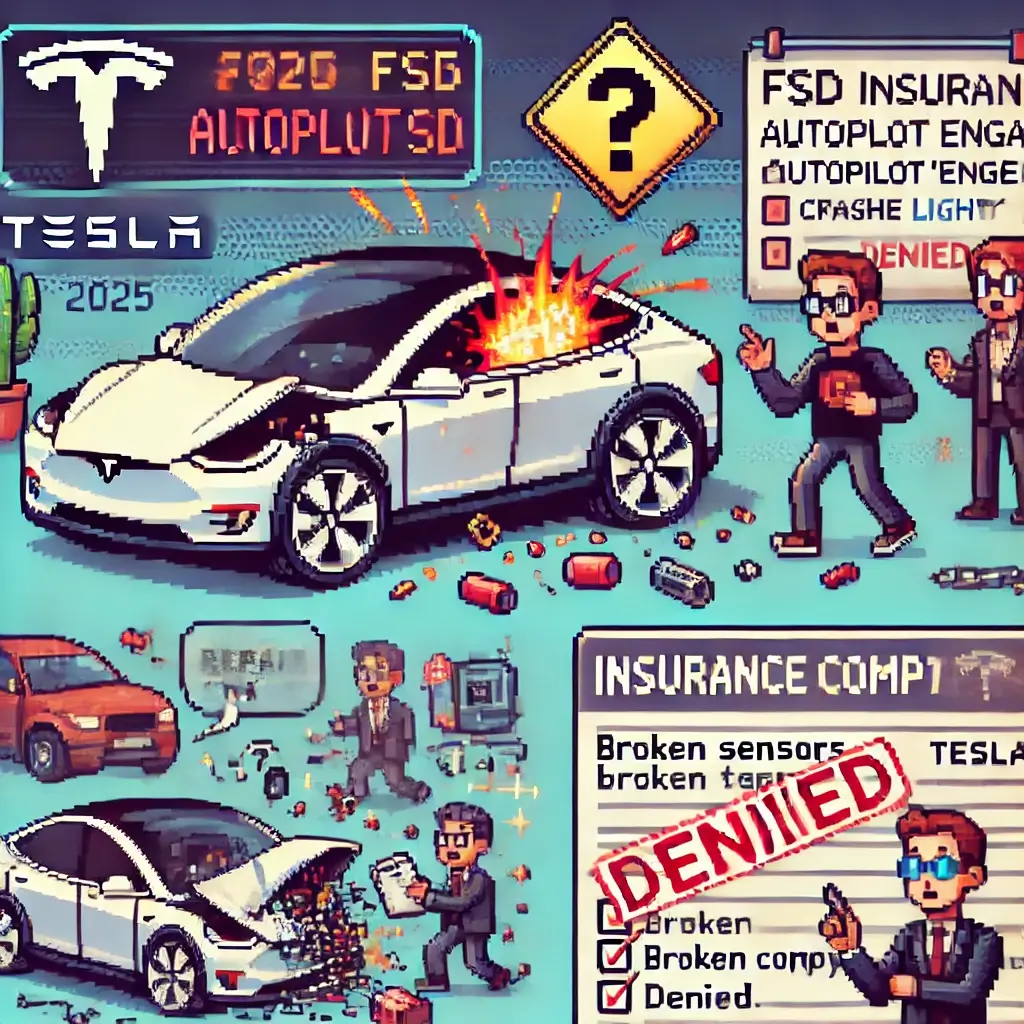
Driver vs System confusion creates disputes. Insurers push liability back to you even when FSD malfunctions.
Repair Exclusion Trap
Uncertified repairs can void coverage. Even minor DIY fixes may lead to denied claims worth thousands.
Data Black Box Trap
Every second is logged. Insurers interpret raw data against you, reducing payouts even if not at fault.
The Full Self-Driving Liability Trap
No discussion of Tesla accident liability insurance is complete without examining Full Self-Driving. Marketed as a technological leap toward autonomy, FSD inspires both awe and skepticism. Tesla enthusiasts hail it as the future of mobility. Critics view it as a beta experiment unleashed on public roads. Insurers, however, see something else entirely: a liability gray zone that allows them to minimize payouts.
Every FSD-related accident generates the same question: who was in control at the moment of impact? Tesla’s disclaimers are unequivocal—drivers must remain attentive with hands on the wheel. Insurers seize upon this as evidence that liability rests solely with the driver. Yet the reality is more complex. FSD can make unpredictable maneuvers—phantom braking, lane drift, abrupt accelerations—that no human could reasonably anticipate. Nevertheless, Tesla accident liability insurance contracts rarely recognize system error as grounds for coverage without a fight.
Consider the case of a driver in California whose Model Y veered into an adjacent lane while FSD was engaged in bumper-to-bumper traffic. Logs showed the driver’s hands were not detected for 15 seconds, even though video evidence suggested they were hovering above the wheel. The insurer denied full coverage, arguing “driver negligence.” The financial impact was staggering: $14,000 in repair costs, weeks of rental expenses, and a premium increase the following year. The driver’s belief in insurance as a safety net evaporated.
Another story from Florida involved phantom braking. The Tesla abruptly braked on a sunny afternoon, mistaking a shadow for an obstacle. The rear driver collided with the Tesla, yet the Tesla owner was partially blamed. Insurers pointed to the driver’s failure to disengage FSD in time, reducing liability coverage by 30%. These cases illustrate how Tesla accident liability insurance reframes system flaws as driver shortcomings, leaving policyholders vulnerable.
Psychologically, this trap wears down drivers. They invest in cutting-edge technology believing it will enhance safety, only to face suspicion and scrutiny in every claim. Legal experts warn that until liability frameworks evolve, Tesla drivers operate in a twilight zone where responsibility is absolute but control is partial. It is a paradox unique to Tesla accident liability insurance, and it shows no signs of resolving in 2025.
| Category | Traditional Insurance | Tesla Insurance 2025 |
|---|---|---|
| Accident Assessment | Police reports & eyewitness | Telemetry, FSD logs, black box data |
| Repairs | Any certified body shop | Tesla-certified facilities only |
| Premium Factors | Driver record & accident history | Real-time driving behavior logs |
The Repair Exclusion Trap
The second major trap lies not in futuristic autonomy but in mundane repairs. Traditional car owners often visit local body shops for minor fixes, confident that insurance will still cover future claims. Tesla owners do so at their peril. Tesla accident liability insurance policies typically mandate certified repairs at Tesla-approved facilities. Any deviation can void coverage, not just for the repair itself but for accidents linked to compromised systems.
Why such strictness? Because Tesla vehicles are not conventional machines. Sensors, cameras, and wiring permeate every component. A bumper is not merely plastic; it houses radar for adaptive cruise control. A side mirror is not simply reflective glass; it integrates a lane-monitoring camera. A windshield replacement is not just glasswork; it involves recalibrating autopilot cameras. Local body shops lack the proprietary software and training to handle these complexities. Even if the repair appears cosmetically sound, it may leave the digital brain of the car impaired.
Insurers exploit this reality. Contracts often state: “Coverage contingent upon use of manufacturer-certified facilities.” This means that if uncertified work contributes even indirectly to a future crash, liability coverage can be denied. Case studies abound. A Texas driver repaired a dented bumper at a neighborhood shop to avoid filing a claim. Weeks later, autopilot malfunctioned during a lane change, causing an accident. The insurer denied liability coverage, attributing the failure to the uncertified repair. The out-of-pocket cost exceeded $12,000. In Illinois, a Model 3 owner replaced a side mirror himself. The misaligned camera caused lane-keeping issues, leading to a highway collision. Again, coverage was denied.
These stories demonstrate how Tesla accident liability insurance punishes cost-saving decisions. The trap is psychological as well as financial. Owners believe they are being prudent by avoiding premium hikes, only to find themselves penalized with massive expenses. Even worse, attempts to conceal uncertified repairs usually backfire. Tesla’s diagnostic systems record irregularities, and service centers can flag improper work. When insurers access these records, they see an airtight case for denial.
The broader impact is economic. Tesla-certified repairs cost significantly more, limiting consumer choice and creating financial strain. Consumer advocates argue that this monopolistic ecosystem unfairly burdens drivers. Some states have introduced “Right to Repair” legislation, but insurers remain resistant. Until reforms take hold, the repair exclusion trap remains a central hazard of Tesla accident liability insurance.
Tesla Accident Insurance Claim Journey
- Step 1: Accident occurs → Driver files claim
- Step 2: Insurer requests Tesla FSD & black box logs
- Step 3: Logs analyzed for “driver negligence”
- Step 4: Coverage decision (Full / Partial / Denied)
The Data Black Box Trap
The third trap is the most invisible yet the most powerful: Tesla’s data black box. Every Tesla is equipped with an Event Data Recorder (EDR) that captures second-by-second logs of vehicle performance. These include speed, acceleration, braking force, steering angle, FSD engagement, and even seat belt usage. The intention is safety research, but in practice, this data becomes the insurer’s weapon of choice. Tesla accident liability insurance disputes increasingly revolve around data interpretation rather than eyewitness accounts.
Imagine being rear-ended at a stoplight. Common sense suggests you are not at fault. But the black box shows you stopped a fraction of a second later than expected. The insurer argues contributory negligence, reducing your payout. Or consider a collision where another driver clearly veered into your lane. Logs reveal you were driving six miles per hour over the limit. Again, insurers cite negligence, even though speeding did not cause the accident. These scenarios reveal the asymmetry of power: data is objective in form but subjective in interpretation. Insurers spin it to minimize liability.
Privacy concerns deepen the problem. Tesla asserts ownership of driving data, sharing it with insurers and authorities upon request. Policyholders often consent unknowingly through insurance contracts. This means every action behind the wheel is potentially evidence against you. The implications extend beyond single accidents. Driving behavior may affect future premiums, employment screenings, or unrelated lawsuits. Critics argue this creates a surveillance state on wheels. Tesla accident liability insurance becomes not just financial protection but also an instrument of control.
International comparisons highlight the urgency. In the European Union, the General Data Protection Regulation (GDPR) grants drivers greater control over their data. In the U.S., protections are fragmented, leaving drivers exposed. Until national standards emerge, insurers will continue to exploit the black box. Policyholders, lacking technical expertise, struggle to challenge interpretations. Independent experts exist but are costly, creating yet another barrier to fairness.
Tesla Insurance Loss Ratio
121%
Combined ratio (May 2025) :contentReference[oaicite:15]{index=15}
Average Tesla Repair Cost
$5,552
27% higher than average vehicle :contentReference[oaicite:16]{index=16}
10-Year Maintenance Cost (Tesla)
$4,035
Lowest among brands reported by CR :contentReference[oaicite:17]{index=17}
| Category | Tesla Model 3 | Overall Average |
|---|---|---|
| Annual Insurance Cost | $3,495 | $2,148 |
EV vs Gas Vehicle: Claim Likelihood
Petrol/Diesel Vehicles
Electric Vehicles (56% more likely) :contentReference[oaicite:18]{index=18}
Frequently Asked Questions
Q1: Can I refuse to share Tesla data with insurers?
In most cases, no. Insurance contracts usually require data sharing during disputes. Refusal can lead to claim denial. Only jurisdictions with explicit data ownership laws provide protection.
Q2: Is Tesla Insurance better than third-party providers?
Tesla Insurance uses real-time data for premiums, rewarding safe driving but penalizing mistakes. Third-party providers may lack direct access to logs but still exploit liability loopholes. Both present risks.
Q3: What steps protect me financially?
Always use certified repair shops. Review policies line by line. Document all service interactions. Consider legal protection plans. Drive defensively, knowing every action is logged.
Q4: How does Tesla accident liability insurance differ from traditional auto coverage?
Traditional coverage relies on eyewitness accounts and police reports. Tesla insurance disputes hinge on telemetry and digital logs, which insurers interpret to their advantage.
Q5: What role will regulation play?
Experts predict that by 2030, federal standards will clarify driver vs. system liability and data ownership. Until then, Tesla owners face uncertainty and risk.
Q6: Does “Right to Repair” legislation help Tesla owners?
Not yet. While some states push for broader repair rights, insurers still enforce certified repair requirements. Without reform, uncertified repairs remain a liability hazard.
Q7: Can Tesla data ever help drivers?
Yes. In rare cases, logs prove driver attentiveness or system malfunction. However, insurers often interpret ambiguous data unfavorably. Independent experts may be needed to leverage it effectively.
Q8: Do other EVs face similar traps?
Yes, but Tesla is the most prominent example due to FSD and its proprietary repair ecosystem. Other EVs may eventually present similar insurance challenges.
Q9: How should I prepare before buying a Tesla?
Budget for higher repair costs at certified facilities. Research insurance providers thoroughly. Ask detailed questions about FSD, repair, and data clauses before signing.
Q10: What’s the single biggest mistake Tesla owners make?
Assuming insurance works the same way it did with conventional cars. Tesla accident liability insurance is a different beast entirely, and ignorance is costly.
Final Thoughts
Tesla accident liability insurance in 2025 is riddled with traps. The Full Self-Driving liability conundrum forces drivers to shoulder responsibility for system errors. The repair exclusion trap punishes uncertified fixes, no matter how minor. The data black box trap transforms every second of driving into potential evidence against the policyholder. Together, these factors create an environment where insurers hold disproportionate power and drivers face financial and psychological strain.
The path forward requires vigilance. Drivers must scrutinize policies, use certified repairs, and recognize the surveillance embedded in their vehicles. Consumer advocates push for reform, but until laws evolve, the burden falls on individuals. Awareness is the strongest defense. Tesla’s innovation is undeniable, but so are the risks hidden within its insurance ecosystem. By confronting these realities head-on, drivers can better navigate the paradox of owning one of the world’s most advanced cars while contending with one of the most unforgiving insurance landscapes.
Keywords: Tesla accident liability insurance, Tesla insurance 2025, FSD liability, Tesla repair exclusions, EV insurance loopholes
🔗 EV Drag Racing Posted 2025-08-22 06:31 UTC 🔗 Tesla Urban Ecosystems Data Traffic Posted 2025-08-21 08:05 UTC 🔗 Weather Range Drop Posted 2025-08-20 05:35 UTC 🔗 EV Charging Solutions Posted 2025-08-19 11:32 UTC 🔗 7 EV Road Trip Hacks Posted 2025-08-19 00:00 UTC