7 EV Road Trip Hacks That Will Change How You Travel Forever
Let’s talk about something real.
Something that keeps a lot of people from making the leap into electric vehicles.
It’s a monster we call range anxiety.
That little voice in the back of your head that whispers, “What if I can’t find a charger?”
Or “What if I get stuck in the middle of nowhere with a dead battery?”
I get it.
I’ve been there.
I remember my first real long-distance trip in an EV, a 500-mile journey from L.A. to San Francisco.
My hands were glued to the wheel at 10 and 2, my eyes darting between the road and the dreaded “miles remaining” number on the dash.
Every mile felt like a precious commodity.
Every hill climb felt like a crime against my battery.
But after a few trips, something incredible happened.
The anxiety faded.
It was replaced by a sense of calm, confidence, and even, dare I say, joy.
I realized that range anxiety isn’t a technical problem—it’s a psychological one.
And like any psychological hurdle, you can absolutely overcome it.
You just need the right tools, the right mindset, and a little bit of know-how.
In this guide, I’m going to share some of the most powerful strategies I’ve learned to conquer the fear of running out of juice.
We’ll break down the practical steps, the apps, the little habits, and the big-picture thinking that will turn your next long-distance EV trip from a source of stress into a fantastic adventure.
By the time we’re done, you’ll be a pro at this.
So, let’s get into it.
Table of Contents
The Anatomy of Range Anxiety: Why It’s All in Your Head
Before we get to the how-to, let’s quickly acknowledge the elephant in the room.
Why do we feel this way?
For decades, we’ve been conditioned to think about refueling in a specific way.
Pull up, fill up in five minutes, and you’re good for another 300-400 miles.
It’s a habit ingrained in our driving DNA.
With an EV, that paradigm shifts.
Instead of a quick pit stop, you’re planning your charging around your lunch, your coffee break, or an overnight stay.
And that change, that loss of a familiar routine, is what triggers the anxiety.
But here’s the beautiful truth: a 2024 study showed that nearly 60% of experienced EV drivers have little to no range anxiety.
It’s not that the technology gets magically better for them; it’s that they’ve built a new kind of muscle memory.
They’ve swapped out the old “find a gas station” routine for a new, more efficient one.
And you can, too.
The key is to replace the unknown with a solid plan.
And that starts long before you even get in the car.
Pre-Trip Planning: Your Secret Weapon Against Anxiety
This is the single most important step.
A little planning goes a very, very long way.
Think of yourself as a pilot, not just a driver.
A pilot wouldn’t take off without a flight plan, would they?
Neither should you.
1. The Power of “A Better Routeplanner” (ABRP)
First and foremost, you need a great trip-planning app.
There are a bunch of them out there, but I’ve found one that rises above the rest for long trips: A Better Routeplanner (ABRP).
It’s not just a map; it’s a co-pilot that knows your car better than you do.
You plug in your exact car model, your starting battery percentage, your desired arrival percentage, and even things like how much luggage you’re carrying or if you’ll be using the AC.
It then crunches all the data—elevation changes, weather, and charging station availability—and gives you a complete, turn-by-turn plan, including exactly where and how long to charge.
It’s like a crystal ball for your trip.
It takes all the guesswork out of the equation.
You’ll see exactly how many stops you need and for how long.
You’ll feel a palpable shift in your mindset, from “I hope I make it” to “I know I’ll make it.”
For a deep dive into how to use ABRP, check out their website.
2. The 80/20 Rule of Charging
This is a game-changer that most new EV drivers don’t realize.
When you’re at a DC fast charger, the charging speed isn’t linear.
It’s a curve.
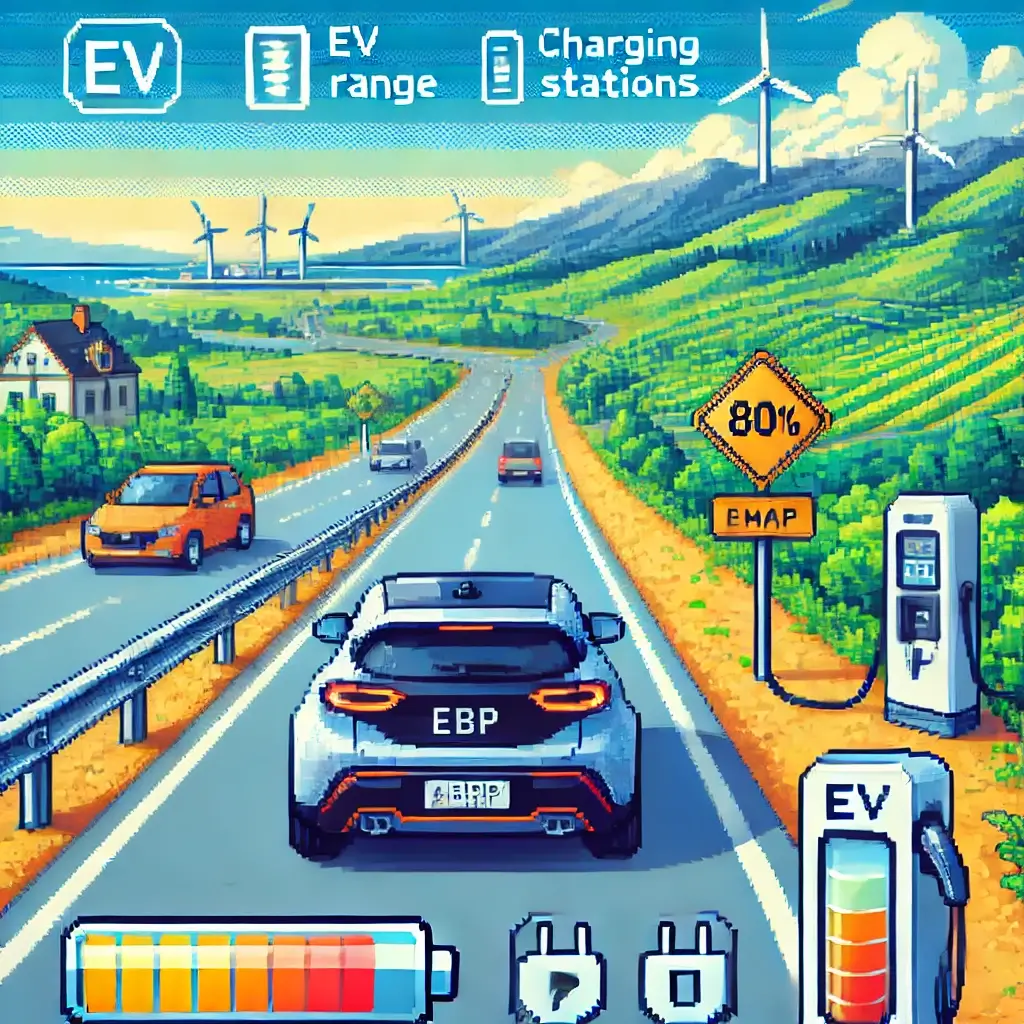
Your car charges incredibly fast from 10% to about 80%—it’s like a fire hose.
But after 80%, the speed slows down to a trickle to protect the battery.
It’s like trying to fill a water balloon once it’s almost full.
So, on a long trip, don’t wait for your battery to hit 10% before you charge.
And don’t try to charge to 100%.
Your best bet is to plan your stops around the 20-80% window.
It’s far more efficient to make two 20-minute stops (topping up from 20% to 80%) than one long 45-minute stop where you spend the last half-hour twiddling your thumbs waiting for the final 20% to trickle in.
Trust me, this one trick alone will save you so much time and frustration.
Real-Time EV Management: Driving Smarter, Not Harder
Now that you have your plan, let’s talk about what happens on the road.
The way you drive can have a huge impact on your real-world range.
This isn’t about being a hypermiler or a slowpoke.
It’s about being smart and efficient.
3. The Art of Regenerative Braking
This is probably the coolest feature of an EV.
Unlike a gas car, which wastes energy as heat when you brake, an EV turns that braking energy back into electricity to recharge the battery.
It’s a little like riding a bike downhill and having the pedals generate power for your lights.
The key is to anticipate stops.
When you see a red light ahead, a slowing car, or an upcoming off-ramp, ease off the accelerator early.
Let the car coast and the regenerative braking do its magic.
You’ll be amazed at how much range you can add back by simply being a smooth and anticipatory driver.
4. The Goldilocks of Speed
We all love the instant torque of an EV, but remember: the faster you go, the more energy you use.
It’s simple physics.
Wind resistance becomes a significant factor at highway speeds.
Driving at 70 mph vs. 75 mph might not seem like a big difference, but it can easily cost you 10-15% of your range on a long trip.
I’m not saying you have to drive in the slow lane.
Just find the “Goldilocks” speed—the sweet spot where you’re not going too slow to annoy other drivers, but not so fast that you’re bleeding energy.
Usually, this is right around the speed limit.
Use cruise control when you can to maintain a consistent speed.
The Charging Game: Know Your Levels, Know Your Lingo
If you’ve ever pulled up to a charger and felt confused by the different plugs, power levels, and networks, you’re not alone.
Let’s demystify it.
There are three main types of chargers you’ll encounter.
Level 1 Charger
Uses a standard 120V household outlet.
Level 2 Charger
Uses a 240V outlet, often found at homes, hotels, and public places.
Level 3 (DC Fast Charger)
The “gas station” of the EV world. Found along highways and major routes.
5. The “Charge While You Eat” Strategy
This is the golden rule of long-distance EV travel.
Don’t plan to sit around waiting for your car to charge.
Plan your charging stops to coincide with your breaks.
Need to stretch your legs and grab a coffee?
Find a charging station at a cafe.
Hungry for lunch?
Look for a charger at a shopping center or a restaurant.
By the time you’re done with your meal, your car will have soaked up enough juice to get you well on your way.
It transforms the “waiting” part of charging into a productive and relaxing part of your trip.
Unlocking the Best EV Apps: My Top 3 for Road Trips
Beyond the trip planner, you need some solid, real-time apps.
These are my personal go-to’s.
1. PlugShare: The Wikipedia of Charging
PlugShare is a must-have.
It’s a crowdsourced map of pretty much every charger on the planet.
What makes it invaluable are the user comments.
People report if a charger is broken, if there’s a line, or if the station is in a great spot with good food nearby.
It’s like having a million co-pilots telling you the real deal about every station you approach.
2. ChargePoint/EVgo/Electrify America: The Network Apps
It’s a good idea to have the apps for the major charging networks downloaded and set up with your payment info before you go.
Sometimes you’ll find a charger that requires its network’s app to activate.
Think of it like being a member of a club.
Having the apps for the major players—like ChargePoint, EVgo, and Electrify America—on your phone will save you from a lot of potential headaches.
They also give you real-time status updates on chargers, so you know if they’re available before you even get there.
Unexpected Challenges: What to Do When Things Go Wrong
Even with the best plan, things can happen.
A charger might be out of service.
There might be a line.
A rogue gust of wind might slash your range.
Don’t panic.
This is where your calm mindset comes in.
1. The Buffer Zone
Always, always, always plan to arrive at a charger with a buffer.
Don’t try to arrive with 2% battery left.
Aim for 10-15%.
That buffer is your safety net, your insurance policy against the unexpected.
It gives you the peace of mind to drive a little further to the next charger if the first one is busy or broken.
2. The Level 2 Lifeline
If the fast chargers are a bust, don’t forget about the slower, but far more common, Level 2 chargers.
They might be at a hotel, a library, or a public parking garage.
It might not be as fast, but it’s a surefire way to get enough range to make it to the next fast charger without stress.
Sometimes, a little detour to a Level 2 spot for a quick top-up can save the day.
The Human Element: Making It an Adventure
This might sound cheesy, but hear me out.
Embrace the new rhythm of EV travel.
It’s not about racing to the finish line.
It’s about the journey.
My family now looks forward to our charging stops.
It’s an excuse to discover a new small town, try a local coffee shop, or just stretch our legs at a park.
It has forced us to slow down, to be more present, and to see parts of the world we would have just zipped past in a gas car.
So, next time you feel that little pang of range anxiety, take a deep breath.
You have the tools.
You have the plan.
You are an EV road trip pro.
Now go drive and enjoy the adventure.
Electric vehicles, Range anxiety, EV road trip, Charging stations, A Better Routeplanner
🔗 Tesla Model Y Accessories Posted 2025-08-18 06:27 UTC 🔗 Tesla Autopilot Hardware Posted 2025-08-17 04:25 UTC 🔗 Raw Materials Powering an EV Posted 2025-08-16 08:27 UTC 🔗 Tesla Showdown: Lease vs Buy Posted 2025-08-15 06:28 UTC 🔗 Tesla Service Center Visit Posted (no date provided) 🔗 7 Insane Tesla Model Y Accessories Posted 2025-08 (Blogspot)