
5 Radical Lessons from Tesla’s Innovation Culture That Will Explode Your Startup’s Growth!
Alright, let’s talk about Tesla. Not the cars, not the rockets, but the crazy, audacious culture that makes it all happen.
As a founder, you’re constantly told to “innovate” and “disrupt,” but what does that really mean?
It’s easy to get bogged down in endless meetings and bureaucratic red tape, the very things that kill innovation.
I’ve been there, staring at a whiteboard filled with ideas that never see the light of day.
It’s frustrating, right?
That’s why we need to look at companies that do it differently—companies like Tesla.
They’ve cracked the code on moving at an almost inhuman pace.
Their innovation culture isn’t just a buzzword; it’s a living, breathing machine that delivers.
And guess what?
You don’t need billions of dollars or a charismatic CEO to learn from them.
You just need to be willing to challenge the status quo, and I mean *really* challenge it.
So, let’s dive into 5 critical lessons from **Tesla’s innovation culture** that you can steal and apply to your own tech startup today.
Table of Contents
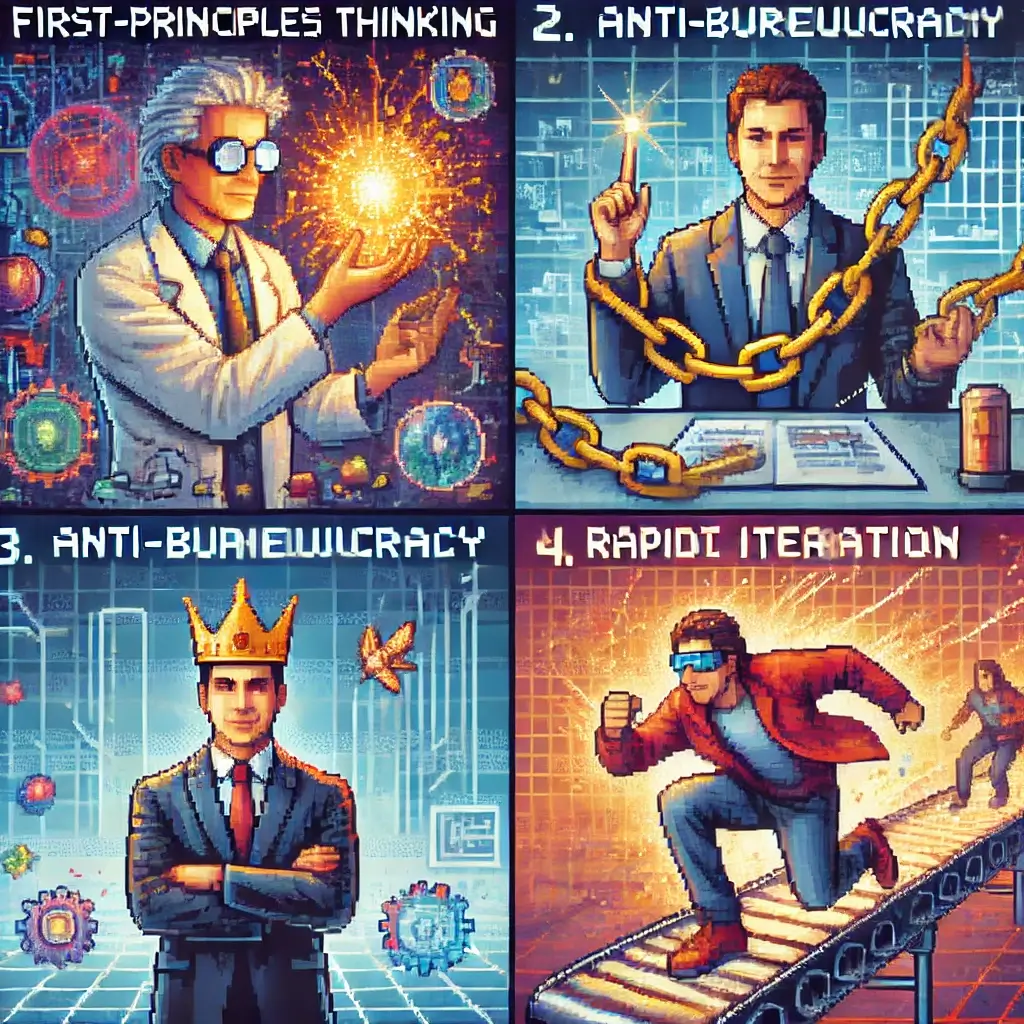
- Lesson 1: The First-Principles Mindset: Deconstruct the Impossible
- Lesson 2: The “Don’t Be Stupid” Rule: Kill the Bureaucracy
- Lesson 3: The Importance of a “Technoking”: Lead with Technical Excellence
- Lesson 4: The Speed of a Sprint: Iterate at an Insane Pace
- Lesson 5: The “Hardcore” Engineering Culture: It’s All About the Product
Lesson 1: The First-Principles Mindset: Deconstruct the Impossible
Ever find yourself saying, “That’s just how it’s always been done”?
Yeah, me too.
It’s the silent killer of innovation, a thought process that traps you in a box built by everyone else’s limitations.
Tesla, and specifically Elon Musk, is famous for the **first-principles mindset**.
Instead of thinking by analogy—”How do we make our car battery like every other car battery?”—they ask, “What are the fundamental, irreducible truths about a car battery?”
They break the problem down to its most basic elements: raw materials, chemistry, thermodynamics.
This isn’t just an abstract concept; it’s a practical tool.
For example, when they were trying to figure out the cost of a rocket, they didn’t look at the market price of rockets.
They looked at the raw materials—the aluminum alloys, the copper, the carbon fiber—and calculated the true cost of building it from scratch.
It’s like being a kid again, asking “why?” over and over until you get to the core truth.
As a startup founder, you can apply this to your own business right now.
Don’t just accept the industry standard for your product’s pricing or manufacturing process.
Break it down.
What is the absolute, most basic truth about what you’re building?
What are the fundamental components, the core value, the raw ingredients?
This mental model can unlock solutions that your competitors, stuck in their analogical thinking, will never even see.
It’s about seeing the world not as it is, but as it could be, stripped of all assumptions.
It’s terrifying and exhilarating all at once.
I remember a time when my team was trying to solve a user onboarding problem.
Everyone was suggesting typical solutions: a tutorial video, a better FAQ, a popup tour.
All good ideas, but they were just variations of what everyone else was doing.
I finally asked, “What is the *fundamental* reason our users are getting stuck?”
We realized it wasn’t about a lack of information; it was about the psychological barrier of an empty screen.
By starting from that first principle, we designed a simple, elegant solution that pre-filled some data, making the first step feel effortless.
The result? Our conversion rate jumped by 30%.
That’s the power of this mindset.
It’s not about being smarter than everyone else; it’s about asking better questions.
It’s about being a scientist, not a copycat.
So, challenge your team to adopt this.
Every time someone proposes a solution, ask them to break it down to its core components.
You’ll be amazed at what they come up with.
It’s a game-changer.
For a deeper dive into this, check out this great article from the **Harvard Business Review** on the topic of first-principles thinking:
Lesson 2: The “Don’t Be Stupid” Rule: Kill the Bureaucracy
Ah, bureaucracy.
The corporate equivalent of a black hole, sucking the life and energy out of every innovative idea.
Tesla has a legendary “Don’t Be Stupid” rule, and it’s brutally simple.
Elon Musk famously sent an email to all employees, a mantra that basically said, if a rule is getting in the way of progress, just ignore it.
He explicitly told employees to use “common sense” and “assume the rule is dumb” if it’s slowing them down.
Now, this sounds chaotic, right?
Like a recipe for disaster.
But when you’re a small startup, moving with urgency is your most powerful asset.
You don’t have the luxury of a 10-person committee to approve a simple feature change.
You need to move fast, break things, and course-correct on the fly.
Think about your own startup.
How many meetings could have been an email?
How many approvals are needed for a small decision that an individual could make?
Are your engineers spending more time updating status reports than they are writing code?
These are the little demons of bureaucracy that creep in and strangle your growth.
Tesla’s culture is a masterclass in radical decentralization of decision-making.
Engineers are empowered to make decisions on the factory floor.
They aren’t waiting for a VP to sign off on a minor process change; they are solving problems in real-time.
This kind of empowerment fosters a sense of ownership and urgency that you simply can’t get in a rigid, hierarchical structure.
It’s about trusting your team.
It’s about hiring smart, capable people and then getting out of their way.
I remember a project where we had a bug that was driving our users crazy.
My team spent an entire day just trying to figure out who had the authority to fix it.
A single line of code was all it took, but the bureaucratic hoops we had to jump through turned a 10-minute fix into a 24-hour ordeal.
It was a humiliating, frustrating experience that taught me a valuable lesson: bureaucracy is the enemy of progress.
So, here’s your action item: go through your team’s processes.
Find one bureaucratic hurdle—a meeting, an approval process, a reporting requirement—and eliminate it.
Just one.
See what happens.
I bet your team will thank you for it, and your speed will increase dramatically.
This isn’t about chaos; it’s about disciplined freedom.
It’s about creating a system where smart people can be smart without permission.
For more on how to cut through corporate red tape, check out this excellent resource from **McKinsey & Company**:
Lesson 3: The Importance of a “Technoking”: Lead with Technical Excellence
Let’s be real: Elon Musk is a polarizing figure.
But you can’t deny his technical depth.
He’s not just a CEO in the traditional sense, sitting in a boardroom all day.
He’s a “Technoking”—a title he actually gave himself.
Whether you like the title or not, the message is clear: he leads from a place of deep technical understanding.
He knows the nuts and bolts of the rockets, the intricacies of the battery packs, the details of the manufacturing process.
This isn’t just for show.
When a leader understands the technical challenges, they can make better, faster decisions.
They can challenge assumptions from a place of knowledge, not just authority.
And most importantly, they earn the respect of their technical teams.
In a tech startup, your product is your lifeblood.
Your team, especially your engineers and product managers, needs to know that you are in the trenches with them.
They need to see that you understand the difference between a bug and a feature, the complexity of a database migration, and the elegance of a well-written line of code.
This doesn’t mean you have to be the best coder or the best designer on your team.
But you need to be technically competent enough to ask the right questions, to sniff out bullshit, and to truly appreciate the hard work of your team.
I remember one of my early mentors, a founder who could get on a call with any engineer and immediately understand the technical limitations and opportunities they were facing.
He wasn’t a master coder, but he spoke their language.
His team would walk through fire for him because they knew he respected their craft and understood their struggles.
That kind of leadership is invaluable in a startup where you’re building something from nothing.
So, if you’re a founder or a leader, take some time to get your hands dirty.
Learn a new programming language, shadow your engineers, or sit in on a design review and actually try to understand the decisions being made.
You’ll not only make better decisions but also build a culture of trust and respect that is crucial for a high-performing technical team.
It’s about being a leader who leads with knowledge, not just a title.
To learn more about the importance of technical leadership, check out this great piece from **Fast Company** on the subject:
Lesson 4: The Speed of a Sprint: Iterate at an Insane Pace
This is where many startups stumble.
They get a product to market, and then they slow down.
They start to get comfortable, and comfort is the enemy of innovation.
Tesla, on the other hand, operates at an insane, almost terrifying pace of iteration.
Look at their cars. They are constantly pushing out over-the-air software updates.
They don’t wait for the next model year to fix a bug or add a new feature.
They deploy it to millions of cars overnight.
This culture of constant, rapid iteration is a cornerstone of their success.
It’s a mentality that says, “Don’t aim for perfection; aim for progress.”
Get a feature out, get feedback, and then make it better.
It’s the opposite of the traditional, waterfall development model that many companies still cling to.
For your startup, this means embracing a culture of shipping early and often.
Don’t spend months or years in a dark room building the “perfect” product.
Build a Minimum Viable Product (MVP), get it into the hands of your users, and learn from them.
Your users are your best quality assurance team and your most valuable source of product ideas.
I remember a time my team was building a new feature that we thought was revolutionary.
We spent six months building it, adding every bell and whistle we could think of.
When we finally launched it, the reception was… underwhelming.
It was too complex, too feature-rich, and it didn’t solve the simple problem our users actually had.
It was a painful lesson in the value of speed and simplicity.
We could have built a basic version in a month, gotten feedback, and then built the right thing.
So, challenge your team to shorten their development cycles.
Cut your sprints in half.
Push for daily deployments if you can.
The goal is to create a rhythm of constant forward momentum, a sense of urgency that keeps everyone on their toes.
It’s better to have a good product that is constantly getting better than a perfect product that never ships.
To understand more about this rapid iteration process, here’s a great article from **Y Combinator** on the importance of speed for startups:
Lesson 5: The “Hardcore” Engineering Culture: It’s All About the Product
Finally, let’s talk about what all of this is in service of: the product itself.
Tesla has a reputation for being a “hardcore” engineering company.
What does that mean?
It means that the product is the hero, and everything else is secondary.
There’s a laser-like focus on building the best possible thing, not on endless meetings about strategy or presentations about market share.
They’re a company of builders, and that’s a culture that every tech startup should aspire to.
In many companies, the most respected people are the managers, the VPs, the ones who talk a good game in the boardroom.
In a hardcore engineering culture, the people who actually build the product are the rock stars.
The engineers who write the most elegant code, the designers who create the most intuitive user interfaces, the product managers who truly understand the user’s needs—these are the people who are celebrated.
This creates a virtuous cycle.
When you put the product first and celebrate the people who build it, you attract the best talent.
When you have the best talent, you build better products.
And when you build better products, you win in the marketplace.
I’ve worked at companies where engineers were seen as a “cost center,” just a resource to be managed.
The result was a demoralized team, a high turnover rate, and a mediocre product.
Then I worked at a company where the best engineers were treated like celebrities.
They were given the freedom to solve hard problems, and their work was celebrated publicly.
The energy in that second company was palpable.
People stayed late not because they were forced to, but because they were passionate about what they were building.
So, as a startup founder, you need to create this culture.
Make sure your engineers feel like the most important people in the room, because in a tech startup, they are.
Give them the tools, the freedom, and the credit they deserve.
Celebrate their achievements, not just in terms of business metrics, but in terms of technical excellence.
This focus on the craft of building is the ultimate lesson from **Tesla’s innovation culture**.
It’s not about the hype; it’s about the substance.
It’s about building a better future, one line of code, one elegant design, one insane risk at a time.
In conclusion, building an innovative culture isn’t about flashy slogans or foosball tables.
It’s about the deep, fundamental principles that govern how your team thinks, works, and builds.
Tesla’s model might be intense, but its core lessons—first-principles thinking, ruthless efficiency, technical leadership, rapid iteration, and a product-first mentality—are universally applicable.
They are a roadmap for any tech startup that wants to stop just talking about innovation and start living it.
Now, go forth and build something amazing.
Tesla innovation culture, tech startups, first-principles thinking, rapid iteration, technical leadership