50 States, 1 Wild Ride: Unpacking Tesla’s Autonomous Driving Laws!
Alright, buckle up, fellow Tesla enthusiasts and future-forward drivers!
Let’s talk about something that keeps me up at night, something that’s as thrilling as a Ludicrous Mode launch and as complex as explaining cryptocurrency to your grandma: the ever-evolving legal maze of autonomous driving.
Specifically, how it impacts us, the proud owners of Teslas, across the glorious 50 states of America.
It’s not just about knowing if your car can drive itself; it’s about understanding if the law agrees with your car’s capabilities.
Trust me, this isn’t some dry legal textbook; think of it more like your friendly, slightly-obsessed neighbor (that’s me!) breaking down the latest gossip from the legislative highways.
We’re on the cusp of a transportation revolution, and with great power (like a car that drives itself) comes great responsibility (like knowing what you can and can’t do with it).
So, let’s dive deep, shall we?
—
Table of Contents
- Introduction: The Wild West of Autonomous Driving Laws
- Understanding the Levels of Autonomy: It’s Not All Self-Driving!
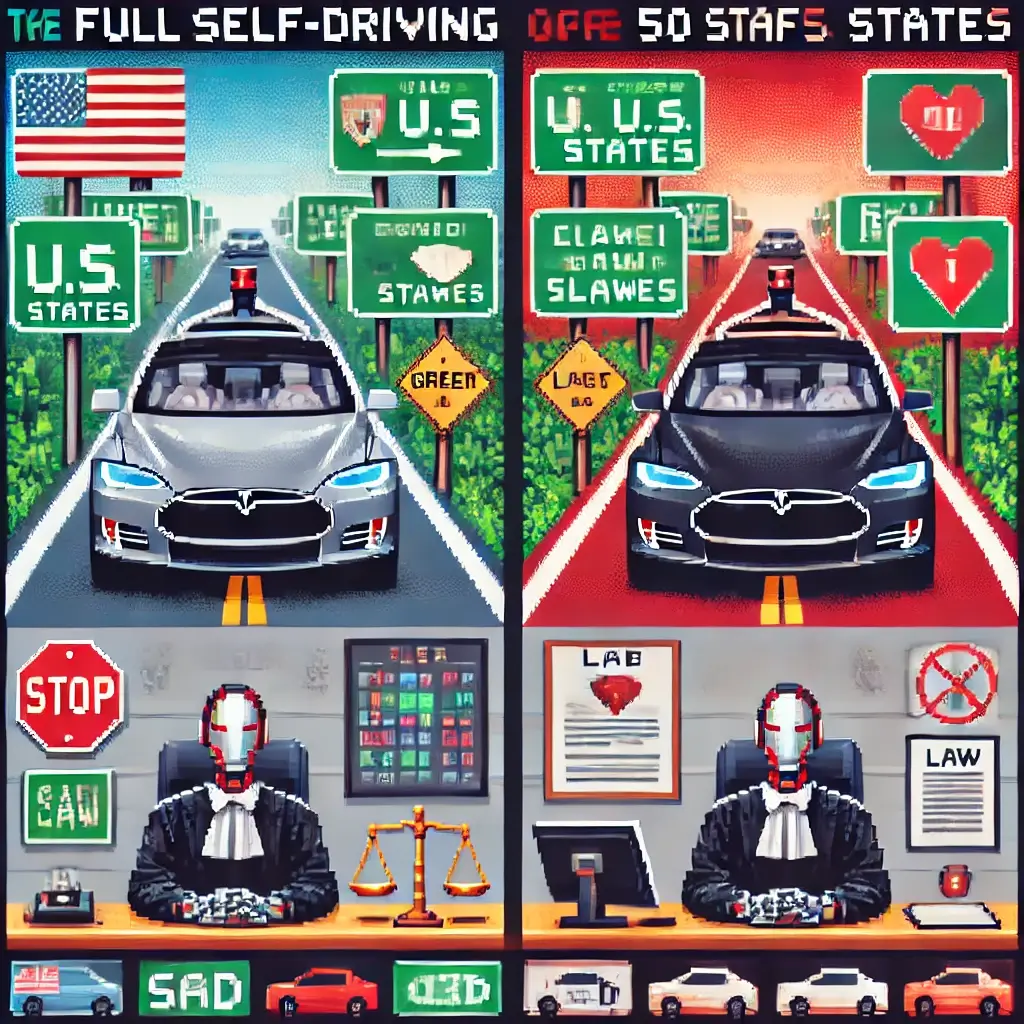
- The Patchwork Problem: Why 50 States Mean 50 Different Rules
- Who’s to Blame? Navigating Liability in an Autonomous World
- Tesla’s Full Self-Driving (FSD): What It Really Means Legally
- A State-by-State Snapshot: Where Can You Truly Unleash FSD?
- The Road Ahead: Challenges and Opportunities
- My Crystal Ball Moment: What Does the Future Hold?
- Final Thoughts: Drive Smart, Drive Informed
—
Introduction: The Wild West of Autonomous Driving Laws
Imagine this: you’re cruising down the highway, your Tesla effortlessly handling traffic, perhaps even navigating a tricky interchange.
It feels like science fiction, right?
But for many of us, it’s just another Tuesday.
Yet, beneath that smooth, silent ride lies a tangled web of regulations, laws, and interpretations that vary wildly from one state line to the next.
It’s truly the Wild West out there, with each state staking its claim on how autonomous vehicles (AVs) can operate.
And let’s be honest, it can be downright confusing.
One minute, your car is a technological marvel, legally permitted to assist you in one way, and the next, you cross a state border, and suddenly, those same features might be viewed through a different legal lens.
As a Tesla owner, you’re not just buying a car; you’re buying into a vision of the future.
But that vision comes with some homework – understanding the legal landscape.
My goal today is to cut through the jargon, offer some real-world insights, and give you the lowdown on what you absolutely need to know to stay on the right side of the law, and more importantly, stay safe.
—
Understanding the Levels of Autonomy: It’s Not All Self-Driving!
Before we dive into the nitty-gritty of state laws, let’s clear up a common misconception: not all “self-driving” is created equal.
When someone says their car drives itself, they might be talking about something vastly different from what you’re imagining.
The Society of Automotive Engineers (SAE) has a pretty universally accepted scale, from Level 0 to Level 5, that helps define just how autonomous a vehicle is.
Think of it like the difference between a really good cruise control system and a car that can literally drop you off at the airport and go park itself.
Most of us, even with Tesla’s “Full Self-Driving” (FSD) beta, are operating in the Level 2 to Level 3 range.
Level 2, or “Partial Driving Automation,” means the car can handle steering and acceleration/deceleration simultaneously, but you, the human driver, are still firmly in charge and responsible for monitoring the environment and taking over at any moment.
This is where Tesla’s Autopilot and FSD beta largely reside right now, despite the marketing name.
Level 3, “Conditional Driving Automation,” is where things get a bit more interesting.
Here, the car can handle most driving tasks under specific conditions, and the human driver is *not* expected to constantly monitor the environment.
However, you still need to be ready to intervene when the system requests it.
This is a big jump because it shifts some of the monitoring responsibility to the car.
Beyond that, Level 4 is “High Driving Automation” – the car can operate autonomously within a defined area or “geofence” and can handle all driving tasks, even if the driver doesn’t respond to a takeover request.
And finally, Level 5, “Full Driving Automation,” is the holy grail: the car can drive itself anywhere, anytime, under all conditions, with no human intervention needed.
No steering wheel, no pedals, just passengers.
Understanding these distinctions is absolutely crucial because state laws are often drafted with these levels in mind.
What’s legal for a Level 2 system might be completely different for a Level 4 system.
It’s like having a driver’s license for a moped versus a commercial truck – very different rules for very different capabilities.
—
The Patchwork Problem: Why 50 States Mean 50 Different Rules
Here’s where the rubber meets the road, or rather, where the autonomous car meets the state line.
Unlike, say, federal emissions standards for cars, there’s no single, overarching federal law governing autonomous vehicles in the US.
Instead, each of the 50 states (and even some municipalities) is busy drafting and enacting its own legislation.
It’s a true legislative “patchwork,” and honestly, it can feel like trying to solve a Rubik’s Cube blindfolded.
One state might have a comprehensive framework, actively encouraging AV testing and deployment, while its neighbor might have very limited laws or even implicit restrictions.
This decentralized approach has its pros and cons.
On the one hand, it allows states to innovate and tailor laws to their specific needs and technological comfort levels.
States like California, Arizona, and Florida have been trailblazers, creating environments that attract AV developers and testers.
On the other hand, for a company like Tesla, or for us, the drivers who might travel across state lines, this variability is a massive headache.
What’s permitted in Nevada might be a grey area in Texas and outright prohibited in New York.
This inconsistency creates legal uncertainty, makes it harder for manufacturers to deploy features uniformly, and places the burden of understanding these nuances squarely on the driver.
It’s like trying to play a board game where every player has their own rulebook.
Confusing, right?
This is why staying informed isn’t just a good idea; it’s a necessity for any Tesla owner venturing beyond their home state.
—
Who’s to Blame? Navigating Liability in an Autonomous World
Ah, the million-dollar question (or perhaps, multi-million-dollar question in a serious accident): when an autonomous vehicle is involved in a crash, who’s ultimately responsible?
This is where the legal system really grapples with the new reality of self-driving tech.
Traditionally, in a car accident, fault is usually assigned to a human driver based on negligence.
But what happens when the “driver” is a computer program?
The current legal framework is trying to catch up, but it’s a slow and often frustrating process.
In the context of Level 2 systems like Tesla’s FSD beta, the consensus is still largely on the human driver.
Why?
Because even with FSD engaged, you are still required to be attentive, to keep your hands on the wheel (or at least be ready to take over instantly), and to be responsible for the operation of the vehicle.
If you’re scrolling through TikTok or taking a nap, and your Tesla gets into an accident, you’re likely on the hook.
This is a critical point that many new Tesla owners, dazzled by the tech, often misunderstand.
It’s not truly “self-driving” in the sense that you can abdicate all responsibility.
However, as we move towards higher levels of autonomy (Level 3 and beyond), the legal landscape of liability begins to shift towards the manufacturer.
If a Level 3 vehicle makes a mistake while operating within its defined parameters, and the human driver was following all instructions, then the manufacturer’s liability starts to come into play, often under product liability laws.
Think of it like a defective product: if a washing machine catches fire due to a manufacturing defect, the manufacturer is liable.
The same principle is beginning to be applied to AVs.
Some states are even beginning to explore specific legislation to address AV liability, but it’s a slow burn.
Insurance companies are also scrambling to adapt, trying to figure out how to assess risk and what new policies are needed for an autonomous future.
The bottom line for now: with a Tesla, *you* are still the primary driver, legally speaking.
Don’t let the “Full Self-Driving” moniker fool you into thinking otherwise.
Your hands need to be ready, and your eyes need to be on the road.
—
Tesla’s Full Self-Driving (FSD): What It Really Means Legally
Ah, Tesla’s Full Self-Driving (FSD).
It’s the feature that gets all the headlines, sparks endless debates, and is often misunderstood.
Let’s be brutally honest here: despite the name, **Tesla FSD is not yet full self-driving in the legal or SAE Level 5 sense.**
It’s a sophisticated Level 2 advanced driver-assistance system (ADAS) that requires constant human supervision.
Think of it as a super-smart co-pilot, not a replacement for you.
Legally, this distinction is paramount.
When you engage FSD, whether it’s navigating city streets, making unprotected left turns, or changing lanes on the highway, you are still considered the driver.
You are responsible for monitoring the system, being ready to intervene at a moment’s notice, and ultimately ensuring the safe operation of the vehicle.
Tesla itself is very clear about this in its disclaimers, even if the marketing can sometimes lead to confusion.
The company explicitly states that FSD requires an “attentive driver” and “does not make the vehicle autonomous.”
This is not just boilerplate language; it’s a legal shield.
If an accident occurs while FSD is engaged and it’s determined that you were not attentive or failed to intervene when necessary, liability will almost certainly fall on you.
Regulators, particularly the National Highway Traffic Safety Administration (NHTSA), are closely scrutinizing Tesla’s FSD and its implications for safety.
They’ve launched investigations into certain incidents, reinforcing the message that even with FSD, the human driver remains the primary operator and responsible party.
So, while FSD offers incredible convenience and a glimpse into the future, never forget that you’re still in the driver’s seat, legally and practically speaking.
Treat it as a powerful tool, not a magical solution that absolves you of your driving duties.
—
A State-by-State Snapshot: Where Can You Truly Unleash FSD?
Alright, let’s get down to brass tacks: where can you really push the boundaries of Tesla’s FSD, and where should you be extra cautious?
Remember, the legal landscape is constantly shifting, so consider this a general guide rather than definitive legal advice (always consult local laws!).
As of mid-2025, most states have laws that either explicitly permit or don’t explicitly prohibit the operation of SAE Level 2 systems like Tesla FSD, provided a human driver remains fully engaged and responsible.
However, some states are far more progressive, while others remain hesitant.
### The Trailblazers: States Embracing Autonomous Tech
These states have generally comprehensive legal frameworks that support the testing and deployment of AVs, including Level 2 and higher systems.
They often have specific regulations for testing permits, insurance, and even some liability considerations.
California: A hotbed for AV development, California has robust regulations for testing and deployment, overseen by the DMV.
They require permits for truly autonomous testing (Level 3+ without a safety driver), but Level 2 systems like FSD are generally permissible with an engaged human driver.
They are, however, very strict on driver attentiveness.
Arizona: Known for its “open for business” approach, Arizona has minimal regulations, which has made it a popular testing ground for companies like Waymo and Cruise.
For Tesla owners, this means generally unfettered use of FSD, but again, the onus is on the driver for supervision.
Nevada: An early adopter, Nevada has specific laws defining autonomous vehicles and even has a special autonomous vehicle license plate.
It’s generally very permissive for supervised Level 2 systems like FSD.
Florida: The Sunshine State has been proactive, enacting laws that remove barriers for AV testing and operation.
They’ve even passed legislation that allows fully autonomous vehicles (Level 4/5) to operate without a human in the loop under certain conditions, though this doesn’t apply to Tesla FSD yet.
Michigan: As the traditional auto industry hub, Michigan has comprehensive legislation supporting AV development and testing, including the testing of vehicles without a human safety driver.
The Middle Ground: States with Emerging or Limited Regulations
Many states fall into this category, where laws might be less explicit, or they’re still in the process of developing a comprehensive framework.
In these states, Level 2 ADAS like FSD are generally allowed under existing traffic laws, but there might be less specific guidance or greater potential for varying interpretations.
Texas: Texas has some legislation related to AVs, generally permitting their operation.
It’s a big state, and local law enforcement might have varying familiarity with FSD.
New York: While New York has some specific laws regarding AV testing, it has been historically more cautious.
Supervised Level 2 systems are generally fine, but don’t expect to see fully driverless vehicles widespread without human safety drivers anytime soon.
Virginia: Has passed legislation defining autonomous vehicles and generally permitting their operation for testing and deployment, but still emphasizes human supervision for lower levels of autonomy.
The Cautious Corner: States with Restrictive or No Explicit Laws
These states might have very little specific legislation, or their existing laws could be interpreted restrictively, particularly regarding autonomous *operation* rather than just *assistance*.
It’s in these areas that knowing your local laws becomes even more crucial, and a more conservative approach to FSD use might be wise.
Washington D.C.: While they have some AV legislation, the densely populated and complex urban environment, combined with cautious regulatory bodies, means a slow rollout for anything beyond Level 2.
Other States with Limited or No Specific AV Laws: Many states simply haven’t passed comprehensive AV legislation.
In these cases, the operation of even Level 2 systems falls under general traffic laws, and the interpretation of “attentive driving” can be subjective.
It’s in these states that you need to be particularly vigilant and prepared to take full control, as local law enforcement might not be as familiar with AV capabilities or specific regulations.
Important Caveat: This is a dynamic situation.
Legislation is constantly being introduced, debated, and passed.
What’s true today might change tomorrow.
Always check the latest information from your state’s Department of Motor Vehicles (DMV) or equivalent transportation authority.
—
The Road Ahead: Challenges and Opportunities
Navigating this legal labyrinth is no small feat, for lawmakers, manufacturers, or us drivers.
There are some significant challenges and, conversely, immense opportunities as autonomous technology continues to mature.
Challenges:
Regulatory Inconsistency: As we’ve discussed, the state-by-state approach creates a confusing and often contradictory legal environment.
This hinders interstate travel with AVs and makes it difficult for companies to scale their deployments.
Public Perception and Trust: High-profile accidents, even if rare, can significantly erode public trust in autonomous technology.
Educating the public on the capabilities and limitations of current AVs is crucial, and this includes correcting misconceptions about systems like Tesla’s FSD.
Cybersecurity Risks: As cars become more connected and reliant on software, they become potential targets for cyberattacks.
Legislation needs to address robust cybersecurity measures to protect vehicles from malicious interference.
Infrastructure Readiness: For higher levels of autonomy to truly flourish, our road infrastructure needs to evolve.
This includes clearer lane markings, V2X (vehicle-to-everything) communication infrastructure, and smart city planning.
Ethical Dilemmas: The “trolley problem” for autonomous cars is a real, albeit rare, consideration.
How should an AV be programmed to make decisions in unavoidable accident scenarios?
While these are often oversimplified in popular media, the ethical implications of programming life-or-death decisions are profound and require careful societal and legal consideration.
Insurance Model Transformation: The entire auto insurance industry is built on the premise of human drivers at fault.
As liability shifts, so too must the insurance models, which is a massive undertaking.
Opportunities:
Enhanced Safety: The potential for AVs to drastically reduce accidents caused by human error (distraction, fatigue, impairment) is enormous.
This alone is a powerful driver for the technology.
Increased Mobility and Accessibility: For the elderly, disabled, or those unable to drive, autonomous vehicles offer unprecedented freedom and independence.
This could revolutionize access to healthcare, employment, and social activities.
Reduced Congestion and Emissions: Optimally routed and platooning autonomous vehicles could significantly improve traffic flow and reduce fuel consumption and emissions.
Economic Growth and Innovation: The development and deployment of AV technology are creating new industries, jobs, and investment opportunities.
It’s a huge economic engine.
More Efficient Transportation of Goods: Autonomous trucks and delivery vehicles could streamline supply chains, reduce costs, and improve efficiency in logistics.
The journey to a fully autonomous future is not just about technological advancement; it’s about building a robust, adaptable legal and societal framework that can safely and equitably integrate these incredible machines into our daily lives.
—
My Crystal Ball Moment: What Does the Future Hold?
Alright, let’s pull out the crystal ball and do some forecasting!
While I don’t have Elon Musk’s direct line (yet!), I spend a lot of time poring over legislative updates, industry news, and, of course, driving my own Tesla.
Here’s what I reckon is on the horizon for autonomous driving, especially concerning Tesla owners and the legal landscape.
1. Federal Overlap is Inevitable (Eventually):
The current patchwork of state laws, while allowing for innovation, is simply unsustainable in the long run.
Imagine if every state had different speed limits on interstates – chaos, right?
The federal government, likely through NHTSA and Congress, will eventually need to step in and provide a more unified framework for autonomous vehicle safety standards, performance metrics, and perhaps even some level of operational guidelines.
This won’t be a quick process – legislative bodies move at a snail’s pace compared to tech development – but it’s coming.
2. More Granular State Laws:
Even with federal oversight, states will continue to have a significant role.
We’ll likely see more nuanced state laws that differentiate clearly between SAE Levels of autonomy.
Expect specific regulations for Level 3 systems that are truly conditional, distinguishing them from Level 2 ADAS.
This means clearer rules on driver monitoring, takeover requirements, and data recording for different autonomous capabilities.
For us Tesla owners, this might mean that FSD, as it evolves, could eventually fall under different legal classifications in some states, potentially allowing for less hands-on driving in very specific scenarios, but with incredibly strict conditions.
3. Evolving Liability Frameworks:
This is arguably the trickiest nut to crack.
As cars become more capable, the shift in liability from driver to manufacturer (or software provider) will continue, especially for higher SAE levels.
We might see new types of insurance policies emerge that specifically cover autonomous vehicle operation, or even a system where manufacturers essentially “insure” their own autonomous fleets.
Don’t be surprised if class-action lawsuits or precedent-setting cases start to shape this landscape even faster than legislation.
4. Data, Data, Data:
The data generated by autonomous vehicles – how they operate, where they go, what decisions they make – will become increasingly central to legal discussions.
Expect more legislation around data privacy, data ownership, and the accessibility of this data for accident reconstruction and liability determination.
If you’re worried about your car collecting data now, just wait.
5. Public Acceptance & Education:
Ultimately, the speed of autonomous vehicle integration will depend heavily on public acceptance.
There will be continued efforts to educate the public, correct misinformation, and build trust.
This includes clearer labeling of ADAS features (looking at you, “Full Self-Driving”!) and public awareness campaigns.
It’s a marathon, not a sprint, but the destination – a safer, more efficient, and more accessible transportation system – is well worth the effort.
So keep driving your Tesla, enjoy the tech, but always keep one eye on the road and the other on the legislative horizon.
—
Final Thoughts: Drive Smart, Drive Informed
Phew! We’ve covered a lot of ground, haven’t we?
From the nuances of SAE levels to the wild inconsistencies of state laws and the ever-present question of liability, the legal landscape of autonomous driving is anything but simple.
As a Tesla owner, you’re at the forefront of this incredible technological revolution.
You’re driving a piece of the future, and that’s incredibly exciting.
But with that excitement comes a vital responsibility: to drive smart and drive informed.
Never forget that despite the impressive capabilities of Tesla’s Full Self-Driving system, it is still a Level 2 advanced driver-assistance system.
It requires your full attention, your hands ready on the wheel, and your readiness to take over at any moment.
The legal system, for the most part, still views you as the driver, and therefore, the primary party responsible for the safe operation of your vehicle.
Stay updated on the laws in your state, and if you’re traveling, do a quick check on the regulations of your destination and any states you’ll be passing through.
Ignorance of the law is, unfortunately, no excuse.
The future of driving is here, and it’s evolving rapidly.
By understanding the legal framework, you can enjoy the incredible benefits of your Tesla’s autonomous features while ensuring you’re always on the right side of the law and, most importantly, safe on the road.
Drive safe out there, my friends!
—
🔧 DIY Tesla Maintenance Guide🔥 Tesla Loyalty Explodes in 2025
🚗 Niche EV Startups Shocking Tesla