Unlock Huge Savings: 5 DIY Tesla Maintenance Hacks Every Owner Needs to Know!
Let’s be real, owning a Tesla is an absolute blast.
The acceleration, the tech, the feeling of driving the future – it’s all incredible.
But let’s also be honest about something else: those service center bills can sometimes feel like a punch to the gut, right?
We all love our Teslas, but nobody loves shelling out hundreds, if not thousands, for routine maintenance that, with a little know-how and a sprinkle of elbow grease, you can totally do yourself.
And guess what? It’s not nearly as scary as it sounds.
Think of it this way: when you pop the “hood” (or rather, the frunk) of your Tesla, you’re not staring at a labyrinth of belts, hoses, and fluids like in a traditional gas-guzzler.
It’s simpler, cleaner, and frankly, a lot less intimidating.
This isn’t about becoming a certified Tesla technician overnight.
It’s about empowering you, the Tesla owner, to take control of some basic, yet crucial, maintenance tasks that will not only save you a significant chunk of change but also give you a deeper understanding and appreciation for your incredible machine.
Trust me, there’s a real satisfaction that comes from maintaining your own vehicle.
It’s like learning to bake your own bread instead of always buying it – you know exactly what’s going into it, and the results are incredibly rewarding.
So, are you ready to become a DIY Tesla maintenance master?
Let’s dive in and demystify the process, one penny-saving task at a time. —
Table of Contents
—
Introduction: Why DIY Tesla Maintenance?
You might be thinking, “A Tesla? DIY maintenance? Isn’t that something only mechanics do?”
And for a long time, that’s what we were all conditioned to believe about cars in general.
But electric vehicles, especially Teslas, are a different breed.
They have fewer moving parts, no oil changes, no spark plugs, and certainly no timing belts to worry about.
This simplicity is precisely why so much of the routine upkeep falls within the grasp of the average, motivated owner.
The primary driver for DIY Tesla maintenance is, without a doubt, the cost savings.
Let’s take tire rotations, for example.
A service center might charge you $50-$100 for this simple procedure.
Do it yourself, and your cost is effectively $0 (minus the initial investment in a jack and stands, which pay for themselves in no time).
Over the lifespan of your Tesla, these small savings add up to a truly significant amount.
It’s like finding extra cash in your old jacket pockets, but on a much grander scale.
Beyond the financial benefits, there’s a genuine sense of accomplishment that comes with maintaining your own vehicle.
You get to know your Tesla on a deeper level, understand its quirks, and feel a greater connection to this amazing piece of engineering.
Plus, let’s be honest, avoiding the hassle of scheduling appointments, dropping off your car, and figuring out rides – that’s a perk in itself!
It’s all about convenience and taking back control of your precious time.
Now, before we jump into the nitty-gritty, a quick disclaimer: always consult your owner’s manual for specific recommendations for your Tesla model.
While many procedures are similar across models, there can be subtle differences.
And remember, safety is paramount.
If you ever feel uncomfortable or unsure about a task, it’s always better to err on the side of caution and consult a professional.
But for the tasks we’re about to cover, with the right tools and a bit of patience, you’ll be amazed at what you can achieve. —
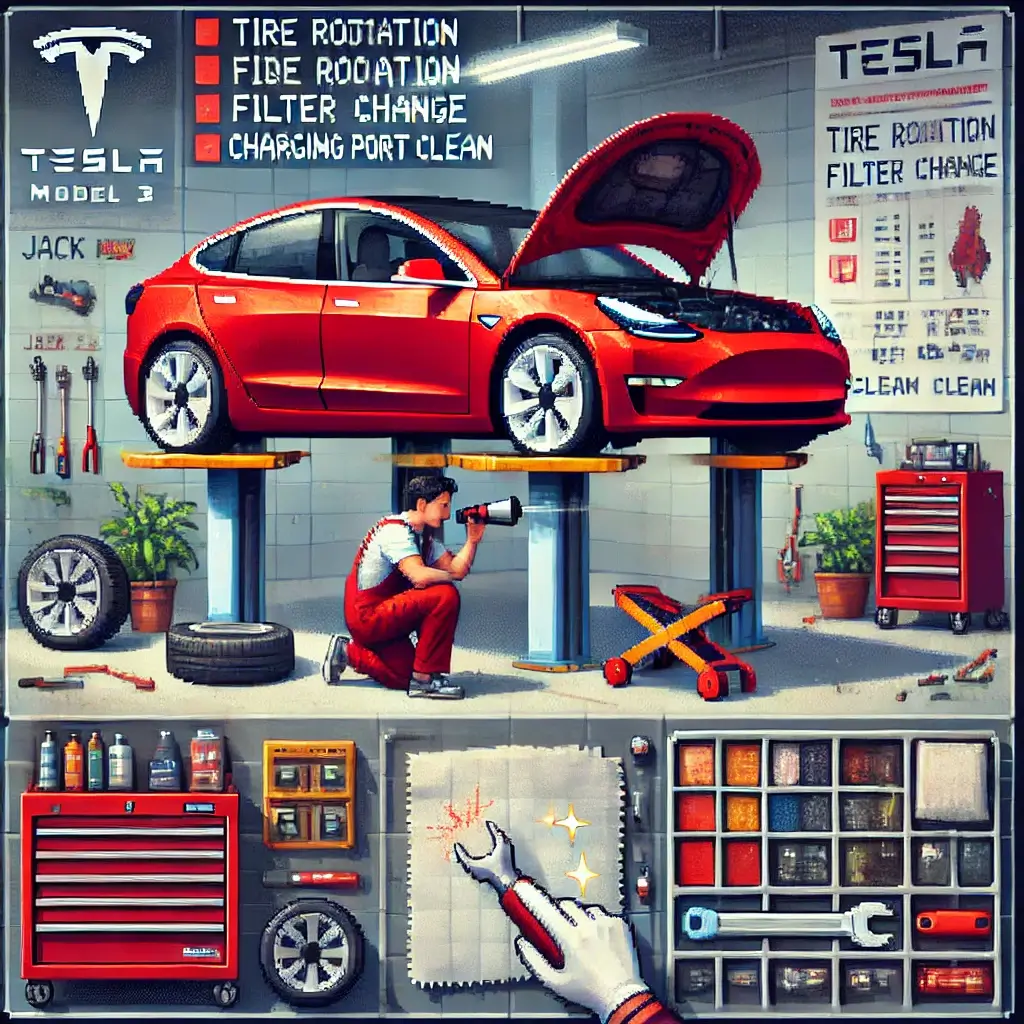
1. Tire Rotation: The Foundation of Tesla Longevity
If there’s one maintenance item that Tesla owners absolutely, positively need to stay on top of, it’s tire rotation.
Seriously, it’s a game-changer for tire longevity and overall driving experience.
Teslas are heavy, powerful machines, and that immediate torque can really put a strain on the tires, especially the rear ones.
Regular rotation helps ensure even wear across all four tires, preventing premature wear on one set and extending the life of your entire tire set by thousands of miles.
Think of it like rotating your mattress – you do it to prevent one side from getting worn out too quickly, right?
Same principle here.
Tesla recommends rotating your tires every 6,250 miles (10,000 km) or if the tread depth difference between the front and rear tires is 2/32 inches (1.5 mm) or greater, whichever comes first.
Now, let’s talk about how to tackle this yourself.
What You’ll Need:
- Floor Jack (a good quality one, capable of lifting your Tesla’s weight)
- Jack Stands (essential for safety – never work under a car supported only by a jack!)
- Tesla Jack Pads (these are crucial! They protect your battery and chassis from damage when jacking)
- Lug Nut Wrench (or impact wrench for quicker work)
- Torque Wrench (absolutely necessary to tighten lug nuts to spec)
- Wheel Chocks
The Process:
1. Safety First: Park your Tesla on a flat, level surface. Engage the parking brake and put the car in Jack Mode (found in your Tesla’s touchscreen under Service > Jack Mode). This disables the auto-leveling suspension and puts the car in a safe state for lifting.
2. Chock ‘Em: Place wheel chocks on the tires that will remain on the ground to prevent any accidental rolling. For example, if you’re lifting the front, chock the rear wheels.
3. Locate Jack Points: This is where your Tesla jack pads come in. Teslas have specific jack points designed to support the vehicle’s weight without damaging the battery pack. These are usually small, circular, reinforced areas just inside the pinch weld, near each wheel. The jack pads fit into these points, providing a safe and stable surface for your jack.
4. Lift and Secure: Place a jack pad on your floor jack, align it with the correct jack point, and slowly lift one corner of the car until the tire is off the ground. Once lifted, immediately slide a jack stand under a sturdy part of the suspension or frame, close to the jack point, and slowly lower the car onto the jack stand. Never rely solely on the jack. Repeat for the other side if you’re rotating front-to-back.
5. Remove Wheels: Using your lug nut wrench, loosen the lug nuts (they should be loosened slightly before lifting the car completely off the ground if you have the strength, but be careful not to roll the car). Once the car is safely on jack stands, fully remove the lug nuts and carefully pull the wheel off.
6. The Rotation Pattern: For Teslas, the most common rotation pattern is front-to-back, meaning you swap the front wheels with the rear wheels on the same side of the car (e.g., front left goes to rear left, front right goes to rear right). This is because most Teslas have staggered wheel sizes or directional tires that don’t allow for cross-pattern rotation.
7. Reinstall and Torque: Mount the rotated wheels back onto their respective hubs. Hand-tighten the lug nuts first. Once all wheels are back on and the car is lowered off the jack stands (but still on the ground), use your torque wrench to tighten the lug nuts to the manufacturer’s specified torque setting. For most Teslas, this is around 129 lb-ft (175 Nm). This step is CRITICAL. Under-tightening can cause wheels to come loose, and over-tightening can warp brake rotors or damage studs.
8. Final Check: Double-check all lug nuts, remove wheel chocks, and take your Tesla for a short test drive to ensure everything feels right.
It might seem like a lot of steps, but once you’ve done it once or twice, it becomes second nature.
And the savings? Significant! Plus, you’ll extend the life of your expensive Tesla tires.
If you’re looking for a good visual guide, I highly recommend checking out some YouTube tutorials on Tesla tire rotations.
Many independent Tesla mechanics or dedicated owners have excellent step-by-step videos.
One reliable source for Tesla DIY information is the Tesla Motors Club Forums – a treasure trove of community knowledge. —
2. Cabin Air Filter Replacement: Breathe Easy, Save Money
Ever notice a funny smell in your Tesla, or feel like the AC isn’t quite as fresh as it used to be?
Chances are, your cabin air filters are due for a change.
These unsung heroes are responsible for filtering out pollen, dust, pollutants, and even unpleasant odors from the air you breathe inside your car.
Just like the air filter in your home’s HVAC system, they get clogged over time.
Tesla recommends replacing your cabin air filters every two years for Model S/X and every 12,000-15,000 miles (20,000-24,000 km) for Model 3/Y, or more frequently if you drive in dusty environments.
A service center might charge you upwards of $100-$250 for this service, including parts and labor.
Doing it yourself? The filters themselves are usually around $30-$50 for a pair.
That’s a massive saving for about 15-30 minutes of your time, depending on your model.
The process varies slightly between Tesla models, with the Model 3/Y being a bit more involved than the S/X.
For Model 3/Y owners, it’s typically located behind the glove compartment, requiring removal of a trim panel.
For Model S/X, they are usually in the frunk or under the dash.
Don’t worry, it’s totally manageable!
What You’ll Need:
- New Tesla Cabin Air Filters (ensure you get the correct ones for your model)
- Trim Removal Tool (plastic pry tool – essential to avoid scratching plastic)
- Screwdriver (usually a Torx T20 or Philips, depending on model)
- Flashlight (always helpful for seeing into tight spaces)
The Process (General – check specific guides for your model):
1. Access the Filters: This is the trickiest part, as it differs by model.
- Model 3/Y: You’ll usually need to remove the passenger side under-dash trim panel and possibly the glove box support bracket. There are several screws and clips. Go slow and use your trim removal tool to gently pry panels without marring them.
- Model S/X: Filters are often accessed from the frunk (under the cowl panel) or under the dash on the passenger side.
2. Locate and Remove Old Filters: Once you’ve accessed the filter housing, you’ll see the old filters. They are usually stacked, one on top of the other. Note their orientation before removing – there’s usually an airflow arrow.
3. Clean (Optional but Recommended): While the filters are out, it’s a great time to vacuum any leaves, dust, or debris that might have collected in the housing. A small shop vac or even a hand vacuum works wonders here.
4. Install New Filters: Insert the new filters, making sure they are oriented correctly according to the airflow arrows (usually pointing towards the rear of the car). Sometimes there’s a top and bottom filter, so ensure they go in the right order.
5. Reassemble: Put everything back together in reverse order. Make sure all clips snap securely and all screws are tightened. Test your AC and fan to ensure everything is working correctly.
The satisfaction of taking a deep, clean breath in your Tesla after replacing those nasty old filters is immense.
It’s like giving your Tesla a fresh set of lungs.
For detailed, model-specific instructions and videos, a great resource is the Tesla DIY YouTube channel. They have step-by-step guides for almost every common DIY task. —
3. Wiper Blade Replacement: Crystal Clear Vision for Pennies
This might seem like a no-brainer, but you’d be surprised how many people drive around with streaky, chattering wiper blades.
Not only is it incredibly annoying, but it’s also a significant safety hazard, especially in heavy rain.
Tesla service centers will happily replace your wiper blades for a premium price.
Meanwhile, a decent pair of aftermarket blades costs about $20-$40, and the entire process takes less than 10 minutes.
It’s one of the easiest and most impactful DIY tasks you can do.
Think of it like cleaning your glasses – you wouldn’t walk around with smudged lenses, so why drive with smudged windshields?
Wiper blades typically need replacement every 6-12 months, depending on your climate and how much you use them.
If they’re leaving streaks, skipping, or making noise, it’s time for a change.
What You’ll Need:
- New Wiper Blades (ensure they are the correct length and attachment type for your Tesla model – Tesla uses a unique “pinch tab” or “side pin” style for most models)
- Soft Cloth or Towel (to protect your windshield)
The Process:
1. Enter Service Mode: On your Tesla’s touchscreen, go to Controls > Service > Wiper Service Mode. This will raise the wipers into a vertical position, making them easy to access and preventing them from snapping back onto the windshield (which can crack it!).
2. Lift Wiper Arm: Gently lift the wiper arm away from the windshield until it locks into place. Be careful not to let it snap back down.
3. Remove Old Blade: There’s usually a small tab or button where the blade connects to the arm. Press or slide this tab, and then slide the old blade off the arm. It might require a little wiggle. Place a soft cloth or towel on the windshield underneath the arm in case it accidentally slips down.
4. Install New Blade: Slide the new wiper blade onto the arm until it clicks securely into place. Make sure it’s fully seated.
5. Lower Wiper Arm: Gently lower the wiper arm back onto the windshield.
6. Exit Service Mode: Turn off Wiper Service Mode on your touchscreen.
7. Test: Give your wipers a test run with some washer fluid to ensure they’re working perfectly and providing streak-free vision.
That’s it! In less time than it takes to order a coffee, you’ve improved your safety and saved some cash.
It’s a simple fix that makes a world of difference.
For finding the right wiper blades and potentially seeing a video demonstration, a reputable online parts retailer like RockAuto often has good selection and detailed fitment information. —
4. Windshield Washer Fluid & Brake Fluid Checks: Simple Yet Crucial
Okay, I know what you’re thinking: “Fluid checks? In an EV? Isn’t that like, old-school car stuff?”
And you’re mostly right – no oil, no transmission fluid, no power steering fluid to worry about!
But Teslas still have a couple of essential fluids that you, the owner, should definitely keep an eye on.
We’re talking about windshield washer fluid and, less frequently, brake fluid.
These are super easy to check and top off, and honestly, letting them run low can be a safety issue (especially washer fluid on a dirty road) or lead to much bigger problems down the line (for brake fluid).
Windshield Washer Fluid: The Most Basic Check
This is probably the easiest “maintenance” item on your Tesla.
You use it constantly to clear your windshield of bugs, dust, and road grime.
Running out on a long trip or during bad weather is a royal pain and can seriously impair your visibility.
What You’ll Need:
- Good quality Windshield Washer Fluid (don’t cheap out; some even contain de-icing agents for winter!)
The Process:
1. Locate the Reservoir: Pop open your frunk (front trunk). The windshield washer fluid reservoir cap is usually bright blue and clearly marked with a windshield icon. It’s impossible to miss!
2. Check Level: The reservoir is typically translucent, so you can usually see the fluid level through the plastic. If it’s low, it’s time for a refill.
3. Top Off: Simply open the cap and pour in your new washer fluid until it reaches the “MAX” line or is nearly full. Don’t overfill.
4. Close and Test: Replace the cap securely and give your windshield washers a quick spray to ensure everything is working.
Seriously, it takes less than 60 seconds.
It’s like refilling your water bottle – simple, essential, and prevents you from being thirsty (or, in this case, blind) later.
Brake Fluid Check: A Less Frequent, But Critical Inspection
Unlike gas cars where brake fluid often needs flushing every couple of years, Tesla’s regenerative braking dramatically reduces the wear on your physical brakes.
This means your brake pads last a super long time, and your brake fluid doesn’t degrade as quickly.
However, it still absorbs moisture over time, which can lead to a spongy pedal feel and reduced braking performance.
Tesla recommends checking brake fluid every 2 years and replacing it every 4 years or 50,000 miles, whichever comes first.
This is one you might want to leave to the professionals for a full flush, but a quick visual check for levels and obvious contamination is well within a DIYer’s capability.
What You’ll Need:
- Flashlight
- Clean rag
The Process:
1. Locate Reservoir: Open the frunk. The brake fluid reservoir is usually a small, opaque reservoir located near the driver’s side, often tucked away a bit. It typically has a yellow cap and is marked with “DOT3” or “DOT4” (which refers to the fluid type – don’t mix them!).
2. Check Level: The reservoir has “MIN” and “MAX” lines. The fluid level should be between these two marks. If it’s consistently at or below “MIN,” you might have a leak or extremely worn brake pads, and it’s time for a professional inspection immediately.
3. Check Condition: The fluid should be relatively clear and amber in color. If it looks dark brown or black, it’s a strong indication that it’s old and contaminated and needs to be flushed by a service center. Do NOT attempt to top off dark fluid – it needs replacement.
4. Close: Securely replace the cap.
While topping off brake fluid is generally discouraged unless you know *why* it’s low (e.g., new pads were installed), knowing where it is and how to check its level and condition empowers you to be proactive about your Tesla’s safety.
For more in-depth information on brake fluid and its importance, the Edmunds car care guide offers a good general overview that applies to Teslas too. —
5. Charging Port Maintenance: Keeping Your Power Flowing
Your Tesla’s charging port is its lifeline, its connection to the energy grid that powers your adventures.
It’s arguably the most used “door” on your entire car.
Given its critical role, keeping it clean and free from debris is a simple yet often overlooked DIY maintenance task.
Think about it: if your phone’s charging port gets gunked up, it won’t charge, right? Same principle applies here.
A dirty charging port can lead to poor connections, slower charging speeds, or even prevent charging altogether.
This isn’t about replacing parts, but rather about proactive care to prevent problems before they start.
What You’ll Need:
- Compressed Air Can (like those used for cleaning keyboards)
- Soft, Lint-Free Cloth or Microfiber Towel
- (Optional) Isopropyl Alcohol (IPA) and Cotton Swabs (for stubborn grime, used very sparingly and carefully)
The Process:
1. Ensure Power is Off: Before doing anything near the charging port, ensure your Tesla is NOT actively charging and the vehicle is off. Common sense, but worth stating!
2. Visual Inspection: Open the charging port door and take a good look inside. Are there any visible signs of dirt, dust, leaves, or even small insects? Check the pins within the port for any corrosion or bending.
3. Blast with Compressed Air: Hold the can of compressed air upright and use short, controlled bursts to blow out any loose debris from the port. Aim for the corners and crevices. Avoid tilting the can too much, as it can spray propellant.
4. Wipe Down: Using your soft, lint-free cloth, gently wipe around the exterior and interior edges of the charging port. Be careful not to push debris further into the port.
5. Stubborn Grime (Use with Caution): If you see stubborn grime or a sticky residue (maybe from a spilled drink or environmental gunk), you can lightly dampen a cotton swab with isopropyl alcohol.
- WARNING: Use alcohol *very sparingly* and do not allow excess liquid to drip into the port. IPA evaporates quickly, but moisture is the enemy of electronics. Do NOT use water or other cleaning solutions.
- Gently wipe the affected areas with the alcohol-dampened swab. Let it air dry completely before attempting to charge.
6. Check Pins: Double-check that all the metal pins inside the port are straight and clean. If any are bent, do NOT attempt to straighten them yourself – this is a job for a professional service technician.
7. Clean Charger Cable: While you’re at it, inspect and clean the end of your mobile connector or Wall Connector cable that plugs into the Tesla. Wipe down the plug itself and use compressed air to clear any debris from the pins on the cable as well. A clean cable and a clean port make for a happy charging experience!
Performing this quick check and clean regularly, especially if you park outdoors or live in a dusty area, can prevent frustrating charging issues and costly repairs down the road.
It’s like brushing your teeth – a small effort now prevents big problems later.
For official Tesla recommendations on charging and care, always refer to the official Tesla Owner’s Manual for your specific model. —
Essential Tools for Your DIY Tesla Toolbox
You don’t need a professional garage full of expensive equipment to get started with DIY Tesla maintenance.
However, having a few key tools will make your life infinitely easier and safer.
Think of these as your essential investment – they pay for themselves after just one or two DIY tasks.
- Floor Jack: A good quality hydraulic floor jack is indispensable for tire rotations. Look for one with a good weight capacity (at least 3 tons is a safe bet).
- Jack Stands: I cannot stress this enough – NEVER work under a car supported only by a jack. Jack stands are your safety net. Get a pair, and use them every single time you lift your car.
- Tesla Jack Pads: These small, rubber pucks are designed to fit perfectly into your Tesla’s specific jack points, preventing damage to the battery pack and frame. They are a non-negotiable item.
- Lug Nut Wrench / Torque Wrench: A standard lug nut wrench will get the nuts off, but a torque wrench is essential for tightening them back to the correct specification. This prevents loose wheels and warped rotors.
- Trim Removal Tools: These plastic pry tools are invaluable for removing interior trim pieces without scratching or damaging them, especially when accessing cabin filters.
- Screwdriver Set: A basic set of Philips and Torx screwdrivers will cover most small fasteners you might encounter.
- Flashlight / Headlamp: Always helpful for illuminating tight spaces.
- Wheel Chocks: Simple but effective for preventing your car from rolling when it’s partially lifted.
- Microfiber Towels and Cleaning Supplies: For general cleaning and detailing, including the charging port.
- Nitrile Gloves: Keep your hands clean and protected.
You can find most of these tools at your local auto parts store or online retailers.
Invest in quality tools; they’ll last longer and perform better, making your DIY experience much more enjoyable. —
Safety First: Non-Negotiable Rules for Tesla DIY
Alright, time for the serious talk. While DIY maintenance is incredibly empowering and cost-effective, it’s absolutely paramount that you prioritize safety above all else.
A car is a heavy, complex machine, even an EV. A few seconds of carelessness can lead to serious injury or damage.
Here are my golden rules for any DIY Tesla work:
- Read Your Owner’s Manual: I know, I know, reading manuals isn’t exciting, but your Tesla’s owner’s manual contains vital, model-specific information on jack points, torque specifications, and safety procedures. Always consult it first!
- Use Jack Stands, ALWAYS: This is worth repeating. A jack is for lifting; jack stands are for supporting. Never get under a vehicle that is only supported by a jack. Ever.
- Engage Jack Mode: For Teslas, this is critical. Jack Mode disables the air suspension (if equipped) and prepares the car for lifting, preventing damage to the suspension system.
- Work on a Flat, Level Surface: An uneven surface increases the risk of your vehicle rolling or slipping off jack stands.
- Use Wheel Chocks: Even on a flat surface, chocking the wheels that remain on the ground adds an extra layer of security.
- Gloves and Eye Protection: Always a good idea. Protect your hands from grime and your eyes from any debris.
- Don’t Rush: Take your time. Rushing leads to mistakes. If you feel frustrated or tired, step away and come back later.
- If in Doubt, Don’t Do It: This is perhaps the most important rule. If a task feels beyond your comfort level or expertise, or if you encounter something unexpected, stop. It’s always cheaper and safer to take your Tesla to a qualified professional than to risk damaging it or injuring yourself.
- Battery Safety: While most DIY tasks don’t involve the high-voltage battery, be aware of its location and avoid damaging it when working under the car. This is why proper jack pad usage is so crucial.
Think of it like this: a few extra minutes spent on safety prep can save you from a lifetime of regret.
It’s not about being overly cautious; it’s about being smart. —
When to Call the Pros: Recognizing Your Limits
While I’m a huge advocate for DIY Tesla maintenance, it’s equally important to know when to throw in the towel and call in the cavalry (i.e., the Tesla service center or a certified independent EV mechanic).
Not everything is meant for the average garage warrior, and attempting tasks beyond your skill level can be dangerous or lead to more expensive repairs.
Here are some scenarios where it’s definitely time to pick up the phone:
- High-Voltage System Work: This is a BIG one. Anything involving the orange high-voltage cables or the battery pack itself is strictly off-limits for DIY. Seriously, messing with high voltage can be fatal. Leave this to trained professionals with specialized equipment.
- Brake System Beyond Fluid Check: While checking brake fluid is fine, bleeding brakes, replacing calipers, or dealing with ABS issues requires specialized tools and knowledge to ensure your braking system is absolutely flawless. Don’t gamble with your stopping power.
- Suspension Component Replacement: While a tire rotation is easy, replacing control arms, struts, or air suspension components can be complex and requires specific alignments and tools.
- Diagnostic Codes / Warning Lights: If your Tesla throws up a persistent warning light on the dash or displays a strange diagnostic code, don’t just clear it and hope it goes away. This usually indicates an underlying issue that needs professional diagnosis.
- Recalls: If your Tesla has an active recall, always take it to a Tesla service center. These are safety-related issues that must be addressed by the manufacturer.
- Software Issues: While many software updates happen over the air, if you’re experiencing persistent software glitches or connectivity issues that aren’t resolved by a simple reset, a service visit might be necessary.
- Anything Requiring Specialized Tesla Tools: Some tasks require proprietary Tesla diagnostic tools or lifting equipment that the average owner won’t have access to.
- If You’re Unsure or Uncomfortable: Again, this is paramount. If you read the instructions, watch the videos, and still feel a knot in your stomach about attempting a task, don’t do it. Your peace of mind and safety are worth more than saving a few bucks.
Think of your Tesla as a super-smart, high-tech computer on wheels. While you can handle some basic maintenance, the complex “brain” and power systems are best left to those who truly understand them.
Knowing your limits is a sign of wisdom, not weakness. —
Conclusion: Empower Your Tesla Ownership Journey
So there you have it – five essential DIY Tesla maintenance tasks that can save you serious cash and deepen your connection with your incredible electric vehicle.
From tire rotations that extend tire life by thousands of miles to simple cabin filter replacements that ensure you’re breathing fresh air, these aren’t just chores; they’re acts of empowerment.
Remember, owning a Tesla is about embracing innovation, and part of that journey can absolutely include understanding and maintaining your vehicle yourself.
You don’t need to be a seasoned mechanic to tackle these jobs.
What you need is a willingness to learn, the right tools, and an unwavering commitment to safety.
The satisfaction you’ll feel after successfully rotating your own tires or breathing in that crisp, clean air after a filter change is truly unmatched.
It’s more than just saving money; it’s about gaining confidence, building skill, and truly taking ownership of your Tesla experience.
So, the next time your Tesla nudges you for a service appointment, pause for a moment.
Is it something you can tackle yourself with a bit of research and effort?
Chances are, the answer might surprise you.
Happy wrenching, fellow Tesla enthusiasts!
You’ve got this. —
Tesla Maintenance, DIY Tesla, Save Money, Electric Vehicle Care, Tesla Owner Tips
🚗 Tesla Loyalty Skyrockets ⚡ Shocking Niche EV Startups 🔋 Top EV Battery Recyclers