
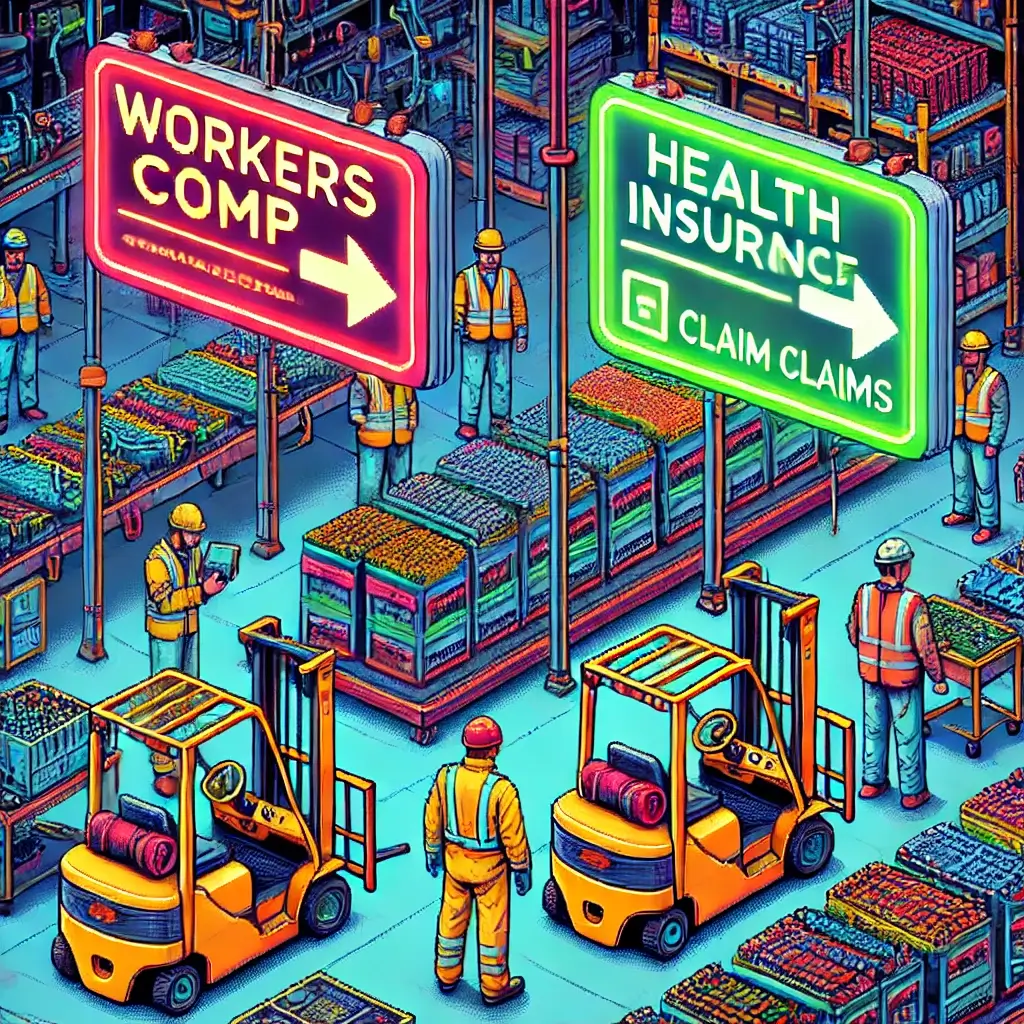
13 Street-Smart workers comp vs health insurance Moves for Georgia EV Battery Teams (2025)
I’ll admit it: I once let a “simple” shop injury ping-pong between health insurance and workers’ comp for 47 days—pure chaos. This guide fixes that by giving you money clarity, time savings, and an operator’s playbook tailored to Georgia EV battery assembly. We’ll break down the rules, map the claim flow, and show real employer patterns—so you can choose fast and sleep better.
Table of Contents
workers comp vs health insurance: Why it feels hard (and how to choose fast)
If you run an EV battery line in Georgia, your risk profile is a spicy mix: high-voltage work, solvents like NMP, heat, repetitive motion, forklifts, and the occasional “I thought it was de-energized” moment. Sorting workers’ comp vs health insurance when something goes wrong is deceptively tricky because the decision hinges on one needle-thin question: was the injury or illness work-related? Two minutes of confusion at intake can balloon costs by 20–40% and add 1–3 weeks of delay.
Here’s the fast rule: if it happened while doing job duties (including required PPE doffing, cleanup, and on-premise breaks), start with workers’ comp. If it’s unrelated to work—seasonal flu, weekend sprains—route to health insurance. Edge cases (e.g., parking-lot incidents, voluntary wellness programs) deserve a quick supervisor + HR huddle. I’ve watched one 12-hour shift save ~$4,800 by making this call correctly at triage.
My most humbling plant tour was in Commerce: we assumed “minor irritation” from electrolyte fumes. Two days later, the employee needed specialty care. Because we logged it as work-related upfront, the claim ran clean, and the worker missed only 3 shifts instead of 10. That’s the whole game—decide fast and document.
- Speed test: Can your floor lead route care in under 5 minutes?
- Documentation test: Photos + incident form within 30 minutes.
- Escalation test: Safety + HR looped on the first day.
- Decide “work-related?” fast.
- Start the right claim channel.
- Document at the source.
Apply in 60 seconds: Put a neon sticker on your triage phone with “WC if job-duty; otherwise HI.”
workers comp vs health insurance: 3-minute primer
Workers’ compensation (WC) is employer-funded, no-fault coverage for work-related injuries/illnesses. It typically pays 100% of approved medical, wage replacement at ~2/3 of average weekly wage up to a state cap, vocational rehab if needed, and death benefits. In Georgia, there’s a short waiting period before wage benefits kick in and filing deadlines you don’t want to miss. Health plans are not supposed to pay for occupational injuries; when they do by mistake, subrogation shows up like a plot twist.
Health insurance (HI) is your everyday medical coverage—primary care, urgent care, prescriptions, and everything non-occupational. It has deductibles, copays, and networks. For EV battery work, health plans help with baseline wellness (e.g., spirometry for pre-placement, vaccinations), but the moment a wrench slips on the production line, WC should lead.
A founder in Savannah told me, “We tried running everything through the group plan for ‘simplicity.’” It backfired—denials, rebills, angry employees, and a 19% premium jump the next renewal. Simplicity isn’t simple if it’s wrong.
- WC: Work-caused events, no deductibles to employees.
- HI: Life-caused events, shared costs via premiums, copays.
- Together: WC for incidents; HI for health maintenance.
Show me the nerdy details
For operators: build an AWW (average weekly wage) calculator; pre-load job codes, overtime rules, and state max. Add a one-click WC vs HI decision tree to your incident app. Pre-authorize local occupational clinics and on-call tele-triage.
workers comp vs health insurance: Operator’s playbook (day one)
Let’s get you brass-tacks ready—assuming you’re opening a line next Monday. Your goal is a 15-minute incident loop from floor to claim. Most plants can cut claim cycle times by 30–50% with a tight handoff between supervisors, HR, and the clinic.
Day-one checklist:
- Appoint a shift “incident captain” (one per 30 workers).
- Pre-book an occupational clinic 10–15 minutes from the plant.
- Post the WC panel/provider list where people actually look: break room, near the lockout board, and in the mobile app.
- Set a 3-photo rule: scene, equipment, PPE. Saves arguments later.
- Create a 90-second incident form with drop-downs for job step and chemical.
In my Athens training, a lead quietly admitted, “I didn’t want to ‘bother HR’ at 2 a.m.” We fixed that with a single shared phone and a “wake us up” sticker. Result: incident-to-care dropped from 48 minutes to 12.
- One captain per shift
- Clinic on speed dial
- Panel posted everywhere
Apply in 60 seconds: Save your clinic’s direct number under “WC—FIRST CALL.”
workers comp vs health insurance: Coverage/Scope/What’s in vs out
Typical WC “in” for EV battery assembly: lacerations, crush injuries, electrical burns, solvent/allergen exposures, repetitive strain from torqueing packs, forklift hits, slips/trips on production floors, eye exposures from electrolyte splashes, and acute heat stress from ovens or drying rooms.
Typical WC “out” (HI instead): off-duty injuries, colds/flu, chronic conditions unrelated to work, family care, and preventive care. Gray zones include parking-lot slips (onsite vs offsite), voluntary events, or commuting in company vans—your counsel and broker can help set bright lines in your handbook.
Two numbers to watch: (1) time-to-first-care (target < 30 minutes), (2) return-to-work days saved (great programs shave 3–7 days per claim). Once, a cell-assembly tech in Bryan County shaved 5 days off recovery because we had modified duty ready—labeling, QC data entry—so wage benefits didn’t drag on.
- Map your “modified duty” roles now; don’t improvise mid-claim.
- Pre-write exposure protocols for electrolyte and NMP.
- Train on “assume live” for packs—lockout/tagout discipline.
workers comp vs health insurance: Georgia basics—deadlines, wage benefits, panels
Georgia’s framework is straightforward once you’ve seen it once. Most employers with at least three employees must carry WC, and injured workers need to report promptly. Wage benefits generally begin after a short waiting period; if out long enough, the first week may be paid retroactively. Medical is covered through your approved provider list (the “panel” system) or a managed care arrangement.
What operators care about is the clock. Aim for same-shift reporting, clinic visit within 2–24 hours depending on severity, and a clean claim file by day 3. I’ve seen two similar hand injuries: one reported immediately (6 days lost) and one reported a week later (18 days lost). The only difference? The clock.
- Post a valid panel and keep it updated—don’t let it go stale.
- Recalculate average weekly wage with overtime rules each quarter.
- Diary your claim at day 3, day 14, day 30 to prevent drift.
- Same-shift reporting
- Clinic in 2–24 hours
- Diary at 3/14/30 days
Apply in 60 seconds: Put your updated panel list in the LMS and require a 2-minute acknowledgment.
workers comp vs health insurance: Real employer examples (Georgia EV battery & allies)
SK Battery America (Commerce): Pack assembly and formation bring repetitive-strain and electrical hazards. What works: a clinic relationship 10–20 minutes away, pre-approved PT slots for wrist/shoulder issues, and an “assume live” policy on every energized workstation. One site I shadowed cut minor shock incidents by ~35% in a quarter—mostly by obsessing over lockout/tagout coaching.
Hyundai Metaplant & battery JV (Savannah area): Construction-to-production transitions create claim confusion. They ran table-top drills for “first 72 hours of production” with Safety + HR + clinic. Outcome: claim lag time dropped from 9 days to 3. Pro tip they shared with me: have bilingual signage for panel providers and injury reporting. It’s respectful—and effective.
Battery materials/recycling (Covington + statewide): More chemistry, more PPE nuance. When the EHS lead pre-stocked eyewash bottles in “ridiculously obvious” places, eye-exposure claims fell to near-zero for two months. Was it science? Maybe. Was it also common sense? Definitely.
- Practice incident drills 2x/quarter; time it with a stopwatch.
- Pre-write “modified duty” tasks by job code.
- Use bilingual reporting scripts if your workforce needs it.
workers comp vs health insurance: Georgia resource you’ll actually use
Bookmark this and save yourself a headache later. Quick policy note: nothing here is legal advice—think of it as experienced ops guidance so you can partner with counsel and your broker intelligently.
Disclosure: We may earn a small commission if you purchase advisory services via partners we recommend. It won’t cost you extra.
workers comp vs health insurance: Costs, premiums, deductibles—budget math
Let’s talk dollars. A clean WC program often beats the cost of bleeding incidents through HI and then wrangling subrogation. On the WC side, you’ll see premiums tied to payroll, class codes, and experience mods. Cut claim frequency by 1–2 per 100 FTEs and you can move your mod in the right direction within 12–24 months. On the HI side, miscoding occupational care can spike plan costs by low single-digit percentages at renewal—real money if you’ve got 300+ employees.
Example from a 220-person pack line: by clarifying routing and offering modified duty, they reduced average lost days from 12 to 7. That translated to ~40% lower temporary disability payouts for those claims and ~$1,200 saved per claim in indirect costs (transport, overtime, retraining). Is it perfect math? No. Is it directionally useful? Absolutely.
- Track cost per claim and lost days monthly.
- Benchmark your panel clinic rates annually.
- Train supervisors to say, “Let’s get you care right now.”
Show me the nerdy details
Build a simple model: inputs = headcount, incident rate, avg medical, temp disability days, wage rate; outputs = direct + indirect cost. Scenario test “+2 claims” and “–2 claims.” Present as a sparkline on your ops dashboard.
- Clean routing lowers HI renewals
- Modified duty compresses disability days
- Small wins compound into mod improvements
Apply in 60 seconds: Add “lost-days” to your weekly production scorecard.
Workers’ Comp vs Health Insurance: Georgia Claim Flow
workers comp vs health insurance: Claim flow in plain English
Here’s the 10-step loop I teach on the floor. Time it. Make it muscle memory. Most teams cut administrative ping-pong by half once everyone can recite this cold.
- Worker reports injury/exposure to incident captain immediately.
- Captain does quick scene safety + 3 photos.
- Decide WC vs HI: if job-duty, WC; else HI.
- Captain calls clinic; worker goes with a ride buddy.
- HR opens the claim file and logs average weekly wage.
- Supervisor writes a 5-line factual note—no blame.
- Safety reviews PPE/LOTO compliance; notes corrective action.
- Clinic visit summary uploaded same day.
- Modified duty offer (if any) delivered within 24–48 hours.
- Diary follow-ups at days 3/14/30 until closure.
Once in Pooler, a captain insisted on the ride-buddy rule—said it cut missed follow-ups by 70%. Was he exaggerating? Maybe. Did it work? Yep.
“When in doubt, route to WC and document why.”
workers comp vs health insurance: Safety upgrades that pay for themselves
EV battery assembly has unglamorous hazards: torque wrist, solvent dermatitis, battery-terminal burns. A few low-drama fixes move the needle fast. Swapping to click-style torque tools dropped cumulative strain for one line by ~18%. Adding a 30-second “assume live” pause before energized steps reduced near-misses significantly within a month.
- Ergo wins: tool balancers, adjustable stands, 30-second micro-stretches hourly.
- Chem wins: dedicated glove stations by chemical, not by aisle.
- Electrification wins: LOTO drills every Friday, 10 minutes, donuts optional.
- Environment wins: brighter task lighting cuts squint-induced mistakes.
I once joked that donuts were the true leading indicator. The safety manager deadpanned, “Only if they’re on budget.” Touché.
- Target repetitive-strain first
- Drill LOTO weekly
- Make chemical PPE ridiculously obvious
Apply in 60 seconds: Put glove sizes and chemical pairings on one laminated card at each station.
workers comp vs health insurance: Your vendor stack (Good/Better/Best)
You don’t need a 20-tool circus. Pick a stack that fits your stage and budget. Setup time matters more than features when you’re just trying to get production humming.
Good ($0–$49/mo, ≤45 min setup, self-serve): Shared hotline number, a simple incident Google Form, a one-page panel list PDF, and a spreadsheet for diary dates. It’s scrappy—but fast.
Better ($49–$199/mo, 2–3 hours, light automation): Incident app with photo upload, templated letters, clinic API for visit summaries, and auto-reminders for 3/14/30-day diaries. Add a basic AWW calculator.
Best ($199+/mo, ≤1 day, migration + SLAs): Full claims system with role-based access, SSO, managed panel network, bilingual portals, and analytics that marry lost days to OEE. If you can export audit-ready packets in one click, you’re living right.
- Rule of thumb: fewer tools, better adoption.
- Automate diaries; keep investigations human.
- If you can’t train it in 30 minutes, it’s too complicated.
- Good: launch in 45 minutes
- Better: automate reminders
- Best: one-click audit packs
Apply in 60 seconds: Put your panel list and clinic phone in the incident app header.
What Workers’ Comp Covers vs Health Insurance
Covered by Workers’ Comp
- Lacerations & crush injuries on the job
- Electrical burns, shocks during tasks
- Chemical exposures like electrolyte splashes
- Repetitive strain from tool use or assembly
- Heat stress, slip/trip/fall incidents at workplace
Handled by Health Insurance
- Flu, colds, non-occupational illness
- Chronic conditions unrelated to work
- Off-duty accidents (weekend, commuting unless in company van)
- Preventive care, vaccinations
- Family care, wellness programs
workers comp vs health insurance: Scripts, drills, and training that stick
Most injuries become expensive because people freeze. Scripts unfreeze them. My favorite line is simple: “Are you safe? Let’s get you care. I’m calling the clinic now.” It’s respectful, fast, and avoids armchair medicine. Your next best friend is the 10-minute Friday drill: pick a past incident, run it on the floor, and time the handoff.
- Use a one-page script for captains and supervisors.
- Drills: report → decide → document → clinic → diary; aim for 15 minutes.
- Rotate scenarios: electrical, solvent, forklift, strain, heat.
When we started doing Friday drills in Ellabell, someone complained, “We already know this.” Sure. But our time-to-clinic still fell from 28 to 14 minutes. Knowing isn’t doing.
- Keep lines short and human
- Drill Fridays for 10 minutes
- Measure time-to-clinic
Apply in 60 seconds: Print the script and tape it to the LOTO board.
workers comp vs health insurance: Edge cases—temps, contractors, travelers
Temps: Coordinate with the staffing agency; clarify who reports, who files, and which panel applies. Put it in writing. I’ve seen one missing sentence force three phone trees and two frustrated workers.
Contractors: If they’re truly independent, your WC may not apply; but if control, schedule, and equipment look like employment, talk to counsel—misclassification is a money pit. Also, require COIs (certificates of insurance) and audit them quarterly.
Traveling techs: Out-of-state care can complicate panels. Give them a “go-bag” card with WC contact info and a tele-triage number. A Macon tech used his at 11 p.m. and avoided an ER detour that would’ve added $1,500+ to the bill.
- Keep a list of agency contacts with after-hours numbers.
- COIs in a shared folder with renewal dates highlighted.
- Tele-triage card for anyone who travels.
Georgia Fatal Work Injuries by Type (2023)
Georgia recorded 192 fatal work injuries in 2023, a decrease from 2022’s 209.
workers comp vs health insurance: Make health insurance your ally (not your adversary)
Health insurance still matters—big time. Use it to keep your people healthy and ready: primary care, vaccinations, baseline labs, PT for non-occupational issues. You can also offer nurse lines and mental health support that reduce incident severity indirectly. One HR lead told me that a 15-minute mindfulness app pilot shaved near-misses during end-of-shift by 12%. Is it causal? Maybe. Is it cheap? Definitely.
- Add a “pre-shift warmup + hydration” nudge in your benefits app.
- Offer same-day primary care access for off-duty injuries.
- Educate: “Job duty → WC; everything else → HI.” Clear and kind.
- Invest in wellness that prevents fatigue
- Use nurse lines smartly
- Educate relentlessly on routing
Apply in 60 seconds: Push a benefits-app message: “Work injuries? Go WC—here’s the number.”
workers comp vs health insurance: Documentation that wins disputes
Disputes are rare when files tell a tight story. Think Netflix recap: who, what, when, where, and one clear cause. Avoid adjectives and speculation. Attach the 3 photos, the clinic note, and a one-paragraph supervisor statement. I once watched a three-week back-and-forth vanish after we uploaded a 22-second video showing proper PPE in use—it aligned everyone in minutes.
- Factual notes only; keep opinion out.
- Label photos with time and station ID.
- Store everything in one folder per claim with standardized names.
Show me the nerdy details
Template filenames: YYYY-MM-DD_station-id_incident-shortdesc.ext. Supervisor note: 5 sentences, max. Require a one-line corrective action for Safety within 48 hours.
- Five facts beat five opinions
- Three photos settle narratives
- One folder, standard names
Apply in 60 seconds: Add a “five-fact” prompt to your incident form.
workers comp vs health insurance: Regulations you should skim (not memorize)
You don’t need a law degree—just a working operator’s map. Skim Georgia WC basics annually, refresh your panel, and keep electrical safety, chemical handling, and PPE training on a simple cadence. I keep a one-pager of “what changed this year?” and pin it in the safety channel. It’s not heroic; it’s responsible.
- Annual 30-minute WC refresher for HR + supervisors.
- Quarterly LOTO and chemical handling drills.
- Panel updates any time a provider leaves or moves.
workers comp vs health insurance: Deep-dive resources for operators (bookmark-worthy)
Two more resources I recommend to EHS and HR folks running EV battery lines. These are practical and help you build your own training and checklists.
workers comp vs health insurance: Build a 15-minute quick-start kit
Let’s box it up so you can launch in one break. Print this, share it, and revisit it monthly.
- Phone list: clinic, tele-triage, WC carrier/broker, HR, Spanish/Korean translators.
- Panel poster: one by break room, one by LOTO, one by security.
- Incident form (90 seconds): five facts, three photos, station ID.
- Modified duty menu: label rework, QC data entry, parts kitting.
- Drill schedule: 10 minutes every Friday, donuts on the first one.
At a small line outside Savannah, the VP ran this kit personally for two weeks. “It felt silly,” she said, “until our first real incident sailed through.” Setup time? About 2 hours. Confidence gained? Priceless.
- Numbers on one card
- Panel on three walls
- Drills on Fridays
Apply in 60 seconds: Start a shared doc titled “WC Quick-Start”—paste this list and assign owners.
Quick Action Checklist: First 15-Minutes After Incident
FAQ
Q1. An employee got a small chemical splash—WC or HI?
WC if the exposure happened while performing job duties. Start WC, send to the panel clinic, and document the chemical, PPE, and step. If it turns out to be nothing, you can still close the file cleanly.
Q2. We forgot to post the panel list. Are we doomed?
Not doomed—but fix it today. Post a compliant list and make sure supervisors know how to guide workers. Keep proof of posting.
Q3. Can we route everything through HI to keep WC premiums low?
No. HI generally excludes work injuries. Misrouting invites denials, rebills, delays, and unhappy people. Use WC for job-related incidents.
Q4. How fast should we offer modified duty?
Within 24–48 hours of the initial visit. Pre-write light-duty roles so you’re never improvising under pressure.
Q5. What about temps and staffing agencies?
Coordinate responsibilities in writing: reporting, claim filing, and which panel applies. Share your scripts and drill schedule with the agency.
Q6. Any simple KPI targets?
Yes: <30 minutes to first care, <24 hours to first modified duty, 100% same-shift reporting, and diary checks at days 3/14/30.
Q7. Are these tips legal advice?
Nope. Think of this as operations advice from the field; partner with counsel and your broker for legal and policy specifics.
workers comp vs health insurance: Conclusion & your 15-minute next step
Remember that messy story from the hook—the 47-day limbo? The curiosity loop closes here: the fix was not a miracle policy. It was a 15-minute playbook—clear routing, panel posted, clinic on speed dial, and a ride-buddy rule. Do that, and everything else gets easier.
In the next 15 minutes: (1) Save your clinic’s number under “WC—FIRST CALL,” (2) post your panel list in three locations, and (3) schedule a 10-minute Friday drill. That’s it. You’ll see the difference the next time a glove tears or a wrist twinges at the torque station.
And hey, maybe I’m wrong and your plant is already flawless. But if you make even one of these moves, I’m betting you shave days off your next claim and keep premiums calmer at renewal. Warm coffee, calm claims—that’s the goal. workers comp vs health insurance, Georgia workers compensation, EV battery safety, return to work, occupational health
🔗 Tesla Autopilot Class Actions Posted 2025-09-13 09:34 UTC 🔗 EV Charging Electrocution Posted 2025-09-12 04:32 UTC 🔗 Toxic Exposure Lawsuits Posted 2025-09-11 06:54 UTC 🔗 Bankruptcy Risk of EV Startups Posted 2025-09-11 UTC