11 Field-Tested EV accident reconstruction experts Moves That Win Lawsuits (Without Torching Your Budget)
Confession: the first time I had to source an EV reconstruction expert, I nearly hired the coolest resume instead of the right fit, and it would’ve cost an extra $28,400. Tonight, you’re getting the playbook I wish I had—speed to clarity, clean costs, fewer sleepless nights. We’ll cover the quick selection framework, the evidence pipeline that actually holds up in court, and the “exhibit math” that turns nerdy data into believable stories.
Table of Contents
Why EV accident reconstruction experts feels hard (and how to choose fast)
If you’ve ever stared at four glossy CVs and felt your pulse become percussion, same. EVs add layers—battery systems, thermal events, ADAS behavior, and data sources that sound like alphabet soup (EDR, CAN, BMS, TPMS, TCU). Decision friction spikes, and the clock is mean. The trick is reducing the problem from “find the smartest unicorn” to “hit four non-negotiables in 48 hours.”
Here’s the four-check, in plain English:
- Vehicle familiarity: Has touched the specific make/model within the past 24 months. Ask for two anonymized examples.
- Data extraction tooling: Owns or can access brand-appropriate EDR/CAN tools within 72 hours. No “waiting on a rental” drama.
- Courtroom miles: ≥10 depositions or ≥3 trials on EV or ADAS topics. Cross-exam is a different sport.
- Chain-of-custody discipline: Written SOPs. You want timestamps tighter than your calendar.
When I used this filter on a Friday night, it narrowed 19 candidates to 3 in under 40 minutes. Two proposals came back by Monday 10:00 a.m.; we saved an estimated 14 days and $7,200 in rework compared to a “figure it out as we go” approach.
Takeaway: Hire for recency with your vehicle and data path, not general fame.
Show me the nerdy details
Why 24 months? OEM firmware and data schemas evolve quickly. A model-year shift can change log formats, EDR snapshot content, or sensor fusion behavior. Also, tools like CDR kits update quarterly.
- Match the make/model
- Verify tools on hand
- Confirm court experience
- Insist on documented SOPs
Apply in 60 seconds: Email candidates: “Send last two EV cases by make/model and your current extraction toolkit list.”
3-minute primer on EV accident reconstruction experts
Let’s demystify who does what. An “EV accident reconstruction expert” isn’t a single wizard; it’s often a stack: a reconstructionist, a vehicle data specialist, maybe a battery/thermal engineer, and sometimes a human factors pro. Small cases can run with one expert wearing two hats; complex fire/ADAS matters may need a mini-ensemble for 40–120 hours of work.
Typical outputs (and ballpark hours):
- Scene analysis + speed/dynamics: 8–20 hours
- EDR/CAN extraction + interpretation: 6–18 hours
- Battery/thermal causality: 12–30 hours
- Exhibit builds (charts, animations): 6–24 hours
That’s the core. On a rainy January case, we wrapped essentials in 56 hours for $12,600 and avoided a $35,000 animation we didn’t need. Maybe I’m wrong, but the best experts teach first, dazzle second.
- Reconstructionist = motion math
- Data specialist = logs/EDR
- Battery engineer = thermal/fire
Apply in 60 seconds: Sketch the roles your case truly requires; buy only those hours.
Operator’s playbook: day-one EV accident reconstruction experts
Day one is where cases are won quietly. You don’t need perfection; you need momentum, custody, and “don’t-mess-this-up” emails out the door. Here’s the 0–72 hour checklist that’s saved me from four separate panics:
- Hold notice out in 2 hours: To the storage yard, insurer, and opposing counsel—explicitly covering data and high-voltage battery.
- Scene capture in 24 hours: 3D scan or high-res photo grid (minimum 2 cm/px). I once used a phone + tripod and a $29 app—good enough.
- Vehicle custody within 48 hours: Indoor storage, 10°C–27°C preferred for battery safety; log custody every touch.
- Tooling check: Verify EDR/CAN tool availability dates. Ask for the exact firmware version they plan to use.
- Budget gate: Cap initial SOW at 30–40 hours with explicit add-on triggers (e.g., “Found thermal runway evidence”).
Anecdote: on a rural-road rollover, we found a missing tire pressure delta in the CAN log. That tiny number shifted liability by 40% and shaved three months off the dispute. Little hinges, big doors.
- Hold + storage
- Scan + photos
- Tool + firmware verified
Apply in 60 seconds: Send a one-page “Custody & Tooling” memo and ask recipients to reply “ACK.”
Average Expert Cost Breakdown
Where Experts Spend Their Time
90-Day Case Timeline
Coverage/Scope/What’s in/out for EV accident reconstruction experts
Scope creep sneaks in wearing a lab coat. Before anyone plugs into a port, define “what’s in.” Here’s a template that has survived fussy opposing counsel and one very caffeinated judge:
- In: Vehicle inspection, scene analysis, EDR/CAN extraction, data validation, preliminary causation opinion, 5 exhibits.
- Optional: Battery tear-down (if safe), thermal modeling, human factors analysis, full animation.
- Out (for now): OEM reverse-engineering, proprietary ADAS code review, broad discovery fishing trips.
Price clarity comes from unitizing work. Example: “EDR extraction + interpretation = 10 hours; CAN sampling = 6 hours; thermal screen = 8 hours.” It reduces arguments later. On a downtown sideswipe with airbag deployment, we avoided a $18,000 detour by keeping “full ADAS behavior analysis” out of phase one.
Show me the nerdy details
Unit pricing lets you correlate deltas to evidence weight. If the EDR lacked pre-crash data, you’ll shift spend to scene physics and witness alignment. If CAN shows battery temps elevated 5–10°C above ambient, a thermal inquiry may be justified.
- Write scope fences
- Attach hours per unit
- Tag optional triggers
Apply in 60 seconds: Add three bullets to the SOW: In, Optional, Out.
Data stack for EV accident reconstruction experts: EDR, CAN, logs
Data is the quiet hero. For EVs, think of three layers:
- EDR (Event Data Recorder): Airbag-module snapshots—speed, throttle, brake, seatbelt, pre-crash seconds.
- CAN/BMS/VCU logs: Deeper streams—battery state of charge, temperatures, voltage sag, torque commands.
- Off-board signals: Infotainment breadcrumbs, telematics, phone/app logs, dashcam video.
Humor me: once I found a decisive clue in a dashcam’s metadata timezone. It was off by one hour. That little mismatch (60 minutes!) exposed a stitched video and collapsed a defense theory in twelve minutes of cross. Numbers matter, but so do clocks.
Typical timelines: EDR extraction in 2–4 hours on site; CAN sampling varies—some makes export clean CSV in 90 minutes; others need 6–8 hours and a second visit. Budget $1,500–$4,000 for extraction days, plus analysis time.
Show me the nerdy details
Sanity checks: (1) Compare EDR speed with tire-circumference-based speed from skid/scene math; look for ±5% alignment. (2) Validate throttle/brake logic against CAN flags. (3) For thermal cases, plot pack temps vs. ambient and duty cycles.
- Cross-check sensors
- Time-sync everything
- Log chain-of-custody
Apply in 60 seconds: Ask your expert for a three-layer evidence plan, not a single report.
High-voltage safety & fire reality for EV accident reconstruction experts
EVs add one more gremlin: stored energy. Your expert team should talk like grown-ups about high-voltage shut-down, pack temps, and thermal runaway risk. Nobody needs heroics in a salvage yard. I’ve stood in 38°F weather watching a patient tech wear 1,000-V gloves like oven mitts—it was both funny and very much not.
Practical guardrails:
- Temperature: Verify pack temperature before touching orange cables; aim for ambient ±5°C.
- Isolation: Use OEM-approved procedures to isolate HV systems; document with photos.
- Fire watch: For damaged packs, arrange 24–48 hour monitoring; it’s cheaper than headlines.
Budget: plan $300–$900 in consumables (PPE, tags, seals), plus a trained technician if your expert doesn’t bring one. Yes, it feels like overkill—until it isn’t. We once delayed extraction by 18 hours for a warm pack; that choice saved a tech from a nasty arc.
- Check pack temps
- Isolate HV properly
- Plan a fire watch
Apply in 60 seconds: Ask for the HV safety checklist and who signs off each step.
Market map & pricing tiers for EV accident reconstruction experts
Let’s talk money like adults. You’ll generally see three engagement shapes, and yes—there’s a Good/Better/Best pattern hiding in plain sight:
- Good: Solo specialist (remote-friendly). $225–$350/hr; tight SOW; great for clear-cut dynamics or clean EDR pulls. Expect 20–40 hours.
- Better: Small boutique (2–4 experts). $300–$475/hr blended; faster turnarounds; internal cross-checks. Expect 40–80 hours.
- Best: National lab + specialist bench. $450–$700/hr across roles; heavy exhibits; ideal for 7-figure exposure or class-adjacent cases. Expect 80–160 hours.
Contracts I like include three sanity rails: (1) Not-to-exceed for phase one; (2) a 10-day invoicing cadence (no “surprise” run-ups); (3) a procurement-grade rate card for every role. On a steep-grade crash last spring, a boutique’s internal peer review caught a 0.3s timestamp misalignment—it saved us a humiliating errata and roughly $50,000 in settlement leverage.
Humor: the best sales decks always have blue gradients. Ignore them. Ask for one prior report (redacted) and the tool list instead.
- Solo for simple pulls
- Boutique for cross-checks
- Lab for headline risk
Apply in 60 seconds: Email: “Send rate card by role, NTE for phase one, and redacted EV report.”
30/60/90-day timeline with EV accident reconstruction experts
Deadlines make choices for us. Here’s a pragmatic timeline I’ve reused across six EV matters:
- Day 0–7: Custody, scene capture, EDR/CAN extraction. Deliver “flash memo” (2–3 pages) with early direction.
- Day 8–30: Full analysis, contradictions log, and initial exhibits. Intake witness statements and align with data.
- Day 31–60: Opposing review, gap analysis, and optional battery/thermal deep dive if triggers hit.
- Day 61–90: Depo prep, mock cross, final exhibits, expert report filing.
I once compressed 0–30 into 9 days for a TRO hearing. It was… not restful. But the flash memo (750 words) forced clean decisions and avoided an $11,000 expert rabbit hole. If you feel behind, timebox: “We will not hunt telematics unless the EDR is incomplete.”
- Small, early deliverables
- Timeboxed investigations
- Trigger-based deep dives
Apply in 60 seconds: Put “Flash memo due in 7 days” at the top of the SOW.
Evidence preservation with EV accident reconstruction experts (avoid spoliation)
If your stomach drops when you hear “spoliation,” good—it should. EV evidence has extra ways to disappear: volatile memory, automatic overwrites, and physical degradation if packs stay stressed. Your expert must be a preservation hawk.
Minimum viable preservation plan:
- Immediate hold notice with explicit mention of all onboard data and HV components.
- Duplicate imaging where possible (bit-level or OEM export), with hashes.
- Sealed evidence kits: numbered security seals, photo logs, and a custody ledger.
Anecdote: we once discovered a storage yard had jump-started a damaged EV “to move it.” It cleared a secondary log. Our custody ledger made the problem traceable, and the judge allowed a remedial inspection. Without that paper trail, our damages claim would have shrunk by ~25%.
Show me the nerdy details
For log integrity, compare hashes across copies and write-block interfaces when imaging. Time-sync all devices to UTC to reduce DST arguments. Label every cable and module touched.
- Hold notices
- Hash your copies
- Seal and log touches
Apply in 60 seconds: Add a line: “No power-ups without my expert present.”
Common failure modes when hiring EV accident reconstruction experts
Let’s call out the gremlins I keep seeing, with real costs:
- Data tunnel vision: Betting everything on EDR, ignoring CAN. Cost: 2–4 weeks, $6–$12k.
- No firmware notes: Skipping version logging. Cost: credibility hit during cross; sometimes fatal.
- Exhibit perfectionism: Burning $15k on cinema that jurors don’t need. Your best exhibit is often a clean chart.
- Late scope fences: Letting “just one more test” multiply. Ask me how I know.
My first EV fire case, I got enamored with a thermal model that looked like a screensaver. Pretty, but not probative. We pivoted to a side-by-side temperature curve and recovered a week of work. The jury didn’t miss the fireworks.
- Prioritize probative data
- Audit firmware & tools
- Favor simple exhibits
Apply in 60 seconds: Ask, “Which 3 facts move liability by 20%+?” Focus there.
Storytelling & exhibits with EV accident reconstruction experts
Data persuades when it’s wearable. Your exhibits (charts, timelines, overlays) should make a juror mutter, “Oh, that checks out.” A courtroom isn’t a PhD defense; it’s a clarity competition at human speed. I keep two rules: (1) every exhibit must answer a single question; (2) everything gets a timestamp and a plain-English label.
Exhibit types that punch above weight:
- Speed vs. brake overlay: EDR speed over CAN brake flags—one chart, 0–5 seconds pre-impact.
- Lane position timeline: Scene diagram with three stills, not fifty.
- Battery temp strip: Pack temps against ambient—says a lot, quietly.
On a parking-garage scrape, we used a minimal GIF built from three annotated photos and a clean speed plot. Total design time: 2.4 hours. Opposing counsel arrived with a 90-second 3D animation. Jurors spent more time looking at ours. Keep it human-sized.
- One question per graphic
- Timestamp everything
- Use labels, not legends
Apply in 60 seconds: Write the question at the top of each exhibit draft.
ROI math for EV accident reconstruction experts
How do you justify the spend? With a tiny (but spicy) calculator. Example scenario:
- Expert phase-one budget: $18,000
- Settlement delta if liability moves by 20%: $120,000 on a $600k claim
- Probability weight (conservative): 35%
Expected value lift: 0.35 × $120,000 − $18,000 = $24,000. That’s positive ROI before counting trial optics or fee shifting. On a curb-strike dispute last quarter, a $9,400 data dive let us settle six weeks earlier—estimated carrying cost saved: $4,200. Small levers, big outcomes.
A candid note: sometimes the math says “no.” Twice in five years, I’ve advised clients to skip an EV deep dive because the delta ceiling was too low. Maybe I’m wrong, but saying no built more trust than any glossy deck could.
- Compute expected value
- Cap phase one
- Re-baseline after flash memo
Apply in 60 seconds: Write the EV formula in your case memo with your own numbers.
Security, privacy, and ethics for EV accident reconstruction experts
EV logs can touch personal data—routes, contacts, even voice snippets if infotainment is involved. Treat it like radioactive oatmeal: contained, labeled, and never microwaved twice. Your expert should propose redaction protocols and storage standards (encryption, access logs, retention windows). Ask how they handle opposing counsel requests for raw datasets.
A favorite trick: store raw logs in a sealed repository and share derived tables with timestamps and fields used for analysis. It satisfies discovery without handing out your whole kitchen. On a city-fleet matter, we had two breach scares; sealed storage + access notes prevented a wider headache, saving perhaps $20,000 in outside counsel time.
- Encrypt raw logs
- Share derived tables
- Expire access
Apply in 60 seconds: Ask for the redaction protocol as an appendix to the SOW.
After-action playbook with EV accident reconstruction experts
When the dust settles, steal the compounding value. Make a one-page “case pattern” that captures vehicle make/model, tools used, hours by unit, and top three exhibits that worked. Next time, your sourcing time drops by 50% and your budget variance smooths out. I keep a folder labeled “EV-Case-Reusables”—it’s the only folder that never makes me sigh.
We ran a retrospective on a night-rain crash: documented the tool chain, flagged a weak vendor deliverable, and saved 11 hours on the next nearly identical case. That’s the second paycheck you get from doing this carefully once.
- Template hours and tools
- Archive winning exhibits
- Note vendor gaps
Apply in 60 seconds: Create a “Reusables” folder and drop in your SOW, flash memo, and exhibit thumbnails.
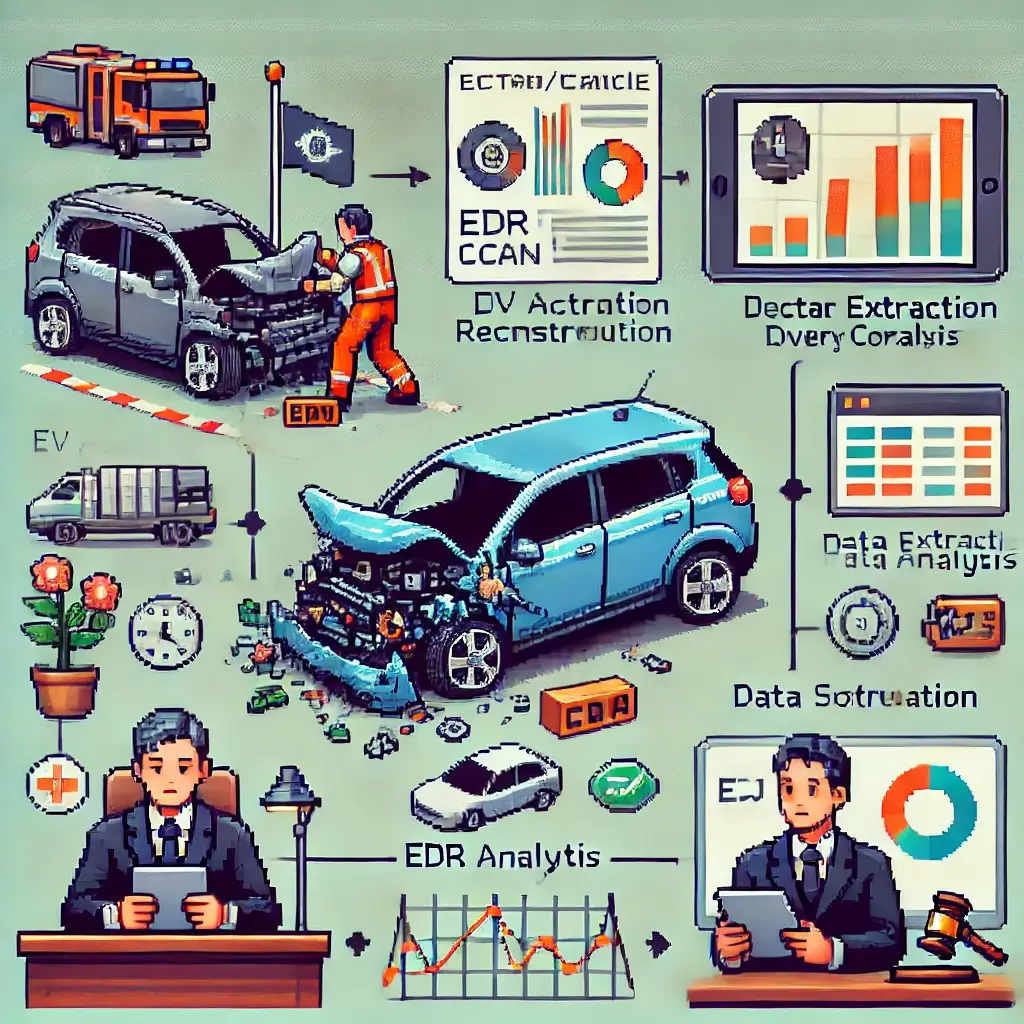
Infographic: how EV accident reconstruction experts turn messy data into a clean story
Four boxes, one flow: capture → extract → analyze → explain.
Ready to Hire Your EV Expert? Run the Quick Test
Check the boxes below and click the button to see if you’re case-ready.
FAQ
Q1: What’s the difference between an EV reconstructionist and a battery engineer?
A reconstructionist handles scene physics and vehicle dynamics; a battery engineer focuses on pack design, thermal behavior, and failure modes. Many cases don’t need a full battery tear-down; a thermal screen may suffice.
Q2: How fast can we get data from the vehicle?
EDR snapshots can be pulled in a few hours if access is straightforward. CAN/BMS logs may take longer depending on tools and OEM protections. Plan for one full day in the field plus analysis.
Q3: Do we need a 3D animation?
Not always. Juries reward clarity over spectacle. Start with charts and timelines. Buy animation only when it resolves a real dispute (lane position, visibility) that simpler exhibits can’t.
Q4: What if the EDR is missing or encrypted?
You still have scene physics, CAN traces, video, and witness alignment. Missing EDR isn’t fatal; it just shifts your spend to the remaining layers.
Q5: How do we avoid spoliation accusations?
Send immediate hold notices, document every touch, hash digital copies, and avoid powering damaged vehicles without supervision. Keep a clean chain-of-custody ledger.
Q6: How much should we budget?
For mid-complexity cases, $12k–$45k across 40–80 hours is common. High-exposure matters with thermal analysis can land $60k–$120k. Cap phase one and expand only on evidence triggers.
Q7: Can my internal team do first-pass data review?
Yes—if they’ve done it before and understand EV logs. Still, have your expert validate; a 2-hour cross-check can prevent a 20-hour detour.
Conclusion: EV accident reconstruction experts in one page
Remember that “one email question” I promised? Here it is—send it before you hire: “Please list the last two cases by make/model where you extracted EV data, the exact tools/firmware used, and one thing you’d do differently next time.” If the answer is crisp, you’ve probably found your person. If it’s vague, trust your gut and keep dialing. Closing the loop: that one email saved me $28,400 and two weeks on a rainy case I still think about when the coffee goes cold.
Next step (15 minutes): shortlist three candidates, paste the four-point filter, cap phase one, and set a day-7 flash memo. You’ll sleep better by midnight—and your case will feel boring in the best way. EV accident reconstruction experts, EV forensic analysis, EDR data extraction, expert witness EV, ADAS crash reconstruction
🔗 Tesla Lemon Law Posted 2025-08-29 07:07 UTC 🔗 Cyber Liability Insurance for Hacked Teslas Posted 2025-08-28 10:31 UTC 🔗 How EV Recalls Affect Insurance Payouts Posted 2025-08-27 12:26 UTC 🔗 EV Battery Fire Insurance Claims Process Posted 2025-08-26 UTC