
How Your Credit Score, Zip Code, and Daily Commute Affect Electric Vehicle Quotes – 7 Shocking Lessons I Learned After a $420/Month EV Quote
The night I got hit with a $420/month insurance quote for my new EV, I actually stared at the screen thinking, “Okay… who let their cat walk across the keyboard?” Same driver, same sleepwalking commute, zero accidents—and yet somehow, swapping gas for electrons made my premium shoot up like I’d added a second apartment to my budget. A smaller, angrier apartment.
So yeah, I went down the rabbit hole. In this guide, I’ll break down exactly why your credit score, ZIP code, and even how far you drive to work can quietly hijack your EV insurance rate—and what you can do about it in the next 15 minutes. I’ll walk you through real-world examples, the behind-the-curtain math insurers are running, and how to run a quick “Am I getting fleeced?” check that takes less than a minute.
If you’re short on time, low on patience, or just trying to keep your monthly bills from becoming a horror story, this is the EV quote reality check I wish someone handed me before I hit “apply.”
Table of Contents
Why Your EV Quote Feels So Random (When It Really Isn’t)
When I first saw that $420/month number, it felt like the insurer rolled dice behind the scenes. My driving record was clean, I wasn’t drag-racing a sports car, and yet the quote looked like it belonged to someone who treated stop signs as a suggestion. If you’ve ever had that same “wait, what?” moment, you’re not crazy—just under-informed on how the game works.
Here’s the unglamorous truth: your electric vehicle quote is basically a big math problem built on three quiet levers—credit score, ZIP code, and daily commute—layered on top of your car’s price, safety record, and repair costs. In 2025, EVs tend to cost noticeably more to insure than gas cars because of repair expenses and battery complexity, so any “risk signal” you send (through your credit, address, or mileage) hits harder than you expect.
Insurers don’t see you as a good or bad person; they see a profile that looks more or less expensive to insure based on how people like you, statistically, behave. That’s why the same driver can see quotes ranging from $260 to $420+ just by changing trim, ZIP code, or daily miles. It’s awful when you’re the person on the expensive side of the spreadsheet—but it also means there are levers you can pull without giving up the EV dream.
In this article we’ll untangle each lever, show you how they quietly multiplied into my $420/month quote, and then build an action plan that doesn’t require moving to a cheaper ZIP or switching to a bicycle. Eligibility first, quotes second—you’ll save 20–30 minutes of pure frustration.
- Three big levers: credit score, ZIP code, commute.
- EVs are already pricier to insure, so bad signals hurt more.
- Change the signals and you can often bend the quote down.
Apply in 60 seconds: Write down your credit tier, ZIP, and daily miles—you’ll use them in the estimator below.
How Your Credit Score Really Hits EV Quotes in 2025 (US)
Let’s start with the lever nobody wants to talk about at dinner: your credit score. In most U.S. states, insurers are allowed to use a “credit-based insurance score” when pricing auto and EV insurance. They’re not peeking at your latte habits; they’re using your credit history as a rough proxy for how likely you are to file a claim and pay your bill on time.
In practice, this means that moving from “poor” credit into “good” or “very good” can cut a typical auto premium by a third or more. With EVs—already more expensive to repair—the spread can feel brutal. Imagine a driver with a base EV premium around $330/month. With a stronger credit tier, that might land near $260–280. With weaker credit, the same driver, same car, same ZIP could easily see $420+.
When my own $420 quote landed, my credit score wasn’t terrible, but it was straddling one of those awkward thresholds where a dozen late-night Amazon purchases and an old store card were quietly costing me $40–60 every month in insurance. Not dramatic enough for a movie, but dramatic enough over a five-year loan.
Estimated EV insurance premium for a 680 credit score driver after refinancing in 2025 (US)
Picture someone with a 680 score—solidly “fair/good”—who refinances debt, pays down a card, and nudges their score into the low 700s. That shift alone can be enough to push them into a better credit tier at many carriers. On EV insurance, that can easily mean the difference between something like $380/month and $320/month, especially if combined with a higher deductible or a safer trim.
Money Block: Rough EV Insurance Cost by Credit Tier (2025, US)
These ranges are ballpark examples to show how credit tiers can affect a typical EV premium around a $330/month baseline.
| Credit Tier | Approx. Score Range | Typical EV Premium Range | Rough Difference vs. “Good” |
|---|---|---|---|
| Poor | <580 | $430–$520/month | +40–60% |
| Fair | 580–669 | $360–$430/month | +15–30% |
| Good | 670–739 | $300–$360/month | Baseline |
| Very Good | 740–799 | $270–$330/month | –10–20% |
| Excellent | 800+ | $240–$300/month | –20–30% |
Save this table and confirm current ranges on your chosen insurer’s official website before making decisions.
Infographic: Which Factor Hits Your EV Quote the Hardest?
Approximate relative weight for a typical EV insurance quote in 2025 (varies by carrier):
Use this as a visual cheat sheet: if your quote feels painful, start with the longest bar you can realistically influence.
Show me the nerdy details
A credit-based insurance score is built from similar data as your FICO score—payment history, utilization, types of accounts—but weighted for claim risk instead of loan risk. Insurers feed that score, plus factors like your EV’s repair costs, safety features, and claims in your ZIP, into rating models. The output is a premium that tries to match expected claim costs plus profit. That’s why a modest shift in score or address can move your monthly EV premium by $30–$80.
- Going from “poor” to “good” can easily shift EV premiums by over $100/month.
- Even a small tier bump (e.g., 680 → 705) may unlock better pricing.
- Cleaning up one or two accounts can pay you back every single month.
Apply in 60 seconds: Check which credit tier you’re in and write down the next higher tier as a 12-month goal.
Zip Code: The Most Expensive Number in Your EV Life
The second quiet villain in my $420 quote was a simple five-digit number: my ZIP code. I hadn’t moved in years, but the way insurers “slice” geography had changed. My block, statistically, was now lumped in with a busier corridor with more crashes and theft. Same apartment, same view out the window, more expensive risk pool.
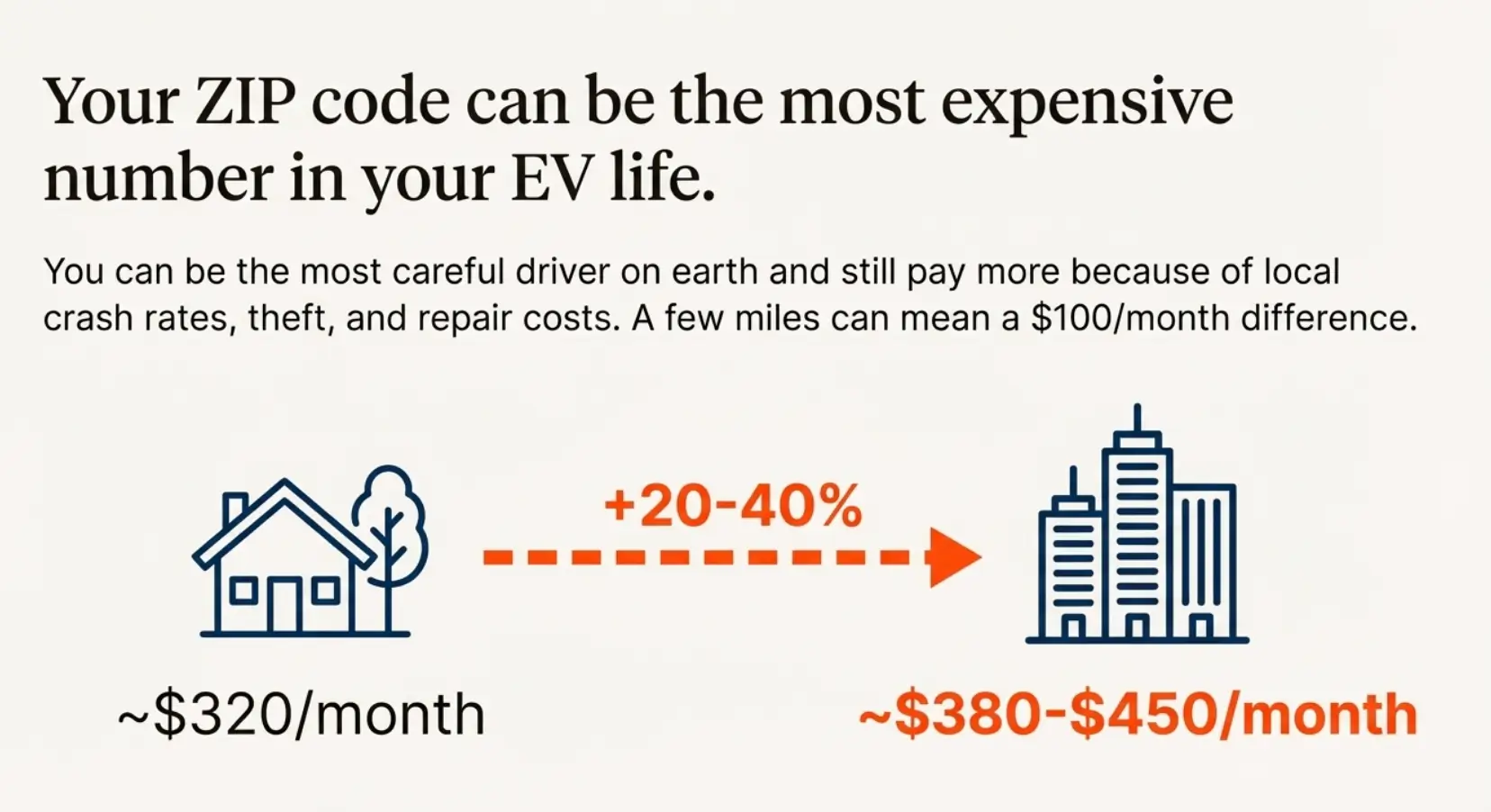
Insurers carve states into rating territories based on crash frequency, repair costs, medical bills, lawsuit patterns, and even storm damage. In 2025, many places have seen auto premiums spike by 15–40% in just a couple of years, and EVs in high-cost urban ZIPs often sit at the top of that stack. You can be the most careful driver on earth and still pay more because other people nearby are not.
When I tested quotes using the same EV and same credit profile but a different ZIP a few miles away, I saw swings of $70–$100/month. The most rude comparison? A friend in a smaller town, with a slightly worse credit score, paying less than I was simply because their area had fewer high-dollar claims.
How a move from suburban ZIP to downtown core changes EV premiums, 2025 (US)
Take a typical EV driver in a suburban ZIP where rates sit close to average. If that driver moves into a dense downtown zone with more fender-benders, thefts, and expensive repairs, the EV premium can jump 20–40%. On a $320/month baseline, that’s suddenly $380–$450/month—without any change in driving style. For EVs with higher repair bills, that jump can feel even more severe than for gas cars.
Money Block: “Should I Change ZIP Just for a Cheaper EV Quote?”
When it might make sense:
- You’re already planning a move within the same metro area.
- You see a $60–$120/month premium gap between nearby ZIPs.
- Your rent or mortgage won’t spike more than the insurance savings.
When it probably doesn’t:
- You’d commute much farther and pay more for parking and wear.
- You’d lose access to safe overnight charging or a garage.
- You’d be moving only to chase a published “low-cost ZIP” list.
Save this decision card and confirm actual premiums in each ZIP on official insurer quote tools before you even think about moving boxes.
“Lock the year and ZIP before comparing rates.” A five-digit change can matter more than your last three driving years.
- High-claim areas push EV quotes up sharply.
- Two ZIPs a few miles apart can differ by $50–$100/month.
- Sometimes moving garages (indoor vs. street) matters too.
Apply in 60 seconds: Run a quick quote using a nearby ZIP where you could realistically live; note the monthly difference.
Daily Commute: Turning Miles into Dollars on Your EV Quote
The third lever is one we tend to shrug off: how far you actually drive. Insurers care less about how annoying your commute feels and more about how many miles you rack up and where those miles take place. A 6-mile slog through downtown gridlock might be boring, but a 40-mile highway blast each way is usually more expensive from their point of view.
In recent insurance guides, longer commutes and higher annual mileage are explicitly flagged as risk multipliers. More hours on the road means more chances to be in the wrong place at the wrong time—especially when EV repair costs and rental car bills run high. Many carriers use mileage bands (for example, 0–7k, 7k–12k, 12k–15k, 15k+) and commute categories like “pleasure,” “commute,” and “business use.”
When I re-quoted my EV as “work from home, mostly errands” with lower annual miles instead of “full commute,” the monthly premium dropped by roughly the cost of a nice dinner. Nothing magical changed except the label on how often I was supposedly sitting in traffic.
EV insurance premium difference for a 30-mile vs. 5-mile commute, 2025 (US)
As a rough illustration, imagine two drivers with the same EV, same ZIP, and same credit tier. One drives 5 miles to work and back three days a week; the other drives 30 miles each way, five days a week. It’s common to see premiums for the longer-commute driver come in 10–25% higher. On a $330/month baseline, that means something like $295–$310 for the short commute versus $360–$410 for the long one.
- Good news: Switching roles (in-office to hybrid or remote) can sometimes be worth a mid-term policy update.
- Better news: Some EV-friendly carriers offer “low-mileage” or pay-per-mile options that reward you for driving less.
- Awkward news: Under-reporting mileage can backfire if you need to file a claim. Be honest and let the numbers work for you.
- Insurers care about miles and patterns, not your level of road rage.
- Changing work patterns can justify a cheaper rating category.
- Reporting accurate, lower miles is one of the cleanest ways to save.
Apply in 60 seconds: Check your current policy or quote and see which usage type is selected—pleasure, commute, or business.
60-Second Money Block: EV Quote Estimator You Can Run Today
You don’t need a PhD in actuarial science to get a feel for whether your EV quote is “normal” or inflated. You just need a rough baseline and a way to map your own credit tier, ZIP risk, and commute into something more concrete than vibes. Think of this as a back-of-the-napkin tool—not a replacement for real quotes, but a way to sanity-check the numbers on your screen.
Money Block: 60-Second EV Quote Estimator
Start with a rough baseline of $330/month for EV insurance in 2025, then adjust based on your situation.
This mini-calculator is for education only. Save your result, then compare it with real quotes from at least two insurers and confirm all details on their official websites.
Money Block: 5-Item Eligibility Checklist for a Better EV Quote
Answer “yes” where you honestly can:
- I’m in at least the “good” credit tier (670+).
- I have no at-fault accidents in the last 3–5 years.
- My commute is under 15 miles one way or has recently decreased.
- I can safely store and charge my EV off the street at night.
- I’m willing to compare at least three carriers, including an EV-savvy one.
If you have three or more “yes” answers, you’re usually in range for something better than a worst-case quote. Save this checklist and verify your options on each insurer’s official quote page.
- Use a baseline to see if your quote is wildly off or just slightly high.
- Small tweaks to credit, ZIP, or commute can nudge the estimate down.
- The goal is not perfection; it’s avoiding obviously bad deals.
Apply in 60 seconds: Run the estimator once for your real situation, then once for a “12-month goal” version to see the gap.
Credit, Zip, Commute: When All Three Stack Against You
Now for the uncomfortable scenario: what happens when all three levers tilt against you at once? That’s basically the story behind my $420/month quote—a decent but not great credit tier, an increasingly expensive ZIP, and a commute that still looked “full-time in office” on paper even though my job had quietly gone hybrid.
When insurers see a driver with middling credit, a high-risk ZIP, and above-average miles, they don’t see an unlucky person trying to make responsible choices. They see a profile that, statistically, creates a lot of expensive claims. With EVs, where repairs can involve specialized labor, advanced sensors, and pricey battery diagnostics, those expected claim costs stack fast.
The trick is that you rarely need to change all three levers at once to escape from “ouch.” Often, improving just one lever significantly—or nudging two levers modestly—is enough to pull a $420 quote back into the $320–$360 band. That’s still not cheap, but over a multi-year ownership period, it’s thousands of dollars back in your pocket.
Short Story: A friend of mine had what we’ll politely call “college-era credit,” lived in a busy city ZIP, and drove 25 miles each way to a hospital job. Her first EV quote came in north of $450/month, which felt like a second rent payment. Instead of giving up, she did three weirdly low-drama things: consolidated two old cards, asked HR to officially shift her schedule to three long shifts instead of five shorter ones, and moved her parking from curbside to a nearby covered garage that offered a small insurance discount. Within nine months, her re-quoted EV premium was closer to $330/month. Same driver, same EV. Different signals.
Combined impact of “okay” credit, risky ZIP, and long commute on EV premiums, 2025 (US)
If you plug those signals into the earlier estimator—say, fair credit (1.3), high-risk ZIP (1.2), and a 30-mile commute (1.15)—your $330 baseline suddenly lands around $590. Real carriers may smooth those numbers, but the direction is the same. The point isn’t to obsess over the perfect multiplier; it’s to see how three “minor” issues can snowball into a truly painful monthly bill.
Show me the nerdy details
Under the hood, insurers use rating factors that often multiply together, rather than simply adding a few dollars here and there. That means a 20% bump for your ZIP, plus a 25% bump for your credit tier, plus a 15% bump for commute can compound instead of stack neatly. For EVs with higher repair costs and more complex parts, these multipliers may be steeper because claim severity is higher.
- You don’t need perfection—just unstack one or two levers.
- Focus on the factor you can change fastest in the next 90 days.
- Re-quote after changes; don’t wait for your renewal to surprise you.
Apply in 60 seconds: Circle the single factor (credit, ZIP, or commute) that feels most changeable for you this year.

Negotiating Better EV Quotes Without Moving or Changing Jobs
Not everyone can move to a cheaper ZIP or magically erase their commute. Good news: you usually don’t have to. In 2025, many EV drivers are finding savings by re-describing the same life more accurately and pairing that with small, high-impact tweaks.
For example, if your job is now hybrid, your mileage estimate may be wildly out of date. If your EV comes with advanced safety tech, some carriers give meaningful discounts that others ignore. If your credit score has improved since you last shopped around, your existing carrier may be quietly pocketing that benefit while competitors are willing to share it with you.
You can also shop across different types of entities: traditional auto insurers (think Progressive, GEICO, State Farm), EV-savvy brands, and even manufacturer-linked options like Tesla Insurance in some regions. Each uses its own recipe, and EVs are still new enough that pricing spreads are often wide.
Money Block: EV Quote Prep List (10 Minutes Before You Compare)
- Current odometer reading and honest annual mileage estimate.
- Exact trim, battery size, and safety package of your EV.
- Latest credit score range (from a bank or reputable app).
- Parking situation: street, driveway, carport, or garage.
- Commute pattern: days per week, miles each way, remote days.
- Desired deductible (e.g., $500 vs. $1,000) and coverage tiers.
- Any accident-free or telematics discounts you might qualify for.
Save this list and have it open while you get quotes so you can plug in the same data on every official insurer website.
- One funny reality: mentioning that your EV sleeps in a locked garage can matter more than which color you chose.
- Another: bumping your deductible from $500 to $1,000 can sometimes cut your premium more than skipping a trim level.
- And a final one: some EV owners are overpaying simply because their insurer still treats them like they drive 5 days a week, 9–5, in 2019 traffic.
Show me the nerdy details
When you adjust deductibles and coverage tiers, you’re changing your share of risk in the insurer’s model. A higher deductible means you pay more out of pocket in a claim, so the insurer’s expected payout shrinks. For EVs with higher repair costs, moving from a $500 to a $1,000 deductible can sometimes free up enough room for a meaningful monthly discount, especially when paired with clean driving and telematics programs.
- Update commute and mileage to reflect your current reality.
- Explore higher deductibles only if you can afford them in a bad month.
- Compare at least three carriers; EV pricing is far from uniform.
Apply in 60 seconds: Decide your “pain but survivable” deductible in dollars and write it down before you quote again.
City vs. Suburb vs. Rural: EV Quote Geography in 2025 (US)
Because this topic leans so heavily on ZIP codes, it’s worth zooming in on geography—especially if you’re in the United States. In 2025, many states have seen steep auto insurance increases, with EV owners sometimes paying an extra premium on top because of repair costs and claim severity. Where you live in that state can matter as much as which EV badge you choose.
A driver in a large metro area, parking on crowded streets and navigating busy intersections, sits in a very different risk bucket than someone in a smaller town with lower theft and cheaper repairs. Even within one city, downtown, inner suburbs, and outer suburbs can each have their own pricing tiers. For EVs, add layers like availability of certified repair shops and parts.
If you’re outside the U.S.—say in Canada or the UK—the story is similar but the labels differ. Postal codes and rating territories still sort drivers into groups, and city centers with heavy traffic usually pay more than quiet outskirts. The names change; the math does not.
Average EV premium difference between metro, suburban, and rural ZIPs, 2025 (US)
As a rough pattern, it’s common to see EV premiums in dense metro ZIPs run 15–40% higher than in nearby suburbs, and rural drivers often see another 10–20% discount beyond that. On a $320/month suburban EV quote, that might mean $380–$450/month in the city versus $260–$290/month in smaller towns. The exact numbers vary, but the direction is remarkably consistent.
Money Block: Simple Coverage Tier Map by Location
| Location | Common Strategy | Notes |
|---|---|---|
| Dense city core | Higher deductibles, robust comprehensive & collision | More theft, parking damage, and expensive repairs. |
| Suburban | Balanced deductibles, standard full coverage | Moderate risk; lots of EV-friendly carriers. |
| Rural / small town | Mix of liability limits and tailored comprehensive | Cheaper premiums but longer repair distances. |
Save this map as a starting point and confirm recommended coverage for your exact ZIP with a licensed agent in your region.
Show me the nerdy details
Regulators often publish comparison reports showing sample drivers across multiple ZIP codes and carriers. These reports reveal how two nearly identical drivers can pay very different amounts purely due to rating territory. For EVs, regulators and insurers also monitor claim severity by location, since repair networks and labor rates vary widely between busy urban centers and smaller towns.
Step-by-Step EV Quote Game Plan for the Next 15 Minutes
Let’s turn all of this into a simple, 15-minute action plan you can follow today. You don’t need to fix your credit overnight or uproot your life; you just need to make your next EV quote far more intentional than your last one.
- Snapshot your situation. Write down your current quote (or renewal), credit tier, ZIP, commute miles, parking setup, and deductible.
- Run the 60-second estimator. Compare your real quote to the rough estimate. Are you wildly above it, slightly above, or roughly in line?
- Pick one main lever for the next 90 days. Credit clean-up, commute adjustment, or parking/security upgrade—choose just one primary focus.
- Update your usage profile. If your work pattern changed (hybrid, remote, new hours), contact your insurer and update your daily miles honestly.
- Gather your data. Use the EV quote prep list from earlier, then open at least two alternative insurers alongside your current one.
- Compare coverage tiers, not just price. Check liability limits, comprehensive/collision, and deductibles side by side before you judge the winners.
- Schedule a re-quote reminder. Put a note on your calendar to re-quote in 6–12 months after your chosen lever has had time to work.
Money Block: Quick “Stay or Switch” Decision Card
- If your current EV premium is within 5–10% of the best alternative for similar coverage, staying can be reasonable.
- If the gap is 15–25% or more, it’s usually worth switching or asking your current insurer to match.
- If your current insurer cannot classify your EV properly or ignores clear discounts, explore EV-specialist carriers.
Save this card and confirm any final decision against official policy documents before you cancel or switch.
- Look at your entire risk picture, not just the EV itself.
- Choose one main improvement goal for this year; revisit later.
- Quotes are snapshots—re-take them after your situation improves.
Apply in 60 seconds: Put a 15-minute “EV quote reset” block on your calendar this week and paste these steps into the entry.

FAQ
Here are some of the most common questions people ask once they realise their electric vehicle quotes are being pushed around by credit score, ZIP code, and daily commute.
1. Is a $420/month EV quote always “too high”?
Not always. In 2025, average EV premiums around $330–$340/month are common, and EVs can cost significantly more to insure than gas cars. A $420/month quote might be reasonable for a pricey EV in a dense city with higher-than-average repair costs. The real test is how that quote compares with what other carriers offer you for the same coverage.
60-second action: Use the estimator above, then get at least one additional real quote to see whether $420 is an outlier or within range.
2. What if I live in a state where insurers can’t use credit scores?
A few U.S. states limit or ban the use of credit in auto insurance pricing. If you live in one of those, your EV quote will lean more heavily on factors like driving record, mileage, ZIP code, and the specific EV you drive. That doesn’t mean credit habits don’t matter for loans or leases; they just aren’t part of the insurance formula.
60-second action: Search your state’s insurance department site for “credit score and auto insurance” to confirm the rules in your area, then focus on mileage and ZIP factors instead.
3. How fast can changing my commute actually lower my EV premium?
Insurers typically adjust premiums when you update your policy, not instantly when your boss switches you to hybrid work. If your daily miles drop and your usage category changes, you can often see a difference on your next bill after you call or update details online. The impact might be modest on its own, but paired with better credit or a safer parking situation, it adds up.
60-second action: Check your current policy’s recorded annual mileage and usage type; if your real commute changed, set a reminder to call your insurer this week.
4. Are EV insurance quotes more sensitive to ZIP code than gas car quotes?
Often, yes. Because EV repairs and replacement parts can be more expensive and concentrated in specific shops, carriers are very sensitive to local claim costs. In high-risk ZIPs with lots of EVs, accidents or thefts can produce large, tech-heavy claims that push rates up faster. In quieter areas, the premium gap between EVs and gas cars may shrink.
60-second action: Run a quick quote on your current insurer’s site for both an EV and a similar gas car in your ZIP to get a feel for the local gap.
5. What can I do if every EV quote I get still feels unaffordable?
If quotes stay stubbornly high, even after shopping around, it may be time to adjust the timing or shape of your EV plan. That could mean choosing a lower-priced EV with cheaper repairs, accepting a higher deductible you can still afford in a bad month, or waiting 6–12 months while you improve credit and mileage. In some regions, hybrids offer better total cost of ownership while you get your risk profile into a more favorable place.
60-second action: List three concrete steps you can take in the next year (credit goal, mileage change, car choice), and revisit EV quotes after at least one is complete.
Final Thoughts: Turning a $420/Month Shock into a Smarter EV Plan
When that $420/month EV quote first hit my inbox, it felt like a verdict: maybe electric cars just weren’t for people like me. Looking back, it wasn’t a verdict at all—it was a badly explained math problem. My credit tier was in an awkward middle zone, my ZIP had quietly become more expensive, and my policy still thought I was commuting like it was 2018.
Once I understood how credit score, ZIP code, and daily commute pull on the strings of electric vehicle quotes, the number stopped feeling like fate and started feeling like a project plan. A few small shifts—cleaning up my credit report, updating mileage with my insurer, and shopping a couple of EV-friendly carriers—were enough to drop my quotes back toward sanity. Not magically cheap, but no longer “am I secretly leasing a spaceship?” expensive.
Your situation will be different, but the levers are the same. Start by running the 60-second estimator, pick one high-impact change you can make in the next 90 days, and schedule a short “quote reset” session once that change is real. You don’t have to fix everything today. You just have to make sure the next number you see—whether it’s $420, $320, or something in between—actually reflects the life you’re living, not the one an old form guessed on your behalf.
Last reviewed: 2025-12; sources: major U.S. auto insurers, EV cost surveys, and current consumer insurance guidance.
Keywords: electric vehicle quotes, EV insurance premium, credit score and car insurance, EV ZIP code risk, daily commute insurance impact