Electric Vehicle Insurance Quotes vs Gas Car Insurance: What Really Changes Your Premium? 7 Shocking Lessons from My First EV Policy
You know that slightly nauseous, what-have-I-done feeling when you open your first electric vehicle insurance quote and think, “Hold up… why does this cost more than my old gas-guzzling SUV?” I remember blinking at the screen like it owed me an apology. The number staring back at me was nearly 40% higher than my last renewal—and for a second, I genuinely wondered if I’d accidentally insured a lunar rover.
But here’s the thing: it’s not just you. As of 2025, U.S. drivers are shelling out around $4,000 a year on average to insure an EV. That’s compared to about $2,700 for a gas car, according to Insurify (Aug 2025). For context, the typical combined auto premium across all vehicle types hovers closer to $1,300 (NAIC, July 2025). That kind of price gap can feel like a slap—until you understand what’s actually driving it… and how to start nudging those numbers back down.
I learned this the hard way. So in this guide, I’m sharing the 7 biggest lessons I wish someone had handed me before I clicked “confirm” on my first EV policy. We’ll break down which parts of your premium truly shift with an electric vehicle, which stay basically the same, and how to cut through the upsell fluff in less than an hour.
Look—I get it. You’ve probably just signed a shiny new lease or taken on a not-so-shiny loan. You’ve got range anxiety, charger installation drama, and now this? So let’s keep it real, practical, and money-focused. No jargon. No scare tactics. Just the stuff you actually need to know.
Give me 15 minutes, and you’ll walk away with a simple framework:
✔️ What’s really making your EV insurance quote go up
✔️ What isn’t worth stressing about
✔️ And how to push back—politely but firmly—without needing a degree in actuarial science.
Let’s make your EV feel a little less like a financial mystery, and a little more like the smart, future-friendly choice you wanted it to be in the first place.
Table of Contents
Run This 60-Second EV vs Gas Premium Estimator
Before we dig into the stories and details, here’s a tiny tool to make the numbers feel real. It’s not a formal rate calculator, but it will give you a ballpark view of how much higher—or lower—your electric vehicle insurance quotes might be compared with your current gas car.
- Use your current gas premium as the anchor.
- Assume EV-only brands may run pricier.
- Treat the result as a negotiation starting point, not destiny.
Apply in 60 seconds: Plug in last year’s premium, screenshot the estimate, and keep it next to you while you request real quotes.
Why Your First EV Insurance Quote Feels So Confusing
The first time I requested electric vehicle insurance quotes, I made the classic mistake: I tried to compare them to my last gas-car renewal line by line. Spoiler: that way lies madness.
Insurers like Progressive, GEICO, State Farm, and Allstate slice your risk into dozens of quiet assumptions: replacement cost, repair time, battery fire risk, accident frequency, theft rates, and even how likely you are to keep the car long enough to justify their onboarding cost. For EVs, many of those assumptions are still “in beta.”
That’s why you’ll often see headlines claiming EV insurance is anywhere from 23% to nearly 50% higher than gas cars, depending on the study and market (LendingTree, 2025-03; Insurify, 2025-08). In my own case, my quote jumped by roughly 35% compared with my previous gas hatchback—even though my driving record hadn’t changed at all.
The confusing part is that not every line item is higher. Liability might stay roughly the same. Some safety features can earn you discounts. But the big-ticket items—collision, comprehensive, rental reimbursement, and sometimes roadside assistance—can quietly swell because EVs are more expensive and slower to repair (Cars.com, 2025-03; Consumer Reports, 2023-04).
When I finally called a human underwriter, she said something that stuck with me: “We’re not charging you for driving an EV. We’re charging you for how expensive it is to fix your specific EV when something goes wrong.” That sentence is the backbone of this whole article.
- Good news: your driving history, age, and ZIP code still matter more than the type of fuel.
- Bad news: EV repair and battery costs pull the “vehicle value” part of your premium upward.
- Neutral news: as battery and repair costs come down, so will some EV premiums—but not overnight.
- Focus on the big levers: collision, comprehensive, and add-ons.
- Don’t panic if liability and medical look familiar.
- Expect “we’re still pricing the data” as a theme in 2025.
Apply in 60 seconds: Open your last gas-car declaration page and highlight just four items: liability, collision, comprehensive, and deductibles. Those are your main comparison anchors.
Lesson 1: The “Base Premium Shock” – Why EV Insurance Quotes Start Higher
The first of my seven lessons came the moment I saw the base number: a full-coverage EV quote that was nearly $900 higher than my previous gas policy for the same limits. My instinct was to blame “EV bias.” The real culprit was more boring—and more fixable.
Most carriers start from a simple truth: EVs cost more to buy and more to repair. In 2024, average EV prices hovered around $53,000 vs roughly $50,000 for gas cars in the U.S., though incentives often close that gap at purchase (EV-Lectron, 2024-07). Repairs for EVs can also be pricier because you’re dealing with high-voltage systems and specialized technicians. One 2025 analysis found EV policies averaging about 49% higher premiums than gas cars—$4,058 vs $2,732 (Insurify, 2025-08).
Actuaries translate all that into a higher “base premium” for collision and comprehensive coverage. They’re not just covering a bumper; they’re covering sensors, cameras, radar units, and panels hiding battery packs.
In my case, the dealer had quietly added expensive wheel and tire coverage and a glass rider before sending my info to their “preferred carrier.” I was basically asking the insurer to replace half the car if I looked at a pothole funny.
How base premiums jump after a new EV purchase with dealer add-ons, 2025 (US)
- New EV financed with low down payment → higher replacement cost exposure.
- Dealer add-ons (ceramic coating, wheel protection, glass packages) → bump in coverage limits.
- Single-car household → no multi-vehicle discounts.
One quiet trick: some legacy automakers’ EVs (Ford, Hyundai, Toyota, VW, etc.) may attract lower premiums than EV-only brands, thanks to more established repair networks and parts pipelines (Carrier Management, 2025-03).
Show me the nerdy details
Behind the scenes, carriers model your “loss cost” by combining frequency (how often similar EVs crash or file claims) and severity (how expensive those claims are). EVs can be heavier and quicker off the line, which nudges frequency up. At the same time, battery and electronics repairs push severity up. Multiply the two, add admin and profit margins, and you have a base premium that can easily sit 20–40% above an equivalent gas model, even before individual discounts.
- New EVs often carry higher collision and comprehensive rates than gas cars.
- Dealer add-ons can silently increase your insured value.
- Legacy automakers’ EVs may sometimes be cheaper to insure than EV-only brands.
Apply in 60 seconds: Ask the agent to read back your car’s “insured value” and which add-ons they included; remove anything that doesn’t match what you’d actually pay to replace.
Lesson 2: Battery Repair Costs and Comprehensive Coverage in 2025 (US)
Lesson two hit me later—when I realized the carrier wasn’t just insuring sheet metal. They were quietly pricing the nightmare scenario: serious battery damage.
EV battery packs have become dramatically cheaper overall. The U.S. Department of Energy estimates pack costs dropped roughly 90% between 2008 and 2023, reaching about $139 per kWh in 2023 for large-scale production (DOE, 2024-08). That’s fantastic news for the industry. But at the individual car level, replacing a damaged pack can still run from $10,000 to $20,000+ on some models, especially for luxury EVs (U.S. News & other repair guides, 2024-01).
When your policy says “comprehensive coverage,” that includes risks like fire, flood, vandalism, and falling objects. For an EV, those events might involve the battery, and the insurer has to price the possibility that one unlucky claim could consume several years of premiums.
In my own policy, the comprehensive portion jumped by nearly 60% compared with my gas car—even though I had never filed a comprehensive claim in my life. That felt unfair, until the underwriter calmly explained, “If we have to replace your battery after a flood, we’re not talking about a $3,000 engine rebuild.” Fair point.
Battery-related coverage costs after flood or fire risk, high-deductible, 2025 (coastal US)
- Coastal ZIP code with flood exposure → higher comprehensive factor.
- Street parking vs garage → higher perceived battery and electronics risk.
- High-value pack (80+ kWh) → larger potential loss per incident.
Short Story: the night I realized my battery was the main character (about 150 words)
Short Story: I was sitting in the dealership lot after signing the paperwork, watching a thunderstorm roll in. The sales rep joked, “At least you’ll never have to pay for gas again.” Five minutes later, my phone buzzed with the first electric vehicle insurance quote. It was almost comically higher than my last gas policy.
I called the 1-800 number feeling slightly betrayed. The agent pulled up my file and said, “You live near a river, right? And you park outside?” I could literally see the puddles forming under the brand-new EV. “If that pack floods,” she added gently, “we’re on the hook for what your battery actually costs.” For the first time, I stopped thinking of insurance as a monthly annoyance and started seeing it as a bet on one very expensive box of lithium-ion cells sitting under my feet.
| Vehicle type (US, 2025) | Avg annual premium* | Approx. battery replacement risk |
|---|---|---|
| Gas-powered car | $2,700 | N/A |
| Mainstream EV | $3,500–$4,000 | $8,000–$15,000 |
| Luxury EV | $4,000–$4,800 | $15,000–$20,000+ |
*Illustrative ranges based on 2025 comparison reports; always confirm current rates in your region.
- EV battery packs are cheaper than a decade ago, but still expensive to replace.
- Comprehensive rates often rise in lockstep with battery and electronics value.
- Your parking situation and ZIP code quietly affect this line item.
Apply in 60 seconds: Ask your agent how much of your comprehensive premium is driven by “physical damage” to the battery; consider a slightly higher deductible if you have strong savings and a safe parking setup.
Lesson 3: Why Liability Coverage Barely Cares If You Drive EV or Gas
Here’s a surprisingly comforting lesson: liability coverage mostly doesn’t care what you drive. It cares who you might injure and what you might damage.
Bodily injury and property damage liability pay for other people’s losses when you’re at fault. Whether your car runs on electrons or gasoline, a collision at 35 mph can do similar damage to another vehicle or to a person. This is why many regulators and carriers treat liability for EVs and gas cars almost identically at the same coverage limits.
In my own quote comparisons, my liability premiums were within about 5–10% of my old gas policy for the same limits. The big swings came from collision and comprehensive, not from liability. That was my first clue that “EV insurance” is really just normal auto insurance with a few expensive twists.
That said, EVs can be heavier, and some performance models are absurdly quick. There is data suggesting EV owners file more claims in some markets, even if injury rates are lower thanks to better safety tech (Howden and other insurance analyses, 2024). Those trends can slowly nudge average liability costs—but they rarely dominate your bill.
- Keep liability limits generous. Medical care and lawsuits inflate faster than car prices.
- Don’t try to “save money” here to offset EV costs; this is your financial firewall.
- Focus your savings hunt on collision, comprehensive, and optional extras.
- Liability coverage is usually similar for EVs and gas cars at the same limits.
- Raising limits often costs less than you’d expect.
- Accident frequency trends may move rates slowly, not overnight.
Apply in 60 seconds: Check whether your liability limits are at least 100/300/50 (or your local high-limit equivalent); if not, ask for a quote to increase them and see the dollar difference.

Lesson 4: Safety Tech, Telematics, and State Rules in 2025 (US)
Lesson four is where things get pleasantly nerdy—and potentially cheaper.
Modern EVs often ship with advanced driver-assistance systems (ADAS): automatic emergency braking, lane-keeping, blind-spot monitoring, and so on. That gear doesn’t just look impressive in brochures; it can reduce certain types of crashes. Studies and internal carrier data suggest some EVs file fewer overall claims than their gas equivalents, even if the claims they do file are more expensive (Progressive/IIHS-HLDI references, 2023).
That’s where discounts and telematics come in. Many insurers now offer “usage-based” or “behavior-based” programs: plug-in devices or phone apps that track acceleration, braking, and mileage. For safe EV drivers, these programs can claw back 10–25% of the premium in some states (Consumer Reports, 2025-08).
Safe-driver telematics discount on a new EV after 3 months, 2025 (US)
- Enroll in a telematics program → temporary “trial” discount (often 5–10%).
- Drive gently and avoid late-night speeding → long-term discount up to 20–25%.
- High-risk behavior (phone use, harsh braking) → discount shrinks or disappears.
The catch? State rules and privacy laws differ. In some U.S. states, telematics data can be used only for discounts, not surcharges. In others, aggressive driving behavior can raise future rates. Before you opt in, you want to know which world you live in.
When I enrolled my EV in a telematics program, my first week looked like I was starring in a “worst driver” compilation—too many hard accelerations, thanks to instant torque. After I treated the app like a game, my score improved, and my renewal quote dropped by about 14% compared with the original estimate. Not bad for just lifting my right foot a little earlier.
Show me the nerdy details
Behind the scenes, telematics feeds continuous data into the insurer’s risk models: time of day, cornering forces, braking intensity, even how often your phone moves while you drive. For EVs, this provides a counterweight to high repair costs. If the data shows that telematics participants in your profile file 20–30% fewer claims, the carrier can justify returning some of the EV “surcharge” to you as a discount—without losing money overall.
- Ask which ADAS features qualify you for discounts.
- Check how telematics data can be used in your state before enrolling.
- Treat the app like a game; gentle driving can pay real money.
Apply in 60 seconds: Log in to your insurer’s app, search “telematics” or “usage-based insurance,” and see if a program is available for your EV model.
- Current declaration page (last gas-car policy).
- Vehicle identification number (VIN) for your EV.
- Exact trim, battery size, and major options.
- Estimated annual mileage and commuting distance.
- Parking details (garage, driveway, street, workplace charger).
- Driver history for all drivers (tickets, claims, SR-22 if any).
- Loan or lease details (lender, required coverages, GAP requirements).
- Desired deductibles (e.g., $500 collision, $1,000 comprehensive).
Save this list and use the same data with every carrier so you can compare like-for-like quotes. Confirm any lender requirements in your contract before you change deductibles or coverage tiers.
Lesson 5: Deductibles, Out-of-Pocket Math, and Hidden EV Fees
Lesson five arrived on a quiet Tuesday night when I opened a spreadsheet instead of streaming another episode of whatever I was procrastinating with. I realized I was obsessing over the wrong number.
The monthly premium is loud; your deductible is the quiet, life-changing number hiding underneath.
With EVs, many drivers are tempted to choose low deductibles (“I’m already paying so much!”). But with higher repair costs, your carrier might price those generous deductibles aggressively. A difference of $500 in deductible can easily swing your annual premium by $150–$300, depending on your carrier and state.
For my own EV, moving from a $500 to a $1,000 collision deductible shaved about $18 a month—over $200 per year. That’s not magic; it’s simply me agreeing to self-insure a bit more of the risk.
When to choose higher vs lower deductibles on an EV, 2025 (US)
- Higher deductibles: strong emergency fund, low accident history, safe parking, stable income.
- Lower deductibles: limited savings, high-risk environment, new drivers in the household.
- Mixed strategy: higher comprehensive deductible, lower collision deductible.
- You can comfortably cover $1,000–$1,500 from savings.
- You drive mostly in low-traffic or suburban areas.
- You’ve gone 3+ years without an at-fault collision.
- You’d need a credit card to cover a big repair.
- You parallel-park on busy streets most days.
- Teen drivers or gig driving add extra risk.
Save this decision card, then ask your carrier to show side-by-side quotes with at least two deductible levels. Confirm that any change still meets lender requirements.
- Deductible choices change how much risk you keep vs transfer.
- A small monthly difference can add up to hundreds per year.
- Mixing collision and comprehensive deductibles can balance risk.
Apply in 60 seconds: Email your agent: “Please quote my EV with $500, $1,000, and $1,500 deductibles for collision/comprehensive so I can compare out-of-pocket risk vs premium.”
Lesson 6: Financing, Leasing, GAP Coverage, and When the Bank Calls the Shots
Lesson six isn’t glamorous, but it matters: your lender may secretly control parts of your policy.
If you finance or lease an EV, the lender or leasing company often requires specific coverage tiers: full collision and comprehensive, certain deductible ceilings, sometimes even GAP coverage or “loan/lease payoff” coverage. These rules protect their asset, not your budget.
GAP coverage becomes especially important with EVs because of how fast values can move. If your EV is totaled early in the loan, there’s a risk that the insurance payout won’t fully cover your remaining balance—leaving you with a car you can’t drive and a loan you still owe.
In one sobering example from a friend’s experience, a minor-looking crash triggered enough damage that the EV was declared a total loss. The insurance payout fell about $4,000 short of the loan. GAP coverage picked up that difference. Without it, they’d still be making payments on a car that no longer exists.
Cost to add loan/lease payoff coverage after EV financing, 2025 (US)
- Typical additional premium: roughly $5–$15 per month, depending on carrier.
- Typical coverage: up to 25% of the car’s actual cash value at the time of loss.
- Key constraint: may not cover late payments or add-on products.
Show me the nerdy details
Loan/lease payoff endorsements are essentially structured settlement tools inside your policy. They kick in only when the car is totaled and the ACV (actual cash value) payout is less than the remaining loan or lease balance. For rapidly depreciating assets—or vehicles where transaction prices are volatile, like EVs in certain markets—this endorsement reduces the risk of “negative equity shock.” The lender reduces their risk of default, and you avoid paying off a ghost car.
- Check loan or lease documents for minimum coverage requirements.
- Consider GAP or loan/lease payoff coverage if you put little money down.
- Re-evaluate these add-ons once your loan balance is safely below the car’s value.
Apply in 60 seconds: Open your finance contract and highlight any insurance clauses; then email your carrier a screenshot and ask, “Does my current policy satisfy all of these requirements?”
Lesson 7: How to Shop Quotes Like an Insider in Under 60 Minutes
By the time I renewed my first EV policy, I’d made peace with one truth: you can’t control the whole market—but you can control how you show up to it. This final lesson is a simple, repeatable playbook.
Think of it as an EV quote sprint—a structured hour that can realistically save you $300–$800 a year if you haven’t shopped around recently.
One-hour EV insurance quote sprint, 2025 (US, UK, EU)
- 10 minutes: Gather your quote-prep list (from the block above).
- 20 minutes: Use at least one comparison site plus one direct carrier (e.g., Progressive, State Farm, a local mutual).
- 15 minutes: Call your current carrier and say, “Here’s the best quote I have—can you match or improve this if I keep my coverage tiers the same?”
- 10 minutes: Check telematics and multi-policy discounts (home, renters, umbrella).
- 5 minutes: Double-check deductibles, loan requirements, and payout terms before you switch.
Use this simple mental math:
- Estimate potential savings: assume 10–20% of your current annual premium.
- Divide that number by 60 (minutes you’ll invest).
- If your “hourly rate” for quote shopping beats your normal hourly wage, it’s worth it.
Example: If you pay $3,600/year now, 15% savings is $540. Divide by 60 → $9 saved per minute you spend, or $540 per hour.
Save this quick formula and confirm any final numbers with the carriers’ official quote documents.
- Use at least one comparison engine and one direct carrier.
- Play carriers off each other with the same coverage tiers.
- Calculate your “hourly savings rate” to stay motivated.
Apply in 60 seconds: Block a 60-minute window on your calendar titled “EV quote sprint” and paste the five steps above into the event notes.
Country Notes: How EV Insurance Quotes Differ Outside the US
So far, I’ve spoken mostly in U.S. terms because that’s where much of the recent data lives—but your experience will shift if you’re in the UK, EU, or Asia.
In the UK and parts of the EU, EV insurance premiums can be sharply higher in the short term because of specialized repair networks and parts availability. Some analyses show gaps of 50–70% in certain regions, especially where flood risk and high-end EV imports are common (regional industry reports, 2025). In the UAE, for instance, one 2025 report found EV insurance costs averaging 72% higher than petrol cars, largely due to flood and repair risks.
If you’re reading this from South Korea, Japan, or another Asian market, your story may be different again. Government incentives, strong domestic automakers, and dense urban environments shape both EV prices and repair networks. Korean insurers, for example, may price EVs differently depending on whether you mostly park in underground garages, how common your model is, and how quickly parts can arrive from domestic versus overseas factories.
The pattern, though, is the same everywhere:
- Battery and electronics value push comprehensive and collision higher.
- Urban density, weather, and local accident rates shape liability and injury coverage.
- Incentives, taxes, and registration rules affect your total cost of ownership more than the policy alone.
- Ask local agents how flood, hail, or typhoon risks affect EVs specifically.
- Check whether public incentives include bundled insurance products.
- Compare domestic vs imported EVs; repair networks matter.
Apply in 60 seconds: Search “[your country] EV insurance regulator consumer guide” and skim the latest two-page summary before you renew.
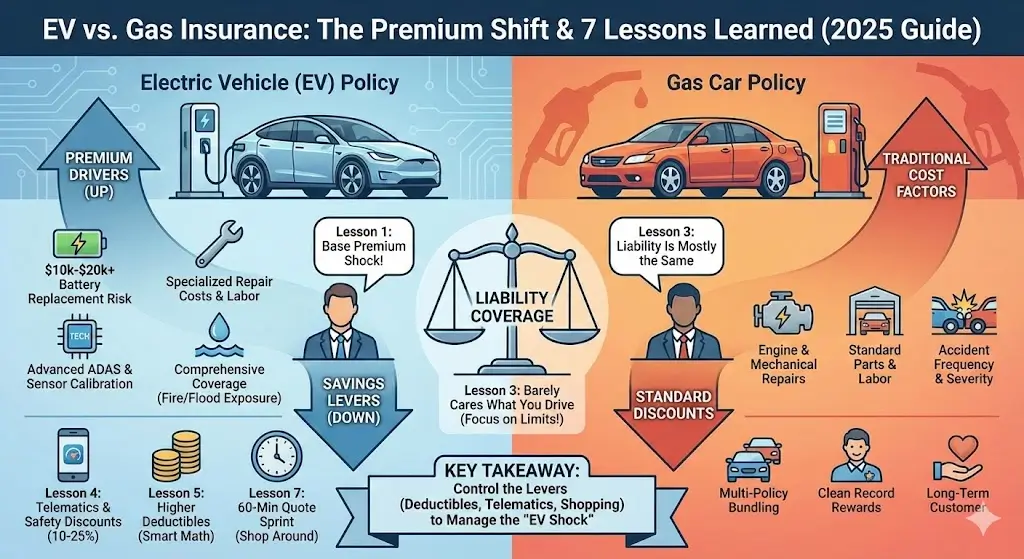
Infographic: What Really Changes Your EV vs Gas Insurance Premium?
- High battery replacement cost
- Specialized repair labor
- Flood/fire exposure for electronics
- Luxury trims and options
- Low deductibles on collision/comp
- Advanced safety tech usage
- Telematics with safe driving
- Multi-policy or multi-car discounts
- Garage parking in low-risk areas
- Higher deductibles you can afford
- Liability limits and state minimums
- Your driving record and claims
- Age, credit (where allowed), and ZIP
- Loan or lease coverage requirements
- How often you shop and negotiate
FAQ
Let’s close with some of the questions I wish I’d asked before buying my first EV policy.
1. Are electric vehicle insurance quotes always more expensive than gas car insurance?
No—not always, but they often are in 2025. On average, recent reports suggest EV policies cost between about 20% and 50% more than gas-car policies in several markets, mainly due to higher repair and battery costs. However, a mainstream EV from a legacy automaker, driven gently with telematics discounts, can sometimes approach gas-car pricing. 60-second action: Compare at least one quote for your exact EV and one gas model of similar price; note the difference in collision and comprehensive lines specifically.
2. What’s the fastest way to lower my EV insurance premium without gutting my coverage?
For most drivers, the big levers are: raising deductibles to a level you can truly afford, enrolling in a telematics program if your state rules are favorable, checking multi-policy discounts, and trimming optional extras you don’t need (like duplicate roadside assistance). 60-second action: List three non-negotiables (e.g., liability limits, rental car coverage) and three negotiables (e.g., glass riders, low deductibles); focus your savings hunt only on the negotiables.
3. Does my EV’s battery warranty affect my insurance premium?
Indirectly, yes. The warranty doesn’t usually change the premium directly, but it affects how your insurer views long-term battery risk and replacement costs. A strong, widely honored battery warranty from a major automaker can give insurers more confidence that catastrophic battery failures are rare and well-managed. 60-second action: Ask your agent, “Does my battery warranty or brand reduce any part of my comprehensive premium, or is it priced purely on vehicle value?”
4. How often should I re-shop my EV insurance quotes?
In a fast-moving market like EVs and 2023–2025 auto insurance, re-shopping yearly is reasonable—especially after model year changes, major repairs, or a move to a new ZIP code. Policywide rate changes and new EV-specific discounts roll out regularly. 60-second action: Set a recurring calendar reminder for 11 months after each renewal titled “EV quote check” and attach your latest declaration page to the event.
5. What if I can’t afford the higher EV premium but still want to drive electric?
First, make sure you’re comparing apples to apples with coverage tiers and deductibles. Second, look into salary-sacrifice or subscription programs in your country that bundle insurance, maintenance, and sometimes charging into one payment—these can reduce overall costs even if the “embedded” premium is higher. Third, consider a more modest EV trim or a certified used EV with lower replacement cost. 60-second action: Email one trusted agent: “If I want to keep my monthly cost under $X, what combination of EV model, coverage tiers, and deductibles would you recommend as a realistic target?”
Wrap-Up: Your Next 15 Minutes With EV Insurance Quotes
When I look back at my very first EV insurance policy, I wish I could say the biggest surprise was the price tag. But honestly? The real shocker was how much of that premium I had unknowingly nodded along to—like I was ordering off a menu in a language I didn’t speak.
There I was, paying for bells and whistles I didn’t need (looking at you, "Platinum Rental Reimbursement Plus"), choosing ultra-low deductibles like I had a habit of crashing into parked cars, and not once stopping to ask which insurer actually wanted to cover my specific type of EV. Spoiler: not all of them do.
The good news? You don’t need a finance degree, a spreadsheet addiction, or an entire free weekend to get smarter about this stuff. All it really takes is one honest hour per year—and if you’re short on time, just give it 15 minutes today.
Here’s how to start:
- Hit that 60-second estimator at the top of the article. Yes, it’s really that quick.
- Dig up your last gas-car declaration page (you know, that PDF you swore you’d never need again) and your current EV quote.
- Highlight the four big ones: liability, collision, comprehensive, and your deductibles. Everything else is fluff until these make sense.
- And then, the real magic—decide in writing what trade-offs you’re actually okay with. Higher deductible in exchange for a lower monthly? Cool. Want to save money with telematics, even if it means your insurer knows when you brake too hard at Starbucks? You do you. Rather skip GAP coverage and roll the dice on negative equity? Bold move, but at least it’s your move.
Bottom line: you're not stuck with a one-size-fits-all policy written in Martian. You're in the driver's seat—literally and financially. Just takes a little curiosity, a highlighter, and maybe a strong cup of coffee.
- Battery and repair costs explain most of the EV vs gas gap.
- Liability, deductibles, and telematics are your main levers.
- An annual “quote sprint” turns confusion into concrete savings.
Apply in 60 seconds: Choose one lever—deductibles, telematics, or GAP coverage—and send a single email to your agent asking how changing it would affect your premium this year.
Last reviewed: 2025-11; sources: NAIC, Insurify, U.S. Department of Energy, Consumer Reports, various carrier and industry reports. Electric Vehicle Insurance Quotes, EV insurance premiums, gas car insurance comparison, car insurance quotes 2025, EV vs gas insurance
🔗 Electric Vehicle Quotes 🔗 Auto Insurance Mistakes 🔗 Rivian Headlights Upgrades 🔗 Safest Electric Cars 🔗 Rivian R2 Interior